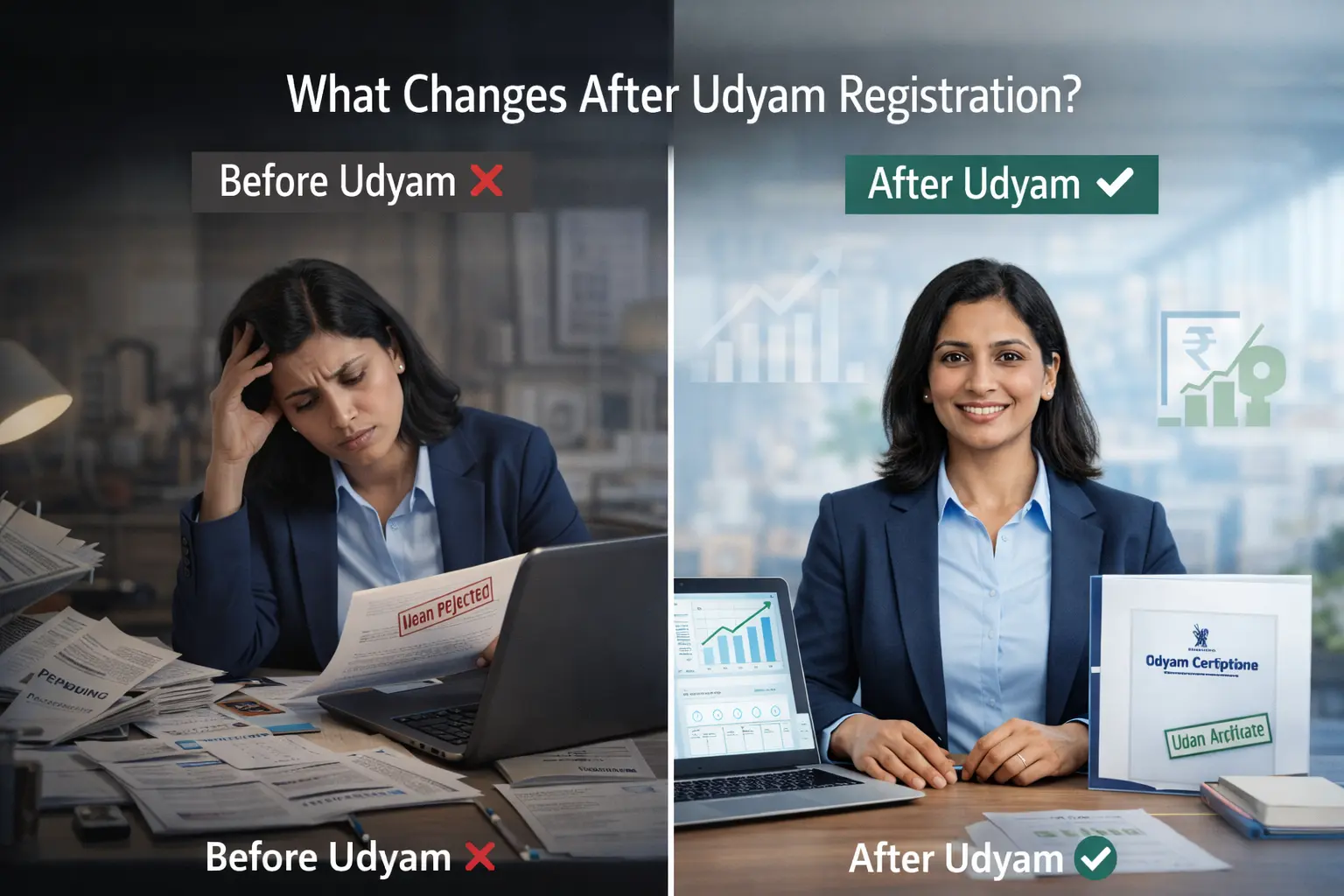
Udyam (MSME) Registration Benefits in 2026: Why Small Businesses Should Register

Why Every Small Business in India Needs Udyam Registration in 2026

In 2026, running a small business in India without Udyam (MSME) registration is like leaving money, protection, and growth opportunities on the table.

With MSMEs contributing over 30% to India’s GDP and nearly 50% of exports, the government has built a powerful ecosystem of incentives, but only registered businesses can access them.

Udyam Registration is not just a certificate. It is your gateway to cheaper loans, legal protection, tax advantages, and government contracts.

The New MSME Definition: Does Your Business Qualify?

The government revised MSME classification in 2025 to allow businesses to scale without losing benefits.

Micro, Small, or Medium? (Updated Limits)

Category Investment Limit Turnover Limit
Micro Up to ₹2.5 Cr Up to ₹10 Cr
Small Up to ₹25 Cr Up to ₹100 Cr
Medium Up to ₹125 Cr Up to ₹500 Cr

If your business falls within these limits, you are eligible for Udyam registration.

Financial Benefits of Udyam Registration (Biggest Advantage)

AIS

1. Collateral-Free Loans up to ₹10 Crore

Under CGTMSE:

  • No collateral required
  • Up to 85% credit guarantee
  • Faster approvals (within 14 days for small loans)

👉 This is a game-changer for startups and MSMEs struggling with funding.

Feature Old Tax Regime New Tax Regime
Tax rates Higher Lower
Deductions Allowed Mostly not allowed
Complexity High Simple
Best for High deductions Low deductions

Legal Impact

Under the new framework:

  • Under-reporting → 50% penalty
  • Misreporting → 200% penalty

Example

A freelancer misses ₹5 lakh income:

  • Tax due: ₹1.5 lakh
  • Penalty: up to ₹3 lakh
  • Total loss: ₹4.5 lakh+

How to Avoid

  1. Always reconcile AIS before filing
  2. Match Form 26AS + TIS + bank records
  3. Don’t rely only on Form 16

2. Choosing the Wrong Tax Regime

Critical Decision Mistake

Most taxpayers choose:

  • Old regime blindly
    OR
  • New regime without calculation

Impact

Wrong choice can cost:

👉 ₹50,000 – ₹2 lakh extra tax annually


Solution

  1. Compare both regimes before filing
  2. Use actual deduction data
  3. Review every financial year

3. Incorrect Capital Gains Reporting

Income tax notice

High-Risk Area

Common mistakes:

  • Not reporting stock profits
  • Ignoring crypto gains
  • Wrong holding period classification

Risk

Capital gains are tracked via:

  • Stock exchanges
  • Mutual funds
  • AIS

👉 Errors trigger scrutiny notices quickly


Example

₹10 lakh unreported gains → penalty + interest = ₹3–5 lakh loss


Prevention

  1. Maintain investment records
  2. Use correct tax rates
  3. Verify AIS data

4. Ignoring Advance Tax

Common Among Freelancers & Businesses

If tax liability exceeds ₹10,000:

👉 Advance tax is mandatory


Penalties

  • Section 234B → interest
  • Section 234C → penalty

Impact

Delay can cost:

👉 ₹10,000 – ₹1 lakh+ depending on income


Fix

  1. Pay quarterly advance tax
  2. Estimate income realistically

5. Claiming Wrong Deductions

Misuse of Sections 80C, 80D

Common issues:

  • Fake or incorrect deductions
  • Overclaiming investments
  • Not having proof

Consequence

  • Classified as misreporting
  • Heavy penalties + scrutiny

Prevention

  1. Keep documents ready
  2. Claim only eligible deductions
  3. Avoid aggressive tax saving

6. GST Non-Compliance (For Businesses)

Major Risk for MSMEs

Mistakes include:

  • Not filing returns
  • Wrong ITC claims
  • Invoice mismatch

Impact

  • ITC blocked
  • GST notices
  • Business disruption

Example

Blocked ITC → working capital loss + penalties


Solution

  1. Regular GST filing
  2. Match GSTR-2B
  3. Maintain proper invoices

7. Not Reporting Foreign Income or Assets

High-Risk Category

Includes:

  • Foreign bank accounts
  • Overseas income
  • Crypto assets

Legal Risk

Covered under strict laws:

  • Heavy penalties
  • Possible prosecution

Impact

Penalty can exceed:

👉 300% of tax liability


Prevention

  1. Declare all foreign assets
  2. Use proper tax disclosure
  3. Take professional guidance

How the Government Tracks Your Income in 2026

Indian Income tax 2026

The system tracks everything through:

  • AIS (income tracking)
  • TIS (summary data)
  • GST filings
  • PAN-linked transactions
  • Banking & investment data

👉 This creates a 360° financial profile

How to Avoid These Tax Mistakes

Ai Taxation at AVC India

Practical Checklist

  • Reconcile AIS before filing
  • Choose correct tax regime
  • Track investments properly
  • Pay advance tax on time
  • Avoid fake deductions
  • Stay GST compliant
  • Disclose all income

By following this checklist, you can save yourself from making Tax mistakes in India 2026 that can cost you lakhs.

FAQs on Tax Mistakes in India 2026

What happens if I make a mistake in ITR?

You may receive a notice and face penalties or interest.

Yes, using updated return (ITR-U), but with additional tax.

Penalties can go up to 200% of tax in serious cases.

Mostly due to AIS mismatch or income under-reporting.

How AVC India Can Help

Book consultation aith AVC

At AVC India, we help you:

✔ Identify tax mistakes before filing
✔ Handle income tax notices
✔ Optimize tax planning legally
✔ Ensure full compliance

Book a consultation today to avoid costly tax errors.

Leave a Reply

Your email address will not be published. Required fields are marked *