

Capital Gain Tax on Property Sale 2025-26: Rates, Calculation & Tax-Saving Exemptions

Selling a property in India can be a significant financial milestone, but it also brings tax implications that you cannot overlook. The profit you earn from the sale technically called capital gain is subject to taxation under the Income Tax Act, and the rates and rules have undergone substantial changes in recent years. Understanding these rules can help you plan effectively, reduce your tax liability legally, and avoid costly mistakes when filing your income tax return .

Understanding Holding Period: Short-Term vs Long-Term Capital Gains

The classification of your capital gain as short-term or long-term depends entirely on how long you held the property before selling it. This distinction matters because it determines the applicable tax rate and the exemptions you can claim. For immovable property, the holding period is considered long-term when it exceeds twenty-four months from the date of acquisition .

If you sell a property within twenty-four months of purchase, any profit is treated as a short-term capital gain and added to your total taxable income. This is taxed according to your applicable income tax slab rate, which can go as high as thirty percent. Several expenses can be deducted while calculating short-term capital gains, including brokerage fees paid to agents, legal costs associated with the property transfer, stamp duty paid, and improvement costs that enhanced the property’s value .

On the other hand, if the property is held for more than twenty-four months, the profit qualifies as a long-term capital gain. The holding period of a property significantly impacts not just the tax rate but also the exemptions and deductions available to you .

Current LTCG Tax Rates and Indexation Rules

A significant shift in the taxation of long-term capital gains on property came with the Finance (No. 2) Act 2024, effective from 23 July 2024. Under the new rules, the LTCG tax rate for land and buildings was reduced to 12.5 percent, but this comes without the benefit of indexation. However, to provide transition relief, the government introduced a grandfathering provision that gives eligible taxpayers a choice .

For properties acquired before 23 July 2024 and sold on or after that date, resident individuals and Hindu Undivided Families can choose between two methods of taxation: paying 12.5 percent tax without indexation, or paying 20 percent tax with indexation benefits. You are allowed to compute your tax under both methods and choose the one that results in a lower liability .

For properties acquired on or after 23 July 2024, the indexation option is not available, and the LTCG tax is applicable at the flat rate of 12.5 percent without indexation . The Cost Inflation Index for the financial year 2025-26 has been set at 363, which helps calculate the indexed cost of acquisition for eligible taxpayers who can still claim this benefit .

How Indexation Works and Its Impact on Tax Liability

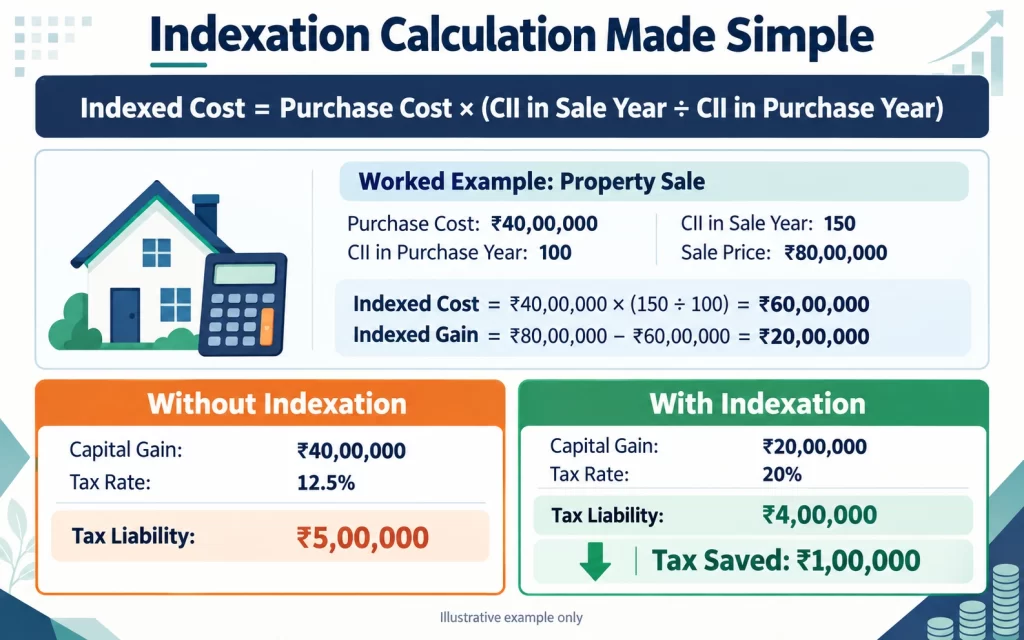
indexation caclution

Indexation is a mechanism that adjusts the purchase cost of your property for inflation using the Cost Inflation Index notified annually by the Income Tax Department. The objective is to ensure you are taxed only on the real gain arising from the asset and not on the portion attributable to inflation over the holding period . The indexed cost is calculated by multiplying the original cost by the ratio of the Cost Inflation Index of the year of sale to that of the year of purchase.

The choice between the two tax calculation methods should not be based on the headline rate alone. In many cases, the lower 12.5 percent rate without indexation may actually result in lower tax than the 20 percent rate with indexation. The benefit of indexation depends significantly on how much the property’s value has appreciated over time . For example, if a property was bought for ten lakh rupees and sold for twenty-eight lakh rupees, the tax under the 20 percent regime with indexation would be approximately 2.83 lakh rupees. However, under the flat 12.5 percent rate without indexation, the tax liability reduces to 2.25 lakh rupees, making it the more tax-efficient option .

Generally, indexation is more beneficial when the property has been held for a very long period and its value has increased largely due to inflation. If your property’s value has appreciated significantly beyond the inflation rate, the lower 12.5 percent rate without indexation may be better. The break-even point depends on the specific purchase and sale years, so calculating your tax under both methods is essential before filing your return .

Exemptions Under Section 54 and Section 54F

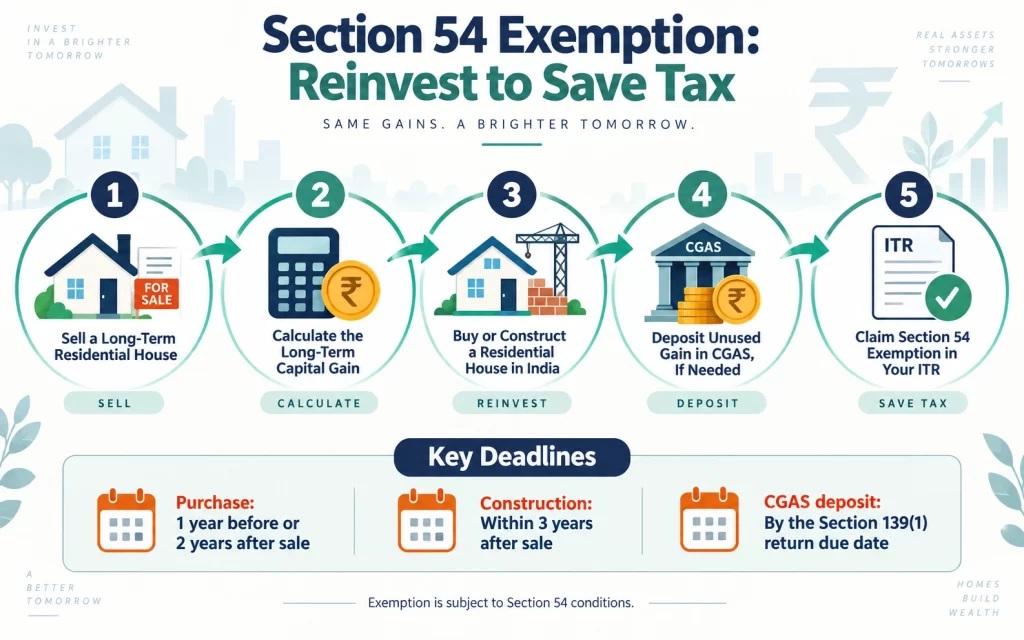
section 54

The Income Tax Act provides several exemptions for long-term capital gains from property sales, with Sections 54 and 54F being the most widely used. These sections allow individuals and Hindu Undivided Families to avoid or reduce LTCG tax by reinvesting the gains into a new residential property, subject to specific conditions and timelines .

Under Section 54, you can claim exemption on capital gains arising from the sale of a residential house property by investing the entire capital gains into purchasing or constructing another residential house in India. The exemption is allowed only for investment in one house property. However, you can claim exemption for two house properties if the amount of long-term capital gains does not exceed two crore rupees, provided this option is exercised once in your lifetime . The exemption amount is the lower of the capital gain, ten crore rupees, or the aggregate amount invested in the new house property and deposited in the Capital Gains Account Scheme .

Section 54F, on the other hand, applies when you sell any long-term capital asset other than a residential house, such as land, and invest the sale proceeds in a residential house property. For full exemption under this section, you must invest the entire net sale consideration in the residential property; if you invest only a portion of the sale proceeds, the exemption is proportionate .

To claim exemptions under these sections, you must ensure the new house is purchased within one year before or two years after the date of transfer, or constructed within three years from the date of transfer. If you are unable to utilise the capital gains for reinvestment by the due date of filing your income tax return, you can deposit the amount in the Capital Gains Account Scheme to preserve the exemption . If the amount deposited remains unutilised after the prescribed period, the unutilised deposit becomes taxable as long-term capital gains in the year the time limit expires . Additionally, if you transfer the new house within three years of purchase or construction, the capital gain claimed as exempt under Section 54 will be deducted from the cost of acquisition of the new house while computing capital gains on its sale .

Other Exemptions and Bond Investments

Beyond Sections 54 and 54F, the Income Tax Act offers several other exemptions for specific situations. Section 54EC allows you to invest capital gains from land or building in specified bonds issued by the National Highways Authority of India, Rural Electrification Corporation, Power Finance Corporation, or Indian Railway Finance Corporation. The investment must be made within six months of the property transfer and is subject to an overall limit of fifty lakh rupees . Exemptions are also available under Section 54B for reinvestment in agricultural land, Section 54D for compulsory acquisition of industrial land, and Sections 54G and 54GA for shifting industrial undertakings to non-urban areas or Special Economic Zones .

TDS Compliance and Practical Considerations

When selling property, the buyer is required to deduct tax at source under Section 194-IA if the property value exceeds fifty lakh rupees. The TDS rate is one percent of the sale consideration or stamp duty value, whichever is higher. The buyer must file Form 26QB within thirty days of the transfer and issue Form 16B to the seller as proof of tax deduction . For Non-Resident Indians selling property in India, the TDS rates are higher: twenty percent on long-term capital gains and thirty percent on short-term capital gains . The tax treatment for Non-Resident Indians follows the same fundamental rules, but they must also consider tax implications in their country of residence and may benefit from Double Taxation Avoidance Agreements .

A Notable Judicial Precedent on Section 54

The Pune Bench of the Income Tax Appellate Tribunal recently clarified an important aspect of Section 54 exemption. In a case where a taxpayer sold a property for 1.10 crore rupees while the stamp duty value was 1.962 crore rupees, the Income Tax Department computed capital gains using the higher stamp duty value under Section 50C. The Tribunal held that Sections 50C and 54 operate independently. While Section 50C permits the tax department to substitute the stamp duty value for the actual sale price while calculating capital gains, it does not automatically take away the exemption available under Section 54 if the taxpayer reinvests the gains and fulfils the prescribed conditions. The deeming fiction created by Section 50C is limited to the computation of capital gains and cannot be used to deny the benefit of Section 54 .

Frequently Asked Questions


The profit from property sale is calculated as the difference between the sale price and the cost of acquisition, after deducting eligible expenses such as brokerage, legal fees, and improvement costs. For long-term capital gains, you can either pay 12.5% without indexation or 20% with indexation, depending on which is more beneficial for your specific situation .

A property is considered long-term if held for more than twenty-four months from the date of acquisition. If sold within twenty-four months, the gain is treated as short-term capital gain and taxed according to your income tax slab rate .


For claiming indexation, you should retain all documents related to the property's acquisition and sale, including the purchase deed, sale deed, payment proofs, allotment letter, and records of capital improvements. For inherited or gifted properties, you also need documents establishing the previous owner's acquisition date and cost .


Yes, as clarified by the Income Tax Appellate Tribunal, the application of Section 50C does not automatically extinguish the right to claim exemption under Section 54, provided you have fulfilled all the conditions prescribed under the law and maintain adequate documentary evidence to support your claim .

Indexation is generally more beneficial when the property has been held for a long period and its value has increased largely because of inflation. If the property has appreciated significantly beyond inflation, the 12.5% rate without indexation may result in lower tax . You should calculate your tax under both methods and choose the lower amount .

Strategic Tax Planning Tips

When planning to sell a property, consider these strategies to minimise your tax liability. Invest in another residential property to claim exemptions under Sections 54 or 54F, using the Capital Gains Account Scheme to preserve your exemption if you cannot complete the purchase immediately. For gains not reinvested in property, consider investing in 54EC bonds within six months to claim exemption up to fifty lakh rupees. Always verify whether your transaction falls under the transitional rules that continue to permit a choice between the two tax regimes, and compute your tax under both methods before filing your return .

The decision between the two tax methods should be based on a direct tax calculation rather than the rate alone. If you are uncertain about which option is more beneficial or need assistance with compliance, consulting a tax professional can help you navigate these complex rules and maximise your tax savings. Selling a property is a significant transaction, and proper planning can make a substantial difference to your post-sale financial position.

Get Expert Help with Your Capital Gains Tax Planning

Navigating the complexities of capital gains tax on property can be challenging, especially with the recent changes introduced by the Finance Act 2024 and the new Income Tax Act 2025. Whether you’re calculating indexation benefits, claiming exemptions under Section 54, or managing TDS compliance, professional guidance ensures you maximize your tax savings while staying fully compliant.

At AVC India, our team of experienced Chartered Accountants and tax consultants specializes in helping individuals, HUFs, and NRIs optimize their capital gains tax strategies. We provide end-to-end support, from computing your tax liability accurately to filing your income tax return with all eligible exemptions and deductions claimed correctly.

Book a free 15-minute consultation with our tax expert today. Let us help you navigate your property sale tax planning, so you can focus on what matters mostyour next investment.

 Visit us at avcindia.co.in or click below to schedule your consultation.


Leave a Reply

Your email address will not be published. Required fields are marked *