
-
-
Tax Services
-
Audit & Assurance
-
Business Setup
-
Accounting & Payroll
-
Advisory
-
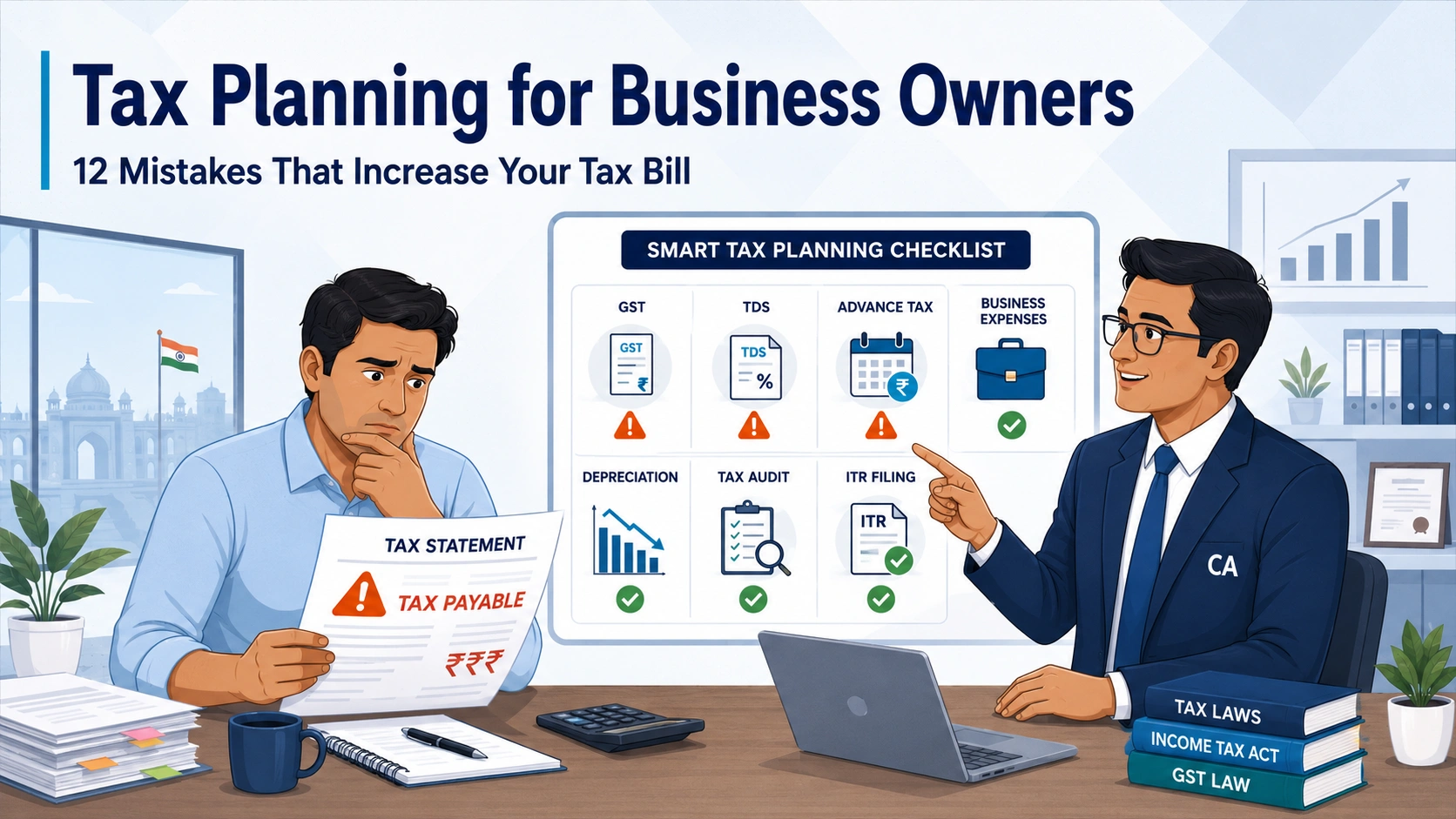
Tax Planning for Business Owners is essential for reducing avoidable tax costs while keeping business finances and compliance on track. A profitable business can still pay more tax than necessary. Usually, this does not happen because of one major error. The tax bill gradually increases because expenses are not properly recorded, advance tax is calculated too late, GST returns do not match the books, eligible deductions are missed or important tax decisions are postponed until March.
Effective tax planning is not about hiding income or using artificial deductions. It is the legal process of coordinating business structure, accounting records, expenses, depreciation, GST, TDS, advance tax and income-tax filing throughout the financial year.
The correct strategy depends on the nature of the business. A sole proprietor, partnership firm, LLP and private limited company do not follow identical tax rules. Therefore, business tax planning should always begin with the entity type, financial position and applicable tax provisions.
Tax planning for business owners means forecasting taxable income, reviewing eligible expenses and deductions, calculating advance tax and completing statutory obligations at the correct time. It also involves checking whether the existing business structure and tax regime remain suitable.
Tax preparation looks backwards and reports transactions that have already happened. Business tax planning looks forward and helps an owner make informed decisions while there is still time to act legally.
A proper plan should create three outcomes: the correct tax liability, adequate supporting documentation and predictable cash flow. It cannot guarantee the lowest possible tax bill, but it can prevent avoidable interest, disallowances and last-minute surprises.
For businesses that also need filing support, professional income tax return filing can connect year-round tax planning with the final computation and return submission.
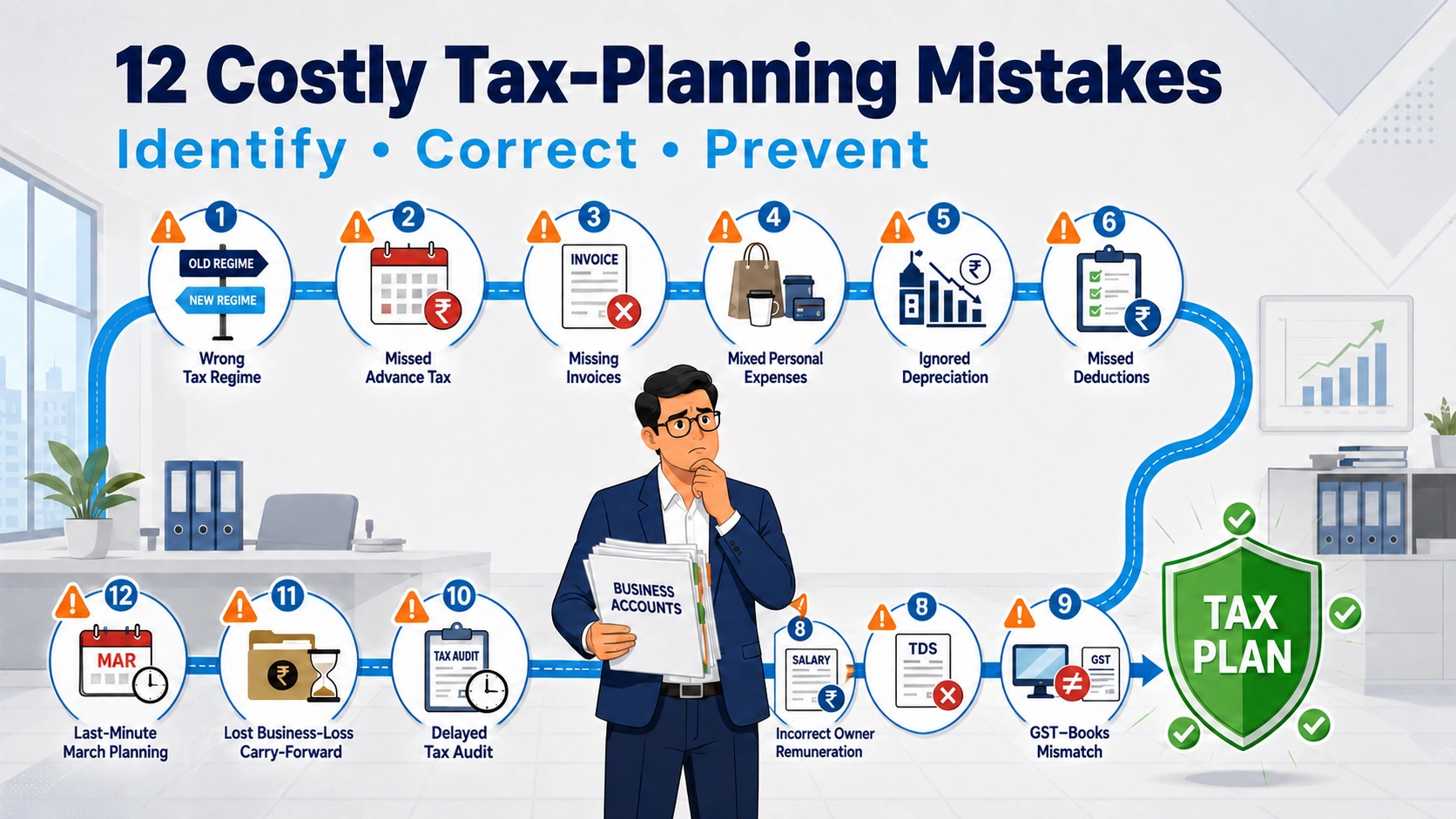
Selecting a tax regime only by comparing headline tax rates can produce the wrong result. Available deductions, exemptions, brought-forward losses, depreciation and future restrictions can materially change the final tax liability.
Individual proprietors with business or professional income must also consider the procedural and switching restrictions connected with the applicable tax regime. Companies, firms and LLPs follow different taxation frameworks.
Before making a choice, calculate the complete liability under every genuinely available option. Consider tax, surcharge, cess, deductions and future flexibility. A regime that appears cheaper this year may not be the most suitable option over several years.
Advance tax generally becomes applicable when the estimated tax liability for the year reaches ₹10,000 or more, subject to applicable exceptions. Under the regular schedule, cumulative payments generally reach 15% by 15 June, 45% by 15 September, 75% by 15 December and 100% by 15 March.
Ignoring these instalments can result in interest and a significant cash-flow burden near the end of the year. This frequently happens when a business performs better than expected but its estimated taxable profit is never revised.
Business owners should prepare a quarterly profit forecast covering expected revenue, expenses, depreciation, TDS credits and tax liability. The estimate should be updated whenever revenue, margins or major expenses change.
For the applicable advance-tax provisions and payment framework, business owners should also refer to the Income Tax Department’s official guidance.
An expense does not automatically become deductible because it was paid from a business bank account. Under the general income-tax principle, the expenditure must be incurred wholly and exclusively for the business or profession. Personal and capital expenses are not allowed under the general business-expense rule.
A missing invoice, unclear payment description or lack of evidence can weaken an otherwise legitimate claim. Bank statements alone may not explain what was purchased or how it was connected with the business.
Maintain a clear trail connecting the invoice, vendor, payment, accounting ledger and business purpose. Travel, software, marketing, professional fees and mixed-use expenses should receive particular attention.
Maintaining these records becomes considerably easier when bookkeeping and financial accounting services are reviewed throughout the year.

Using the same account for household and business spending creates inaccurate accounts and makes tax deductions harder to support. Personal travel, investments, family expenses or purchases do not become deductible merely because the business paid for them.
Open separate bank accounts and use separate cards for business transactions. Proprietor drawings, partner withdrawals and director-related payments should be recorded under the correct ledgers.
If an asset or service is used for both personal and business purposes, document a reasonable business-use allocation. Claiming the entire amount without justification can increase compliance risk instead of reducing tax legally.

Capital assets such as computers, machinery, furniture and certain intangible assets may not qualify as immediate revenue expenses. Tax relief is generally provided through depreciation under the applicable rules.
Problems arise when the fixed-asset register is incomplete, an asset is placed in the wrong category or its installation and usage dates cannot be established. Accounting depreciation should also not be copied automatically into the tax computation because accounting and income-tax treatment may differ.
Keep purchase invoices, payment records, ownership details, asset locations and “put to use” dates. Review significant purchases before the financial year ends, but never buy an unnecessary asset only to obtain a partial tax deduction.
Some businesses overpay tax because valid operating expenses are not recorded. Others make the opposite mistake and treat every payment as deductible. Interest, employee costs, insurance, rent, statutory payments, bad debts and professional fees can have different conditions.
Review the expense ledgers before year-end and identify unsupported, incorrectly classified or omitted transactions. Each deduction should answer three questions: Was the expense genuinely incurred? Which provision governs it? Do the available records satisfy the conditions?
This approach is more reliable than searching for general “tax-saving expenses” and trying to apply them without considering the business facts.
A sole proprietor cannot create a deductible salary simply by paying money to themselves. A partnership firm or LLP may claim eligible remuneration to working partners only when the deed, authorization and statutory conditions are satisfied.
A company director’s salary involves a different legal relationship. It should be commercially reasonable, properly approved, reflected through payroll and supported by the director’s actual role. TDS and other applicable obligations must also be considered.
Owner remuneration should be reviewed before payment or accrual. Moving money from the business to its owner does not automatically create a deductible business expense.
For businesses operating as partnership firms, see the detailed income tax guide for partnership firms for the specific taxation and remuneration considerations.
TDS affects vendor payments, expense deductibility, interest, certificates and statutory reporting. Failure to deduct or deposit TDS on certain payments to residents can result in a 30% disallowance under the applicable provision, subject to specified conditions and available remedies.
Businesses should determine TDS applicability when a vendor is onboarded, not several months after payment. PAN details, payment type, threshold, deduction rate and deposit deadline should be checked through a consistent process.
The TDS payable ledger, challans, returns and certificates should be reconciled regularly. Waiting until the income-tax return is prepared may leave insufficient time to correct errors.
A structured TDS compliance process can therefore form an important part of year-round business tax planning.
GST returns and financial statements may contain legitimate differences because they serve related but different purposes. However, every material difference should be identified and explained.
Compare the sales ledger with GSTR-1 and GSTR-3B. Purchase records and eligible input tax credit should also be reviewed against GSTR-2B. Timing differences, credit notes, advances, cancelled invoices and unrecorded transactions should be documented.
For the GST side of this process, businesses can also review GST services in Gurgaon, including return filing and reconciliation support.
GST Services in Gurgaon – AVC India
Suppose a service business reports ₹80 lakh in outward supplies through GST records but shows ₹72 lakh in its accounting revenue. The difference may have a valid explanation, but it must be reconciled before taxable income and advance tax can be calculated reliably.
Businesses should also reconcile their GST records with the applicable GST portal data, including GSTR-2B and other return information.
Tax-audit applicability is not determined by one universal turnover figure. It depends on whether the taxpayer carries on a business or profession, annual turnover or gross receipts, the proportion of cash transactions and the conditions of applicable presumptive-tax provisions.
Under the familiar Section 44AB framework used for relevant assessment periods, the ordinary business threshold, enhanced threshold for qualifying low-cash businesses and professional threshold operate under different conditions. Companies and LLPs may also have separate audit obligations under other laws.
Determine audit applicability during the year. Waiting until the filing deadline can expose unresolved inventory, TDS, GST, related-party and balance-confirmation problems.
If you need to understand the practical requirements in more detail, see our guide to tax audit in Gurgaon.
Tax Audit in Gurgaon – AVC India
Businesses should also verify the applicable tax-audit forms and filing requirements through the official Income Tax Department resources.
A business loss may reduce tax in a future profitable year, but different losses follow different rules. Ordinary business losses, speculative losses, capital losses and unabsorbed depreciation do not have identical set-off and carry-forward treatment.
Ordinary business losses generally have an eight-assessment-year carry-forward period. Timely filing of the return is important for preserving specified losses, while unabsorbed depreciation receives different treatment.
File the correct loss return within the applicable deadline and maintain an assessment-year-wise schedule. Do not assume that a late or updated return will automatically restore every missed carry-forward benefit.
Before filing, businesses should also reconcile relevant tax information with AIS and Form 26AS.
This is one of the most expensive tax planning mistakes for business owners. By March, contracts have already been signed, payments have been made, TDS events have passed, assets have been used and supporting documents may be missing.
Last-minute planning can encourage unnecessary purchases or aggressive deduction claims. Genuine tax planning should be connected with monthly bookkeeping, quarterly forecasting and periodic compliance reviews.
Close the books every month, review advance tax quarterly and examine structure, remuneration, deductions, assets, losses and audit requirements well before the financial year ends.
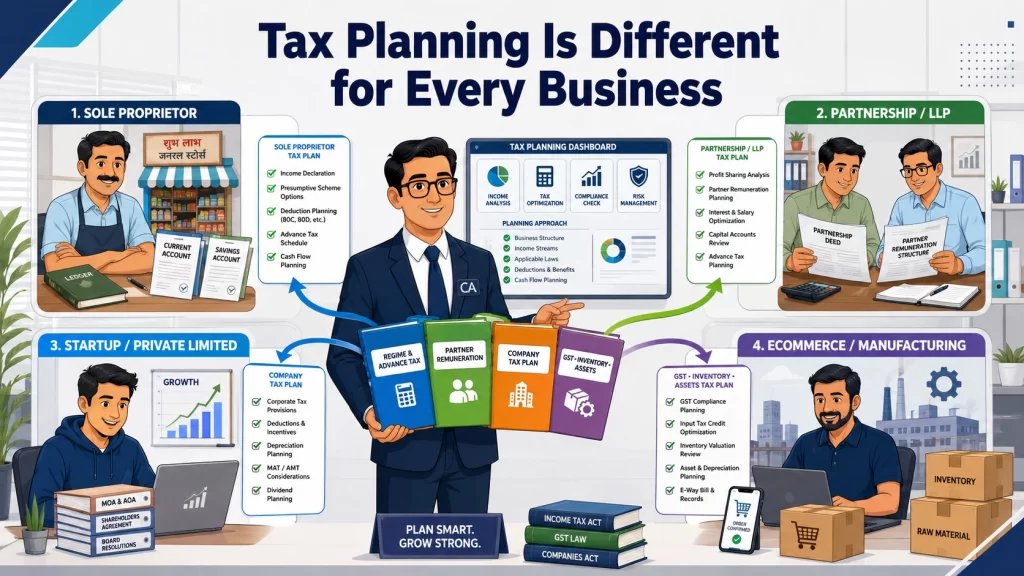
A sole proprietor should concentrate on separating personal transactions, comparing available tax regimes and forecasting advance tax on total income. A professional or consultant should also monitor gross receipts, documentation and presumptive-tax eligibility.
For eligible businesses and professionals, understanding the rules around presumptive taxation can be an important part of business tax planning.
Presumptive Taxation Scheme – AVC India
Partnership firms and LLPs should focus on the partnership deed, working-partner remuneration, interest, drawings and TDS. Private limited companies need reliable payroll records, related-party documentation, corporate tax-option calculations and proper approvals for director remuneration.
Startups and ecommerce businesses should reconcile platform reports, bank settlements, GST returns, TDS or TCS records and revenue in the books. Manufacturers should give additional attention to inventory, fixed assets, capitalization, depreciation and GST input tax credit.
Every month, close the accounting records, collect invoices, separate personal transactions and reconcile bank, GST and TDS ledgers. Every quarter, estimate full-year taxable profit, review advance tax and compare reported GST turnover with accounting revenue.
Before year-end, examine remuneration, deductions, statutory dues, fixed assets, losses, regime assumptions and audit applicability. Before filing the income-tax return, reconcile the final accounts with GST returns, AIS, Form 26AS, TDS records, audit reports and tax payments.
This connected process turns business tax planning into a financial-management system instead of a once-a-year filing exercise.
Professional review becomes useful when a business changes its legal structure, approaches an audit or presumptive-tax threshold, receives investment, admits new partners, appoints directors, purchases substantial assets or operates across multiple states.
A CA should also be consulted when GST turnover does not match the books, losses are being carried forward, owner remuneration is unclear or the business cannot estimate its tax liability confidently.
A useful tax-planning review should provide a projected profit calculation, estimated tax liability, reconciliation status, compliance calendar, risk list and document checklist—not merely a completed return.
Gurgaon and Gurugram have a diverse business ecosystem covering technology companies, consultants, startups, ecommerce operations, manufacturers and professional-service firms. Businesses operating across Cyber City, Udyog Vihar, Sohna Road, Golf Course Road and IMT Manesar may therefore face very different tax-planning requirements.
A tax planning consultant in Gurgaon should understand the business model, entity structure and transaction flow. Effective support should connect bookkeeping, GST, TDS, advance tax, tax audit and ITR filing. Growing businesses may also require Virtual CFO assistance for regular forecasting and management reporting.
Tax planning for business owners is the year-round process of forecasting taxable profit, reviewing allowable expenses, calculating advance tax and coordinating accounting, GST, TDS, depreciation, audit and ITR requirements. Its purpose is to achieve a lawful and supportable tax outcome while managing cash flow.
Business owners can reduce tax legally by claiming properly documented allowable expenses, using correct depreciation, preserving eligible losses, selecting an available tax regime after calculation and meeting TDS, GST, advance-tax, audit and return-filing conditions.
Business tax planning should begin with the first monthly accounting close and continue throughout the financial year. Quarterly reviews help update taxable-profit forecasts and advance tax, while major structural and year-end decisions should be examined well before 31 March.
No. An expense must satisfy the applicable tax provision. Under the general rule, it should be incurred wholly and exclusively for the business or profession and should not be personal or capital expenditure. Specific expenses may have additional conditions.
Not necessarily. Tax-audit applicability depends on the relevant year, business or professional receipts, cash receipts and payments, and presumptive-tax conditions. Other statutory audit obligations may also apply. The complete facts should be reviewed before reaching a conclusion.
GST and books should be reconciled to identify missing invoices, timing differences, credit notes, classification errors and input-tax-credit issues. Reconciliation also ensures that turnover and expenses used in the income-tax return can be explained against GST records.
Many business losses can be carried forward, but their category, filing deadline, set-off rules and permitted period matter. Ordinary business losses generally have an eight-assessment-year limit, while unabsorbed depreciation and other categories follow different rules.
A small business should consider a CA review when it is uncertain about regime selection, advance tax, GST and TDS reconciliation, audit applicability, business losses, remuneration or major asset purchases. Professional review can create a clearer calculation, compliance calendar and evidence checklist.
Effective tax planning requires more than preparing an income-tax return at the end of the year. Your accounting records, business expenses, depreciation, GST, TDS, advance tax, remuneration, losses and audit requirements should work together through one coordinated plan.
AVC India helps business owners, startups, professionals and growing companies review their tax position, identify avoidable compliance gaps and build a legally supportable tax strategy. Professional guidance can help you protect genuine deductions, manage upcoming tax payments and make better financial decisions throughout the year.
Do not wait until year-end to discover costly tax-planning mistakes. Contact AVC India to discuss your business tax planning, accounting, GST compliance, advance tax, tax audit, ITR filing and Virtual CFO requirements.