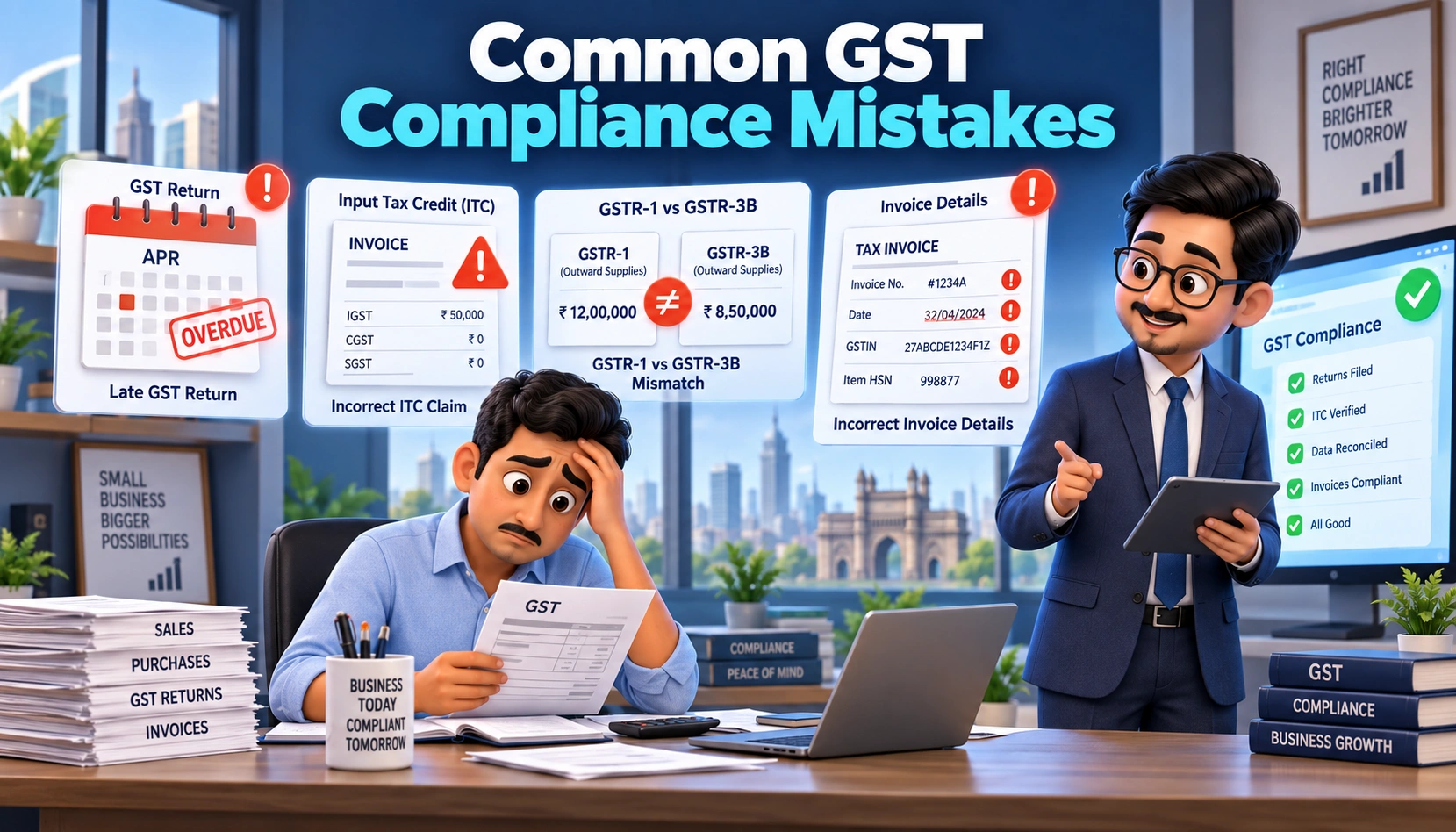
GST compliance involves more than submitting a return before the due date. A business must report sales correctly, claim only eligible input tax credit (ITC), maintain valid invoices, pay the correct tax and keep its returns consistent with its accounting records. Even an unintentional difference can be detected through the GST system and may require an explanation.
Many GST compliance mistakes begin as small bookkeeping problems: an invoice is reported in the wrong period, a credit note is missed, ITC is claimed without verification, or the liability in GSTR-3B does not agree with GSTR-1. If unresolved, these issues may lead to an intimation, scrutiny notice, demand, interest or penalty, depending on the facts and applicable law.
Why GST Compliance Mistakes Can Trigger Notices
GST returns are connected. GSTR-1 contains details of outward supplies, while GSTR-3B is the summary return used to declare GST liabilities and eligible ITC. The GST Portal generates GSTR-2B using information furnished by suppliers. Since these records can be compared electronically, an unexplained difference may become visible even when it results from a genuine clerical error.
The official GST system has specific workflows for differences. A liability mismatch between GSTR-1 and GSTR-3B may be communicated through Form GST DRC-01B. A difference between ITC available in GSTR-2B and ITC claimed in GSTR-3B may result in Form GST DRC-01C. During return scrutiny, Form GST ASMT-10 can communicate discrepancies, and the taxpayer may reply through Form GST ASMT-11. Not every mismatch proves tax evasion or creates a final demand, but it requires prompt investigation and supporting records.
1. Mismatch Between GSTR-1 and GSTR-3B
How the mismatch occurs
One of the most important GST compliance mistakes is reporting one amount of outward supplies in GSTR-1 but declaring a different tax liability in GSTR-3B. An omitted invoice, incorrectly adjusted credit note, wrong tax period, incomplete sales register or manual entry error can create this difference. Liabilities from GSTR-1 or GSTR-1A can auto-populate into relevant GSTR-3B tables, but taxpayers must review them because the source data may be incomplete or wrong.
How to prevent it
Before filing, reconcile the sales register, e-invoice data, credit and debit notes, GSTR-1 and GSTR-3B. Investigate every difference and retain a working paper explaining amendments and timing issues. If short-paid tax is identified, take professional advice on the correct adjustment or voluntary-payment route.
2. Claiming Incorrect or Ineligible Input Tax Credit
ITC receives close attention because it reduces the tax payable in cash. Section 16 of the CGST Act makes ITC subject to conditions and restrictions. Broadly, a claimant must possess the prescribed document, receive the goods or services, meet applicable supplier-reporting and credit-availability conditions, ensure the tax has been paid as prescribed and furnish the required return. Blocked-credit and reversal rules may also apply. Frequent errors include duplicate claims, personal expenses, blocked credits, inadequate documents and failure to reverse credit where required. A business should not claim ITC only because an invoice appears in GSTR-2B. Theofficial GST Portal describes GSTR-2B as an auto-drafted statement based on supplier information. The taxpayer must still verify eligibility under the law and confirm the underlying transaction.
3. Not Reconciling GSTR-2B With Purchase Records
Failure to perform a monthly purchase reconciliation is one of the most common GST return filing mistakes. When ITC claimed in GSTR-3B exceeds the amount that can be supported by GSTR-2B and the books, the difference may trigger DRC-01C or further scrutiny. Compare vendor GSTINs, invoices, taxable values, tax amounts, notes and expense types. Identify duplicates, missing invoices and items requiring vendor follow-up.
4. Late Filing or Non-Filing of Returns
Missing GST return deadlines may lead to late fees, interest where tax remains unpaid and further compliance restrictions. A nil period must not be ignored. TheGST Portal’s GSTR-1 guidance states that GSTR-1 must be filed even when there is no business activity for the applicable tax period. The Portal also states that GSTR-9 cannot be filed until all applicable GSTR-1 and GSTR-3B returns for the year have been filed. Maintain a compliance calendar for invoice closure, reconciliation, payment, approval and filing. Set an internal deadline before the legal due date.
5. Incorrect Invoice Details, HSN/SAC Codes or Place of Supply
A proper tax invoice supports accurate reporting. Wrong GSTINs, duplicate invoice numbers, inaccurate taxable values, incorrect place of supply and wrong HSN or SAC classification can change the tax treatment and affect the recipient’s credit. Classification errors may lead to the wrong GST rate or to a supply being incorrectly treated as taxable, exempt, nil-rated or zero-rated. These categories are not interchangeable. A place-of-supply error can also affect whether CGST and SGST or IGST is charged. Use a controlled invoice template, validate GSTINs periodically and obtain advice where classification or place of supply is uncertain. Also review credit notes, debit notes, cancellations and prior-period amendments. Record the reason, return period and evidence for every material adjustment.
6. Ignoring E-Invoicing and E-Way Bill Requirements
Where applicable, e-invoicing requires specified document details to be reported to an Invoice Registration Portal and an Invoice Reference Number obtained. An accounting-software invoice alone may not complete the process. The official GST guidance advises taxpayers to review e-invoice information auto-populated into GSTR-1 before filing. Cancelled invoices, amendments, credit notes and information transferred from multiple systems require special attention. Where an e-way bill is required, differences involving invoice details, document numbers or transport information can create additional compliance risk.
7. Missing Reverse Charge Liability
Under the reverse charge mechanism (RCM), the recipient rather than the supplier pays GST for notified categories of supplies.CBIC guidance confirms that RCM may apply to notified goods as well as services. Businesses may overlook RCM because the vendor invoice does not charge GST in the usual way or an expense is booked without tax review. Professional fees, rent, transport, imports of services and other purchases should be mapped against the provisions and current notifications rather than treated as automatically subject to RCM. The exact position depends on the supply, parties and applicable period.
8. Differences Between Returns and Books
Turnover and tax figures appear across books, financial statements, e-invoices, e-way bills and GST returns. Differences can arise from cut-off errors, ledger mapping or missing branch data. Monthly return preparation should therefore begin with the books rather than the portal alone. At year-end, reconcile turnover, liability, ITC, RCM, electronic ledgers and all filed returns. TheGSTR-9 guidance explains that the Portal uses GSTR-1, GSTR-3B and GSTR-2B data in its system-computed annual-return information, which makes periodic accuracy important.
9. Ignoring GST Portal Communications
One of the most avoidable GST compliance mistakes is failing to monitor the GST Portal. A notice may be missed when access remains with a former employee, registered contact details are outdated or no person is responsible for checking communications. The official Portal explains that notices can be accessed through Services > User Services > View Notices and Orders. Download and review every communication immediately. Identify the form, tax period, issue, response deadline and evidence required. A reply should answer each point with reconciliations and supporting documents rather than offer a generic explanation.
How to Avoid GST Notices: A Practical Compliance Checklist
A reliable GST process connects accounting, operations and tax reporting. Each month, close sales and purchase records on time, reconcile GSTR-1 with GSTR-3B, compare purchases with GSTR-2B, test ITC eligibility, check RCM transactions, review e-invoices and e-way bills, and retain invoice-level workings. Use maker-checker approval wherever practical so that someone other than the preparer reviews the return. Keep filed returns, ledger extracts, reconciliations, ITC notes, vendor follow-ups, RCM workings and explanations for amendments. This turns filing into a defensible audit trail.
What to Do After Receiving a GST Notice
Verify the notice on the GST Portal and record the deadline. Reproduce the calculation from relevant returns, ledgers and invoices, separate genuine errors from timing differences, and prepare a point-by-point response with evidence. Where a short payment or excess ITC claim is identified, obtain advice on the appropriate correction or payment procedure. Form GST DRC-03 is available for specified voluntary payments, but making a payment does not remove the need to understand and respond to the communication. Preserve the acknowledgement and a complete copy of the submission.
Get Professional GST Compliance Support From AVC India
AVC India supports businesses with GST registration, return filing, reconciliations, reviews, audits and indirect-tax advisory. The goal is to identify GST compliance mistakes early and reduce exposure to notices, interest and penalties. Review your GST compliance before a notice arrives. If you need help reconciling GSTR-1, GSTR-3B and GSTR-2B, reviewing ITC or responding to a GST communication, visitAVC India orcontact the AVC India team today.
Frequently Asked Questions About GST Compliance Mistakes
They include GSTR-1 and GSTR-3B differences, unsupported or ineligible ITC, failure to reconcile GSTR-2B, late or missed returns, incorrect invoices, missed RCM liability and ignored portal communications.
A notice or intimation may arise from return discrepancies, ITC differences, non-filing, short payment, incorrect disclosures or issues found during scrutiny or audit. The exact reason and response depend on the form and facts.
No. A mismatch may result from a timing or reporting error, but it must be reconciled and explained. Any tax, interest or penalty depends on the underlying facts and applicable provisions.
No. The taxpayer must also satisfy the CGST Act and rules, possess the required documents, establish receipt and business use, and consider blocked-credit and reversal provisions.
Yes, where the return is applicable. Official guidance specifically states that GSTR-1 must be filed even when there was no business activity in the tax period.
AVC India providesGST registration and filing support, reconciliations, indirect-tax advisory andGST audit support. A review can identify mismatches, documentation gaps and incorrect positions before they become larger disputes.
Conclusion
Most GST compliance mistakes can be reduced through timely bookkeeping, invoice-level reconciliation, careful ITC review and regular monitoring of the GST Portal. Businesses should treat GSTR-1, GSTR-3B, GSTR-2B, RCM, invoices and annual-return data as one connected compliance system. When a discrepancy appears, act quickly, preserve evidence and seek professional advice based on the facts.