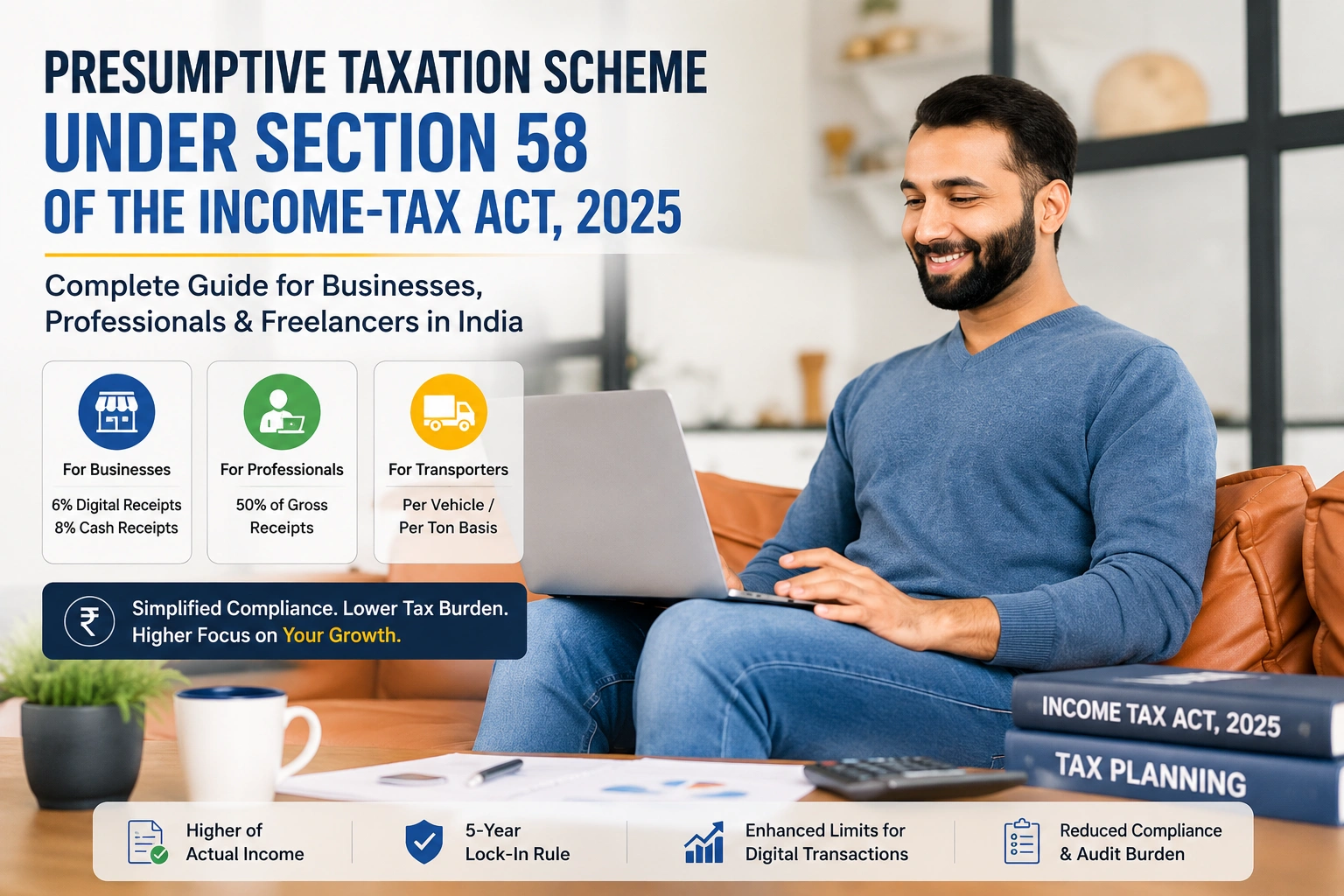
Presumptive Taxation Scheme Under Section 58 of the Income-tax Act, 2025 Complete Guide for Businesses, Professionals & Freelancers in India

India’s direct tax system is entering a major transition phase with the introduction of the new Income-tax Act, 2025. One of the biggest changes for small businesses, professionals, freelancers, and transport operators is the restructuring of the Income tax Presumptive Taxation Scheme under the unified framework of presumptive taxation under section 58. For years, taxpayers relied on Sections 44AD, 44ADA, and 44AE under the old Income-tax Act, 1961. However, under the section 58 income tax act 2025, these provisions are consolidated into a more structured compliance framework while introducing stricter rules, enhanced digital transaction incentives, and stronger audit enforcement mechanisms. If you are a freelancer, consultant, small business owner, trader, retailer, or transport operator, understanding how the Income tax Presumptive Taxation Scheme in India now works is essential for proper tax planning. This guide explains the eligibility rules, presumptive taxation turnover limit, presumptive tax calculations, compliance traps, audit risks, practical examples, and strategic tax-saving insights under the Income-tax Act, 2025.

What Is the Presumptive Taxation Scheme?

The Presumptive Taxation Scheme under Section 58 of the Income-tax Act, 2025 is a simplified taxation framework that allows eligible businesses and professionals to declare income at fixed presumptive rates instead of maintaining detailed books of accounts and undergoing mandatory tax audits. The primary objective of the scheme is to reduce compliance burdens for small taxpayers. Instead of calculating every individual business expense manually, the government presumes a fixed percentage of turnover or gross receipts as taxable income. This framework is particularly useful for small retailers, freelancers, consultants, doctors, architects, transport businesses, and professionals with relatively simple accounting structures.

The Shift From Sections 44AD, 44ADA & 44AE to Section 58

One of the biggest mistakes many websites are currently making is continuing to explain the Income tax Presumptive Taxation Scheme entirely through the old Income-tax Act, 1961 framework. The Income-tax Act, 2025 introduces a major structural transition that businesses and professionals should understand properly. Instead of maintaining separate provisions under Section 44AD, Section 44ADA, and Section 44AE, the new legislation consolidates them into a unified framework of presumptive taxation under section 58. The intention behind this change is to simplify compliance, reduce interpretational disputes, modernize tax administration, and improve digital reporting systems under the section 58 income tax act 2025. Another major change introduced under the new framework is the replacement of the concepts of “Previous Year” and “Assessment Year” with the simpler “Tax Year” system, making the presumptive taxation scheme India easier to understand for taxpayers.

Old vs New Presumptive Taxation Framework

Old Income-tax Act, 1961 Income-tax Act, 2025
Section 44AD Section 58(2) Sl. No. 1
Section 44ADA Section 58(2) Sl. No. 3
Section 44AE Section 58(2) Sl. No. 2
Section 44AB (Audit) Section 63

Who Can Opt for the Presumptive Taxation Scheme?

Section 58 divides presumptive taxation into three broad categories covering small businesses, specified professionals, and goods carriage businesses. Each category has separate eligibility conditions, turnover limits, and tax calculation rules. Understanding the correct category is important because choosing the wrong presumptive framework can trigger unnecessary compliance issues and even audit exposure.


Presumptive Taxation for Small Businesses

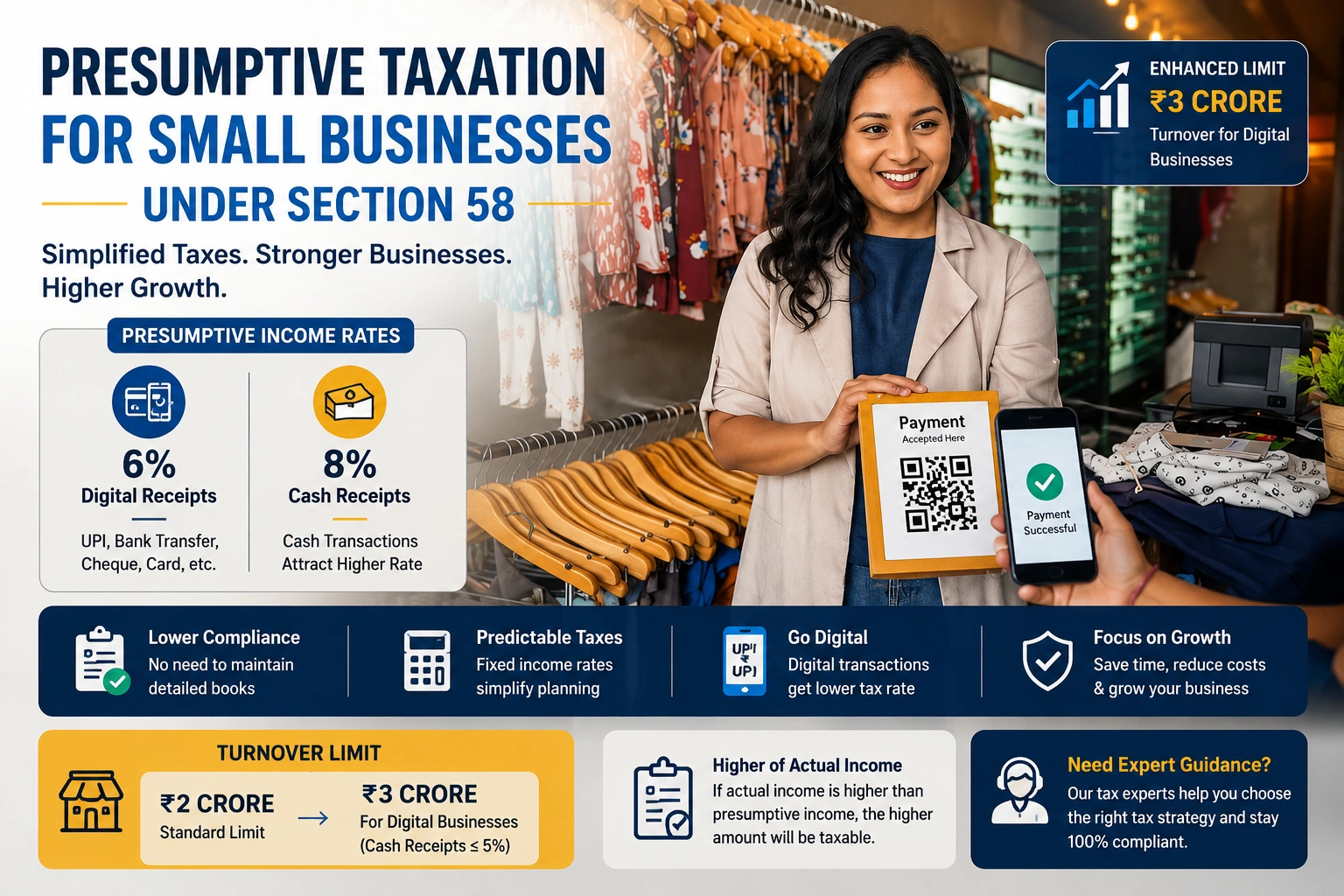
This category under the Income tax Presumptive Taxation Scheme replaces the old Section 44AD framework and is primarily designed for small and medium-sized businesses operating with relatively straightforward accounting structures. Under the presumptive taxation under section 58 framework, the scheme is available for resident individuals, Hindu Undivided Families (HUFs), and resident partnership firms. However, LLPs, companies, commission agents, and brokerage businesses are excluded from eligibility. The standard presumptive taxation turnover limit under the scheme is ₹2 crore. However, businesses can avail the enhanced turnover threshold of ₹3 crore if their cash receipts remain within 5% of total turnover. This provision under the presumptive taxation scheme India strongly encourages digital transactions and formal financial reporting.

Turnover Limits

Criteria Limit
Standard Turnover Limit ₹2 crore
Enhanced Limit for Digital Businesses ₹3 crore

Presumptive Income Rates

Type of Receipt Presumptive Income
Digital Receipts 6%
Cash Receipts 8%

Businesses receiving payments through UPI, bank transfers, account-payee cheques, or other digital methods benefit from the lower 6% presumptive income rate. On the other hand, cash receipts attract the higher 8% presumptive rate. This distinction significantly impacts tax liability, especially for businesses with large turnover volumes.

Presumptive Taxation for Professionals Under Section 58

This category replaces the earlier Section 44ADA framework and is highly relevant for freelancers and independent professionals operating in India’s growing digital economy. Under the Income tax Presumptive Taxation Scheme, this category covers specified professions such as legal services, accounting, technical consultancy, architecture, engineering, medical practice, interior decoration, and IT consultancy services. Eligibility is restricted to resident individuals and traditional partnership firms under the presumptive taxation under section 58 framework. LLPs, companies, and HUFs are not eligible under this category. The standard gross receipt threshold under the presumptive taxation turnover limit is ₹50 lakh. However, professionals can avail the enhanced ₹75 lakh threshold if their cash receipts remain within 5% of total gross receipts, making the presumptive taxation scheme India more attractive for digital-first professionals.

Gross Receipt Limits

Criteria Limit
Standard Limit ₹50 lakh
Enhanced Digital Limit ₹75 lakh

Under the professional presumptive framework, 50% of gross receipts are treated as taxable income. Unlike business taxation, there is no separate 6% or 8% distinction for professionals. The 50% presumptive rate applies uniformly. This structure simplifies compliance significantly, although it may not always be tax-efficient for professionals with substantial operating expenses.

Presumptive Taxation for Goods Carriage Businesses

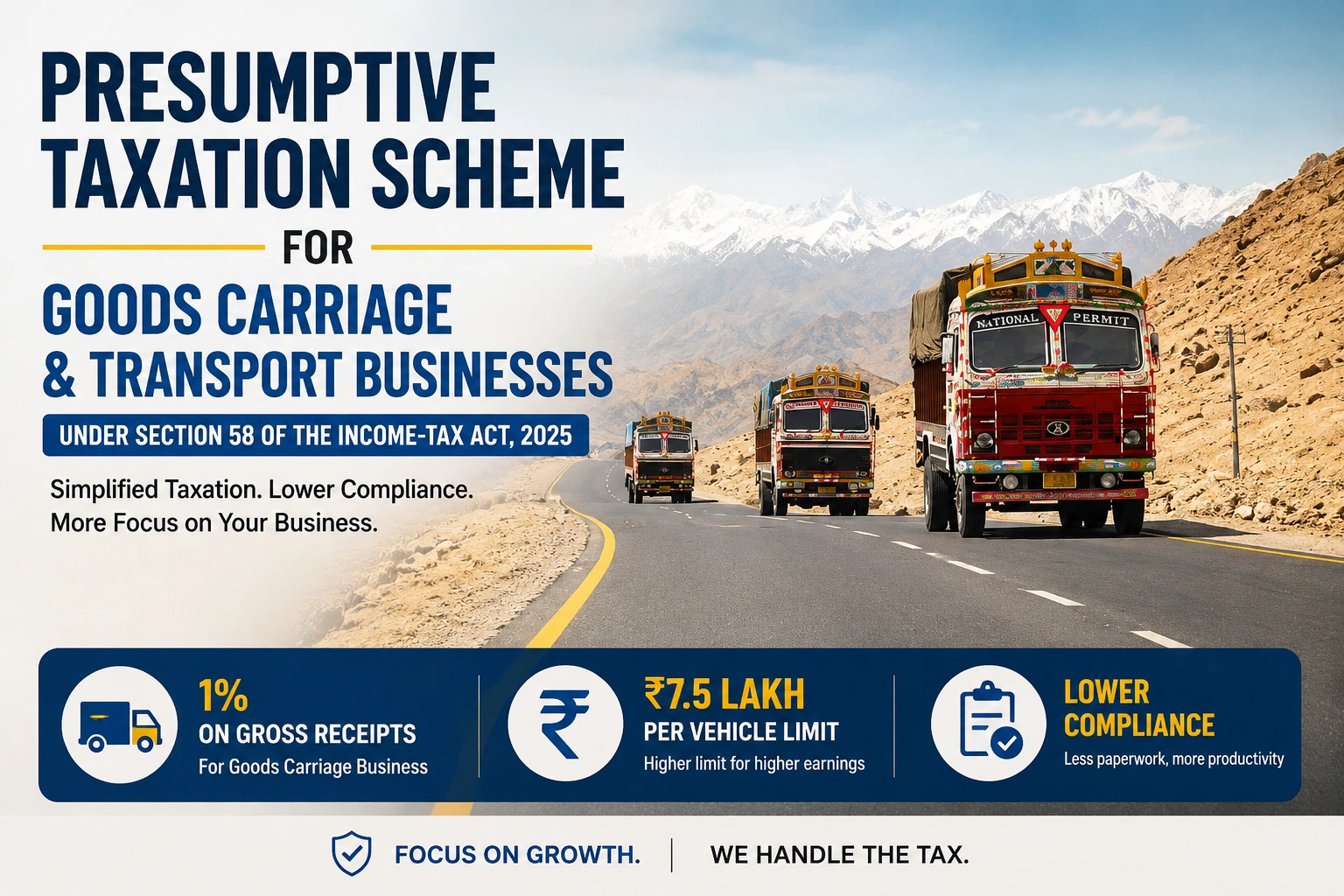
The transport business category replaces the old Section 44AE framework and is specifically designed for small logistics operators and transport businesses. The scheme is available to taxpayers owning not more than 10 goods carriage vehicles during the Tax Year. Unlike the business and professional categories, this framework is available to individuals, HUFs, firms, LLPs, and companies. Tax calculation depends on vehicle classification.

Presumptive Income Calculation

Vehicle Type Presumptive Calculation
Heavy Goods Vehicle ₹1,000 per ton per month
Other Goods Vehicle ₹7,500 per vehicle per month

Heavy goods vehicles exceeding 12,000 kilograms are taxed on a tonnage basis, while smaller goods vehicles follow a fixed monthly presumptive structure. This scheme remains particularly attractive for small transport operators because partner remuneration deductions may still be available under specific circumstances.

Quick Answers to Common Presumptive Taxation Questions

Can LLPs opt for presumptive taxation?

 LLPs are not eligible for presumptive taxation under the business and professional categories of Section 58. However, LLPs involved in eligible goods carriage businesses may still qualify under the transport framework.

Is presumptive taxation available for freelancers?

Yes. Freelancers engaged in specified professions such as software consultancy, technical consulting, architecture, legal practice, and accounting can opt under the professional category of Section 58.

Can salaried employees use presumptive taxation?

Salaried employees can use presumptive taxation only if they separately earn eligible business or professional income in addition to salary income.

Is GST still applicable under presumptive taxation?

Yes. Presumptive taxation only changes income tax computation. GST registration and compliance requirements continue independently.

Can businesses claim actual expenses?

Under presumptive taxation, separate business expense deductions are generally not allowed because taxable income is already presumed at fixed statutory rates.

Important Compliance Rules Most Taxpayers Ignore

Most online articles focus heavily on the benefits of presumptive taxation but rarely explain the compliance risks associated with the scheme. In reality, many taxpayers end up facing penalties, audits, or long-term restrictions simply because they misunderstand these provisions. Understanding these rules properly is essential before opting into the scheme.

The 5-Year Lock-In Rule

Once a taxpayer opts for presumptive taxation, the expectation is that the scheme will continue for five consecutive Tax Years. The government introduced this provision to discourage taxpayers from frequently switching between taxation systems solely to reduce taxes opportunistically. This rule is especially important for businesses with fluctuating profit margins because exiting the scheme early can create long-term consequences.

What Happens If You Opt Out?

If a taxpayer voluntarily exits the presumptive scheme before completing the mandatory five-year period, a lock-out restriction applies for the next five years. During this lock-out period, the taxpayer cannot re-enter the presumptive scheme and may also become subject to detailed bookkeeping and audit requirements. Many small businesses overlook this rule entirely while making short-term tax-saving decisions.

Mandatory Audit Trigger Under Section 63

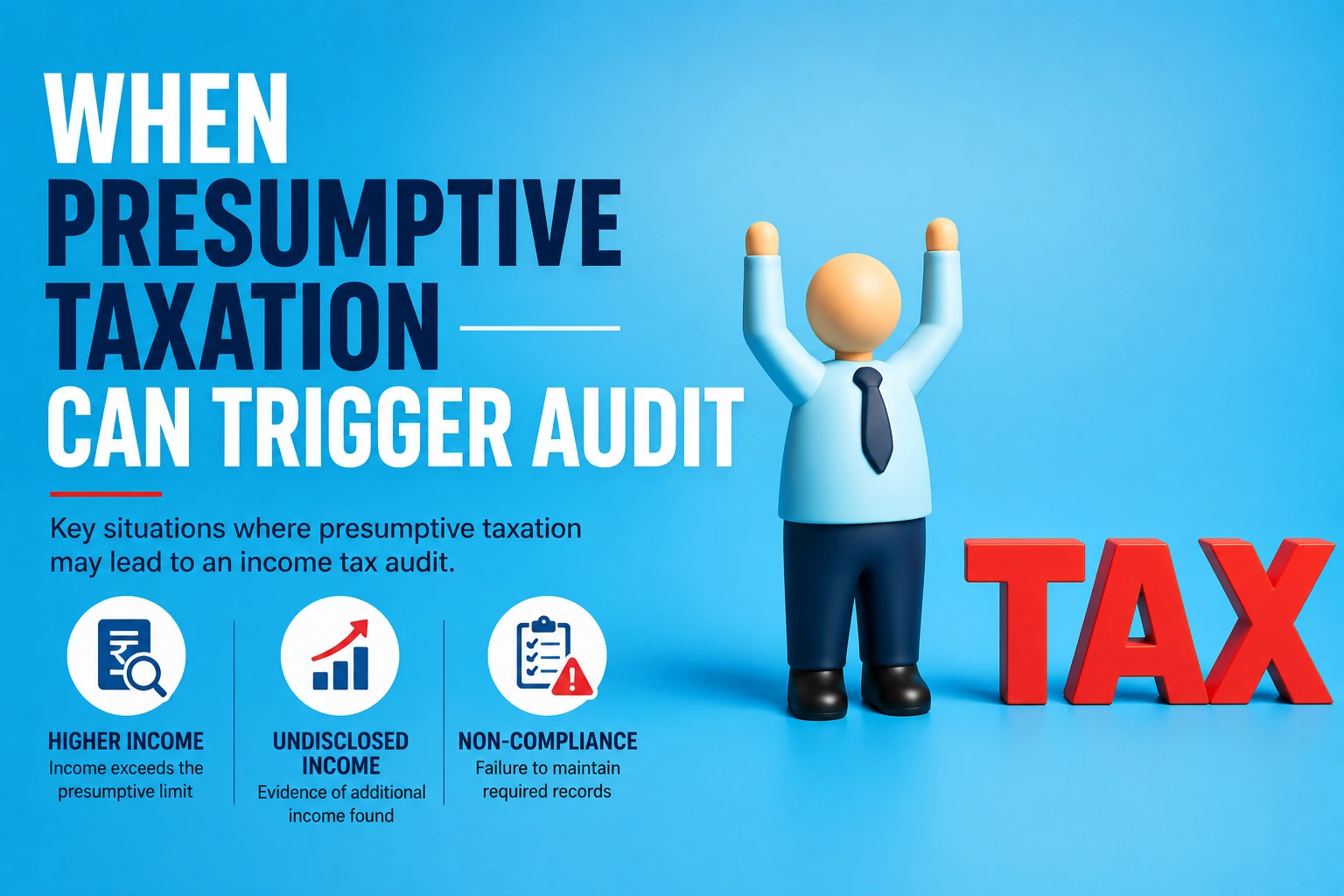
If a taxpayer opts out of presumptive taxation and total income exceeds the exemption threshold, maintaining detailed books of accounts becomes mandatory. In many situations, a statutory audit under Section 63 may also become compulsory. This creates a significantly higher compliance burden compared to the simplified presumptive framework. Businesses should therefore evaluate long-term operational stability before entering the scheme.

The “Higher of Actual Income” Rule

One of the most important changes introduced under the Income-tax Act, 2025 is the “higher of actual income” principle. Under this framework, presumptive rates are treated as minimum taxable income thresholds rather than maximum tax caps. If actual profits exceed the presumptive amount, taxpayers are legally required to declare the higher actual income. This rule closes a major loophole that previously existed in practice and significantly changes tax planning strategies for many businesses.

Advance Tax Rules Under Presumptive Taxation

Eligible businesses and professionals under Section 58 generally have the flexibility to pay 100% advance tax in a single installment before March 15. However, transport businesses operating under the goods carriage category may still need to follow normal advance tax schedules depending on their structure and income classification. Failure to comply with advance tax provisions can result in interest liabilities and penalties.

Real-Life Examples of Presumptive Taxation

Understanding theoretical rules is useful, but practical examples make the actual implications much clearer. The following case studies explain how presumptive taxation affects different business models in real situations.

Case Study 1 – Freelance IT Consultant

Ms. Sharma works as an independent software architect with annual professional receipts of ₹65 lakh. Since her entire income is received digitally, she qualifies for the enhanced ₹75 lakh threshold. However, her actual business expenses, including software subscriptions, outsourced development work, office infrastructure, and technical tools, amount to ₹40 lakh annually.

Under Normal Taxation

Calculation Amount
Gross Receipts ₹65 lakh
Less Expenses ₹40 lakh
Taxable Income ₹25 lakh

Under Presumptive Taxation

Calculation Amount
50% of Receipts ₹32.5 lakh

Although the Income tax Presumptive Taxation Scheme simplifies compliance and eliminates detailed bookkeeping requirements, her taxable income increases significantly under the presumptive taxation under section 58 framework. This example highlights why professionals with high operational expenses should carefully compare both taxation systems before choosing the presumptive taxation scheme India for their tax planning.

Case Study 2 – Digital Retail Business

Mr. Patel operates a consumer electronics business with annual turnover of ₹2.8 crore. Since over 95% of receipts are digital, he qualifies for the enhanced ₹3 crore turnover threshold.

Business Data

Component Amount
Total Turnover ₹2.8 crore
Digital Receipts ₹2.75 crore
Cash Receipts ₹5 lakh

Presumptive Calculation

Component Calculation
Digital Turnover 6% of ₹2.75 crore
Cash Turnover 8% of ₹5 lakh

The total presumptive income comes to approximately ₹16.9 lakh. However, his actual business profits are ₹33.6 lakh.Under the “higher of actual income” rule, he must legally declare the higher actual income rather than the lower presumptive amount. This is one of the most misunderstood aspects of the new framework.

Case Study 3 – Logistics Partnership Firm

A small logistics partnership firm owns six heavy vehicles and three light goods vehicles.

Monthly Calculation

Vehicle Type Monthly Presumptive Income
Heavy Vehicles ₹90,000
Light Vehicles ₹22,500

The total monthly presumptive income works out to ₹1,12,500, resulting in annual presumptive income of approximately ₹13.5 lakh. One major strategic advantage in this category is that eligible transport partnership firms may still claim partner remuneration deductions under specific circumstances, making the scheme highly beneficial for small logistics operators.

Advantages of Presumptive Taxation

The biggest advantage of presumptive taxation is simplified compliance. Eligible taxpayers can avoid maintaining extensive books of accounts and, in many cases, eliminate mandatory audit requirements. The scheme also provides predictable tax computation, making cash flow planning easier for small businesses and professionals. Digital-first businesses benefit further because digital receipts attract lower presumptive taxation rates. For many freelancers and small enterprises, the reduction in accounting complexity itself becomes a significant operational advantage.

Disadvantages of Presumptive Taxation

Despite its simplicity, presumptive taxation may not suit every business model. Some key disadvantages include:

*High-expense businesses may end up paying more tax due to restricted expense deductions.

*Loss-making or low-margin businesses may find the scheme financially inefficient.

*The five-year lock-in and lock-out rules can create long-term compliance issues.

*The “higher of actual income” rule may increase scrutiny for certain businesses.

Normal Taxation vs Presumptive Taxation

Factor Presumptive Taxation Normal Taxation
Bookkeeping Minimal Detailed
Audit Requirement Usually avoided Often mandatory
Expense Deductions Restricted Allowed
Compliance Complexity Lower Higher
Best For Small/simple businesses High-expense businesses

Should You Choose Presumptive Taxation?

digital-first businesses, and professionals operating with relatively low expense structures. However, businesses with substantial infrastructure costs, large employee expenses, thin profit margins, or volatile profitability should compare both taxation systems carefully before opting in. The decision should never be based only on short-term tax savings. Long-term compliance obligations, audit exposure, operational flexibility, and future scalability must also be considered.

Frequently Asked Questions (FAQs)

Can I switch from presumptive taxation to normal taxation?

Yes, but exiting the scheme before the mandatory lock-in period may trigger the five-year lock-out restrictions under Section 58.


Certain personal deductions under Chapter VI-A may still apply. However, separate business expense deductions are heavily restricted under presumptive taxation.


No. Eligible taxpayers may voluntarily choose between presumptive taxation and normal taxation systems.


For eligible businesses and professionals under presumptive taxation, advance tax is generally payable before March 15.

Final Thoughts on the New Presumptive Taxation Framework

Income tax Presumptive Taxation Scheme

The transition to the Income-tax Act, 2025 represents far more than a simple renumbering exercise. The new Section 58 framework introduces stricter compliance discipline, stronger anti-abuse provisions, enhanced digital incentives, and clearer audit triggers. For many small businesses and professionals, presumptive taxation can substantially reduce compliance burdens and simplify tax administration. At the same time, the framework is far less forgiving of mistakes than many taxpayers realize. Choosing the wrong taxation method without understanding the lock-in rules, audit implications, deduction restrictions, and actual income disclosure requirements can create expensive long-term consequences.

Need Professional Guidance?

If you are unsure whether presumptive taxation is suitable for your business or profession, AVC’s tax experts can help you evaluate eligibility, compare tax liability, avoid audit risks, and file accurately under the new Income-tax Act, 2025 framework.

Leave a Reply

Your email address will not be published. Required fields are marked *