Income Tax Return Filing in India (FY 2025–26): Complete Step-by-Step Guide

Income Tax Return Filing in India is not just a legal requirement; it is a financial responsibility that directly impacts your future compliance, creditworthiness, and peace of mind.

Yet every year, thousands of individuals and business owners face penalties, notices, or rejected returns due to incorrect or delayed filing.

This guide by AVC India explains everything you need to know about ITR filing for FY 2025–26 (AY 2026–27) in a clear, practical, and India-specific manner.

What Is ITR (Income Tax Return Filing in India)?

An Income Tax Return is a declaration submitted to the Income Tax Department of India that reports:

  • Your income earned during the financial year

  • Taxes paid or deducted (TDS)

  • Deductions and exemptions claimed

  • Refund payable or tax due

Filing ITR creates a financial record that is often required for:

  • Loan approvals

  • Visa applications

  • Government tenders

  • Startup and business compliance

Who Is Required to File ITR in India?

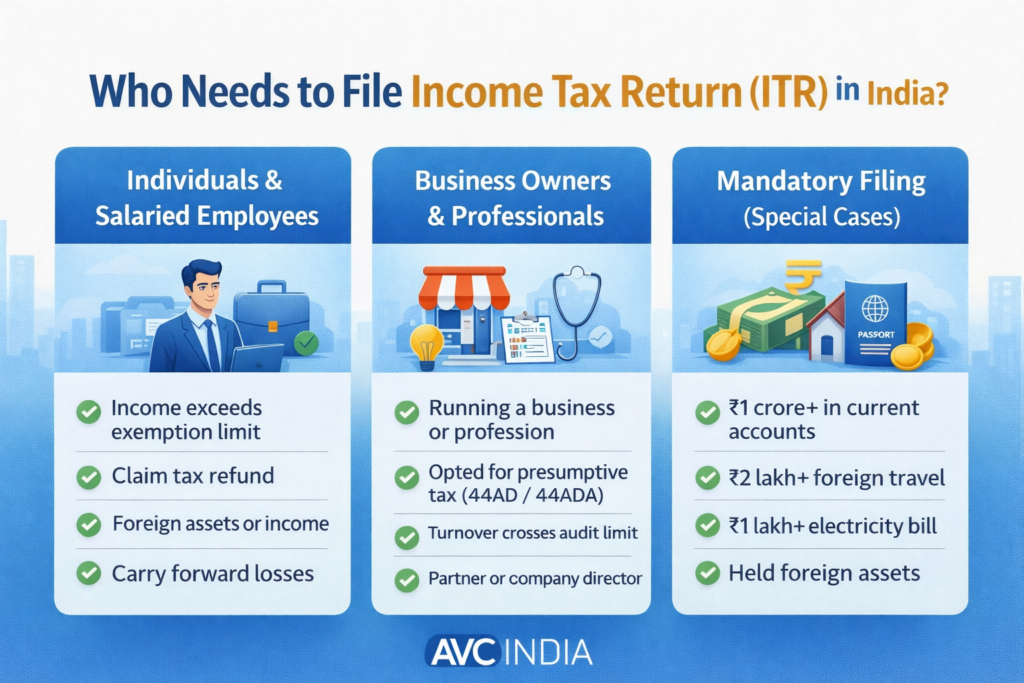
Who Is Required to File ITR in India?

You must file an ITR if you fall under any of the following categories:

Individuals & Salaried Employees

  • Total income exceeds the basic exemption limit

  • You want to claim a tax refund

  • You have foreign assets or income

  • You want to carry forward losses

Business Owners & Professionals

  • You run a business or profession

  • You opt for presumptive taxation (44AD / 44ADA)

  • Your turnover crosses audit thresholds

  • You are a partner or director in a company

Mandatory Filing (Even If Income Is Low)

  • Deposited ₹1 crore+ in current accounts

  • Spent ₹2 lakh+ on foreign travel

  • Paid ₹1 lakh+ electricity bill

  • Held foreign assets

ITR Forms Explained (Which One Should You Use?)

ITR Form Applicable To
ITR-1 (Sahaj) Resident individuals with salary/pension, one house property, and other income (interest), having total income up to ₹50 lakh
ITR-2 Individuals & HUFs not having business or professional income, but having capital gains, multiple house properties, or foreign assets/income
ITR-3 Individuals & HUFs having income from business or profession, including partners in firms
ITR-4 (Sugam) Individuals, HUFs & firms (other than LLPs) opting for presumptive taxation under Sections 44AD, 44ADA, or 44AE, with income up to ₹50 lakh
ITR-5 Firms, LLPs, AOPs, BOIs, and other entities not required to file ITR-7
ITR-6 Companies other than those claiming exemption under Section 11
ITR-7 Trusts, political parties, research institutions, and other persons required to file returns under Sections 139(4A) to 139(4F)

Choosing the wrong ITR form is one of the most common reasons for defective returns and notices.

Step-by-Step Process of online Income Tax Return Filing in India

Income Tax Return Filing in India

ITR Forms Explained (Which One Should You Use?)

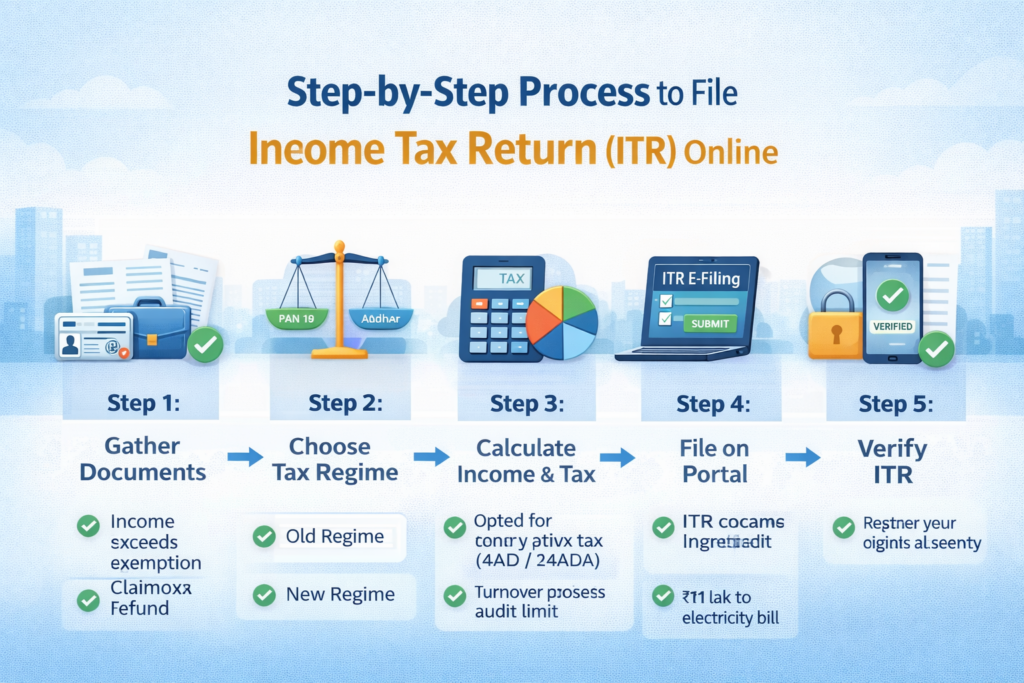
Step 1: Gather Required Documents

  • PAN & Aadhaar

  • Form 16 / Salary slips

  • Bank statements

  • Investment proofs (80C, 80D, etc.)

  • Capital gains statements (if any)

Step 2: Choose the Correct Tax Regime

  • Old Regime: Allows deductions & exemptions

  • New Regime: Lower slab rates, fewer deductions

⚠️ Choosing the wrong regime can increase tax liability unnecessarily.


Step 3: Calculate Total Income & Tax

  • Salary / Business income

  • Interest income

  • Capital gains

  • Other sources

Apply deductions correctly and compute final tax payable or refund.


Step 4: File ITR on the Income Tax Portal

  • Log in to the Income Tax e-filing portal

  • Select assessment year and ITR form

  • Fill details carefully

  • Submit the return


Step 5: Verify Your ITR

Your return is invalid unless verified.
Verification methods:

  • Aadhaar OTP

  • Net banking

  • Bank account EVC

Common ITR Filing Mistakes to Avoid

  • Filing under the wrong ITR form

  • Not reporting interest income

  • Ignoring capital gains

  • Mismatch between Form 16 and AIS

  • Missing verification after filing

  • Late filing leading to penalties

These mistakes often trigger Income Tax Notices, even when tax paid is correct.

Due Date for ITR Filing (FY 2025–26)

Category Due Date
Individuals (Non-Audit) 31st July 2026
Businesses (Audit Cases) 30th September 2026

Late filing may result in:

  • Penalty up to ₹5,000

  • Loss of deductions

  • Interest on tax payable

Why Professional ITR Filing Matters

While online filing appears simple, tax laws are not.

A Chartered Accountant helps you:

  • Optimize tax liability legally

  • Avoid scrutiny & penalties

  • Handle notices professionally

  • Maintain long-term compliance

For business owners and professionals, incorrect filing can cost far more than CA fees.

How AVC India Can Help

How AVC India Can Help

At AVC India, we provide:

  • Accurate ITR filing for individuals & businesses

  • Tax planning aligned with Indian laws

  • Error-free compliance & documentation

  • End-to-end support for notices & audits


Get Your ITR Filed the Right Way

If you want peace of mind, compliance clarity, and tax efficiency, our experts are ready to assist.

Contact AVC India today for professional income tax filing support.

2 Comments

  1. Undeniably believe that which you said. Your favorite reason seemed to be on the internet the
    simplest thing to be aware of. I say to you, I certainly get irked
    while people think about worries that they just don’t know about.
    You managed to hit the nail upon the top as well as defined out the
    whole thing without having side-effects , people can take
    a signal. Will probably be back to get more. Thanks

Leave a Reply

Your email address will not be published. Required fields are marked *