-
 varun@avcindia.co.in
-
 Inquire about Tax Services:
+91 9999 275 999
Inquire about Tax Services:
+91 9999 275 999
varun@avcindia.co.in
Inquire about Tax Services:
+91 9999 275 999

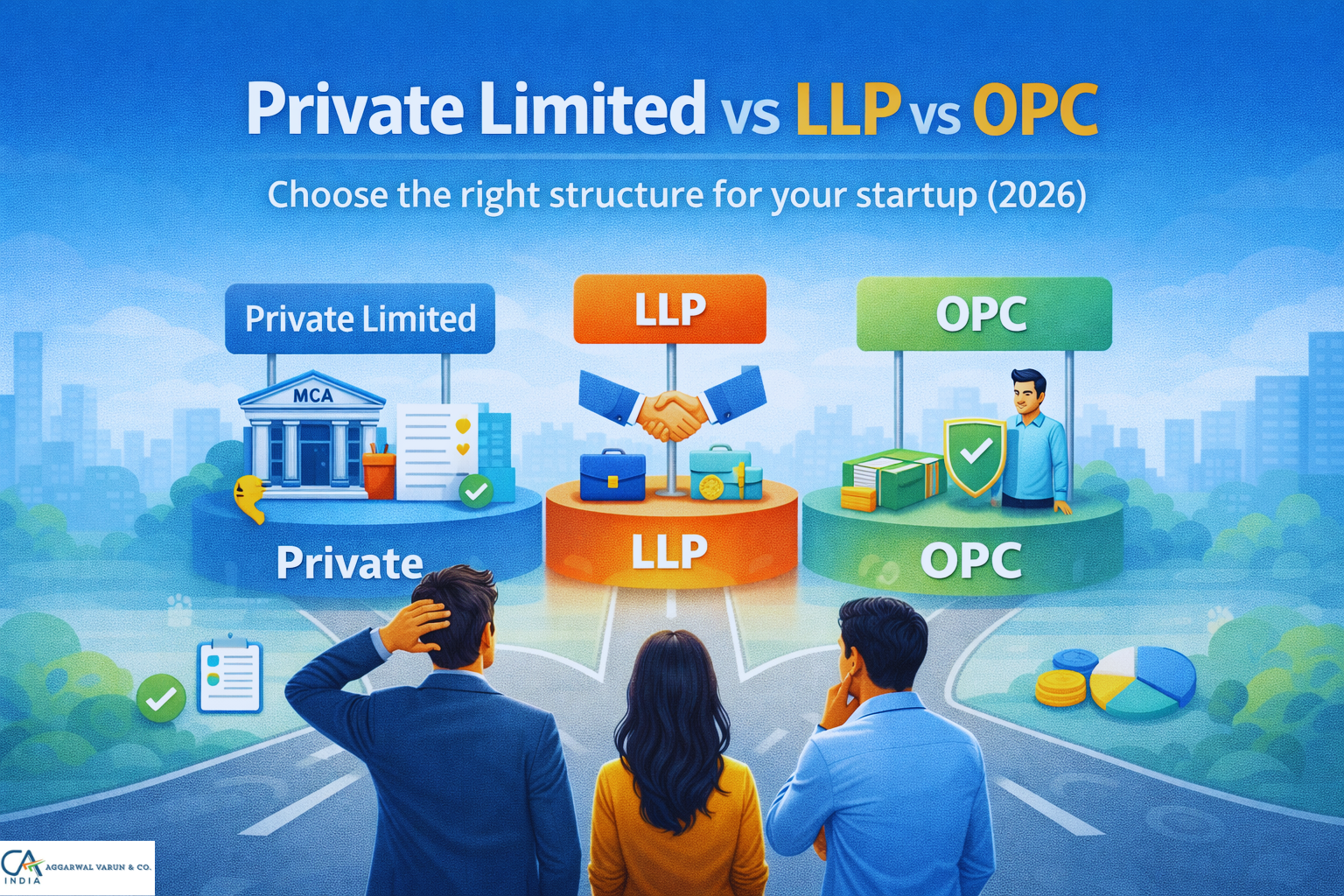
Choosing the best business structure for Indian startups can be one of the most consequential decisions a founder will ever make. Whether you are a solo entrepreneur testing the waters or a team of co-founders ready to pitch venture capitalists, the entity you register under determines your tax burden, compliance workload, fundraising ability, and long-term credibility
In India, three structures dominate the startup landscape: the Private Limited Company (Pvt Ltd), the Limited Liability Partnership (LLP), and the One Person Company (OPC). Each is governed by distinct legislation, carries unique advantages, and fits a different founder profile.
A business entity is the legal form under which a business operates. In India, entity formation is supervised by the Ministry of Corporate Affairs (MCA) and governed primarily by the Companies Act, 2013 and the LLP Act, 2008.
The structure you choose shapes the four pillars of your business:
Taxation: the rate at which profits are taxed
Compliance: How many filings, audits, and meetings are required each year
Fundraising: whether you can issue equity shares and attract institutional investors
Getting this decision wrong can lead to unnecessary tax outgo, compliance penalties, or an inability to raise capital when you need it most.
In India, the most popular corporate structure for high-growth businesses is a private limited company. It offers a distinct legal personality, restricted responsibility for shareholders, and a strong structure for obtaining outside funding. It is governed by the Companies Act of 2013. Early adoption of the Pvt Ltd form by well-known businesses like Flipkart and Ola allowed them to obtain several rounds of venture capital.
A Pvt Ltd must have two directors and two shareholders, at least one of whom must be an Indian resident. The business is qualified for 100% Foreign Direct Investment under the automatic procedure and may have up to 200 members. It is the ideal vehicle for VC and PE investors since it can issue equity shares, preference shares, and Employee Stock Options (ESOPs).
With the protection of limited liability and the operational flexibility of a typical partnership, the LLP is a hybrid entity created by the LLP Act of 2008. The entity has a distinct legal existence, and partners are exclusively accountable for the amount of their agreed-upon contribution.
There is no maximum number of partners required for an LLP, and at least two selected partners are required, one of whom must reside in India. This form is used by international professional services organisations such as KPMG India Services LLP and EY LLP because it offers liability protection and fits with their partnership governance approach.
The Companies Act of 2013 introduced the OPC with the express purpose of empowering sole proprietors. Without the necessity for a co-founder, it enables one person to form a business with limited liability, a distinct legal identity, and corporate credibility.
In the event that the owner becomes incompetent, an OPC just needs one candidate and one member. Foreign nationals are not permitted to form an OPC; only Indian citizens, whether they are residents or non-residents, may do so
The compliance burden varies significantly across these three structures:
Taxation often surprises founders the most.
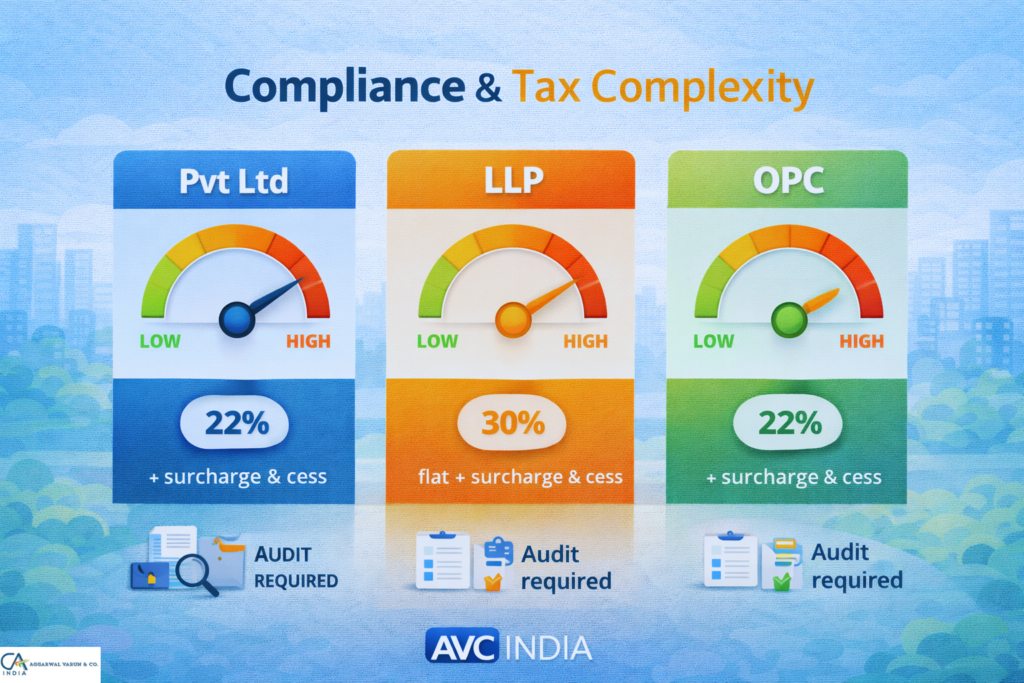
| Entity | Tax Rate | Notes |
|---|---|---|
| Private Limited Company | ~22% + surcharge & cess | Lowest corporate rate under new tax regime |
| OPC | ~22% + surcharge & cess | Same corporate tax treatment as Pvt Ltd |
| LLP | 30% flat + surcharge & cess | Higher base rate; but profit distributions to partners are tax-free in their hands |
If minimising tax outgo is a priority and your business is profitable, the Pvt Ltd or OPC structure offers a clear advantage at the 22% rate versus the LLP’s 30%.
The only sensible option if you intend to raise venture capital, angel investment, or eventually go public is a Private Limited Company. The typical instruments that VC and PE investors anticipate, equity shares and ESOPs, can be issued by Pvt Ltd firms. This structure is nearly always preferred by investors due to its transferable ownership, transparent shareholding patterns, and conformity to international investment standards.
Equity shares cannot be issued by an LLP. LLPs are effectively excluded from the startup finance ecosystem since they are only able to generate capital through partner contributions or debt instruments like bank loans.
The same is true for an OPC. There is no way to attract equity investors because just one shareholder is allowed. Early conversion to Pvt Ltd is advised for any founder hoping to raise seed financing.
| Feature | Pvt Ltd | LLP | OPC |
|---|---|---|---|
| Credibility | Highest | Moderate | Moderate |
| Fundraising | Equity shares, VC/PE friendly | Debt/partner contribution only | Limited — single owner |
| Tax Rate | ~22% | ~30% | ~22% |
| Compliance Cost | High | Low–Moderate | Moderate |
| FDI Eligibility | Yes (automatic route) | Yes (with restrictions) | No (Indian citizens only) |
| ESOP Capability | Yes | No | No |
| Mandatory Audit | Always | Above threshold | Above threshold |
| Registration Cost | ₹15k–₹20k | ₹10k–₹15k | ₹12k–₹15k |
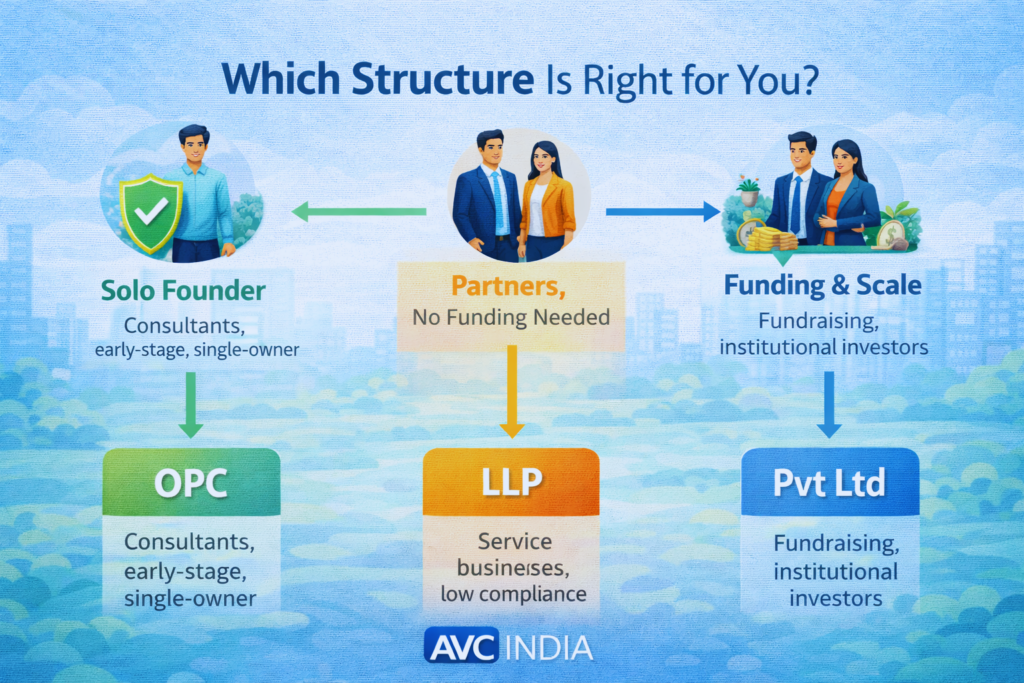
Scenario 1: Solo Tech Founder: Rina is building a SaaS product from her home office with no co-founder and no immediate funding plans. She incorporates an OPC to gain limited liability and a professional corporate identity while keeping compliance costs low.
Scenario 2: Two-Founder Startup Seeking Funding: Arjun and Meera are co-founders of an enterprise SaaS startup. They plan to approach angel investors within 12 months. They register a Private Limited Company because it allows them to issue equity, create an ESOP pool, and present a familiar structure to investors.
Scenario 3: Chartered Accountancy Practice: Three CAs want to set up a consultancy. They do not need external funding and prefer flexible governance. An LLP fits perfectly, offering limited liability and lower compliance without the overhead of a full corporate structure.

There is no one-size-fits-all answer. Your choice should align with where you see your business in three to five years, not just where it stands today :
Get a personalised entity selection and compliance roadmap from AVC India’s experts. Book your free consultation today and start your entrepreneurial journey on the right legal foundation.
