GST registration in Gurgaon is mandatory once your annual turnover crosses ₹40 lakh for goods or ₹20 lakh for services (Haryana is a normal-category state under Section 22 of the CGST Act), and it is compulsory regardless of turnover for e-commerce sellers, inter-state suppliers and certain others under Section 24. The government charges no fee to register on the GST portal. Under the rules effective 1 November 2025, low-risk applicants can receive a GSTIN in three working days; standard clean applications are approved within seven working days, and up to 30 days where physical verification is required. Gurgaon businesses fall under Haryana GST state code 06 and the CGST Gurugram Commissionerate. Gurugram is one of India’s densest business hubs, and its GST office is known for careful verification of every new application. This guide explains exactly when GST registration becomes compulsory for a Gurgaon business, the documents that officers can and cannot ask for after the April 2025 reforms, what registration costs, how long it now takes under the 2025 fast-track rules, how to use a virtual or coworking address safely, and what to do if you receive a clarification notice or a rejection. Every legal point is tied to the specific section, rule or form so you can act with confidence.
What is GST registration, and how does it work in Gurgaon?
GST registration is the process of obtaining a 15-digit Goods and Services Tax Identification Number (GSTIN) that lets a business legally collect GST, claim input tax credit, and file returns. For a Gurgaon business, the GSTIN begins with state code 06, which identifies Haryana. The Goods and Services Tax replaced most indirect taxes in India from 1 July 2017. Once registered, a business receives a PAN-based GSTIN whose first two digits denote the state of registration 06 for every business registered in Haryana, including Gurugram. Registration is administered jointly: the central tax authority operates through the CGST Gurugram Commissionerate (which sits within the Panchkula Zone), while the state tax is administered by the Excise and Taxation Department, Haryana, under the Haryana GST Act, 2017. Which authority processes your file depends on the jurisdiction your address maps to, but the online application and the law are the same either way. A GSTIN is not merely a compliance formality in Gurugram. Enterprise clients, marketplaces such as Amazon and Flipkart, and most B2B vendors will not onboard a supplier without one, and you cannot claim input tax credit on your own purchases until you hold a valid registration.
Who needs GST registration in Gurgaon?
You must register for GST in Gurgaon once your aggregate annual turnover exceeds ₹40 lakh for goods or ₹20 lakh for services. Separately, registration is compulsory regardless of turnover if you sell inter-state, sell through an e-commerce operator, or fall into any other category listed in Section 24 of the CGST Act.
Turnover thresholds (Section 22)
Because Haryana is a normal-category state, a Gurgaon business supplying only goods must register once aggregate turnover crosses ₹40 lakh in a financial year, while a service provider must register at ₹20 lakh. A business that supplies both goods and services is generally assessed against the lower ₹20 lakh services threshold. “Aggregate turnover” is calculated across India on a single PAN and includes taxable, exempt, export and inter-state supplies, but excludes GST itself and inward supplies taxed under reverse charge. You have 30 days from the date you become liable to apply, under Section 25.
Type of Supply (Gurgaon / Haryana)
GST Registration Threshold
Goods Only
₹40 lakh aggregate annual turnover.
Services Only (or Goods + Services)
₹20 lakh aggregate annual turnover.
Persons Covered Under Section 24 of the CGST Act
Compulsory GST registration from the first rupee of taxable supply, irrespective of turnover.
Compulsory registration regardless of turnover (Section 24)
Certain businesses must register even if turnover is nil. Under Section 24, this includes anyone making inter-state taxable supplies of goods, casual taxable persons and non-resident taxable persons, persons required to pay tax under reverse charge, persons who must deduct TDS or collect TCS, input service distributors, agents supplying on behalf of a principal, and most relevant for Gurgaon’s large seller base persons supplying goods through an e-commerce operator. If you sell on a marketplace or ship to customers in other states, the ₹40 lakh and ₹20 lakh thresholds do not protect you.
Who is exempt (Section 23)
A person dealing exclusively in supplies that are wholly exempt or not liable to GST, and agriculturists supplying produce from their own land, are not required to register. Businesses below the threshold may still register voluntarily to claim input tax credit and to appear credible to enterprise clients a common and often sensible choice for Gurugram startups and consultants.
Documents required for GST registration in Gurgaon
The core documents are the PAN and Aadhaar of the proprietor, partners or directors; proof of the business constitution; proof of the principal place of business (ownership document, or a registered rent agreement plus a No-Objection Certificate and a recent utility bill); bank details; and photographs. Companies and LLPs also need a Digital Signature Certificate. The exact set depends on your business structure. In Gurugram, the single most common cause of delay or rejection is weak address proof, so pay particular attention to that.
Address proof for a Gurgaon premises
For an owned premises, the latest property-tax receipt, municipal khata or electricity bill establishes possession. For a rented or shared premises, you need a rent or lease agreement together with a No-Objection Certificate from the owner and a recent utility bill in the owner’s name. In Haryana, a lease of more than eleven months should be a registered agreement; an unregistered long-term lease is a frequent trigger for a clarification notice. Keep the utility bill recent bills older than about two months are often questioned and make sure the name and address match exactly across the agreement, the NOC and the bill. A DHBVN or UHBVN electricity bill is the cleanest supporting document in the Gurugram belt.
What the officer cannot demand (Instruction 03/2025-GST)
This is where an up-to-date filing gives you a real advantage. Under CBIC Instruction No. 03/2025-GST dated 17 April 2025, officers are directed to stick strictly to the documents listed in the application form and not to raise queries on presumptive or extraneous grounds. In practice, if you have provided valid proof of the premises, the officer should not demand the landlord’s PAN, Aadhaar or photograph, and should not reject or query an application simply because a director lives in another state or because a product’s HSN code seems unusual for the area. Any demand for a document outside the prescribed list now requires the prior approval of a Deputy or Assistant Commissioner. Knowing this lets you push back, politely and correctly, on an over-broad query rather than scrambling for paperwork you do not legally owe.
GST registration fees in Gurgaon: what it actually costs
The government charges no fee to register for GST on the official portal registration is genuinely free. Any amount you pay is a professional fee for a CA or consultant to prepare and file the application, which in Gurgaon typically ranges from a few hundred to a few thousand rupees depending on business complexity.
There is no statutory government charge for a normal GST registration, so a search for “GST registration online free” is answered honestly: the portal itself costs nothing. What you may choose to pay for is professional help vetting documents, drafting the application correctly the first time, handling Aadhaar or biometric authentication, and responding to any clarification notice so the file is approved without a second cycle. That is usually money well spent in Gurugram, where a rejected application costs far more time than a clean one. The only genuinely government-mandated outflow arises for a casual taxable person or a non-resident taxable person, who must deposit an advance amount of estimated tax at the time of registration; that is a tax deposit, not a registration fee.
How to apply for GST registration online (step by step)
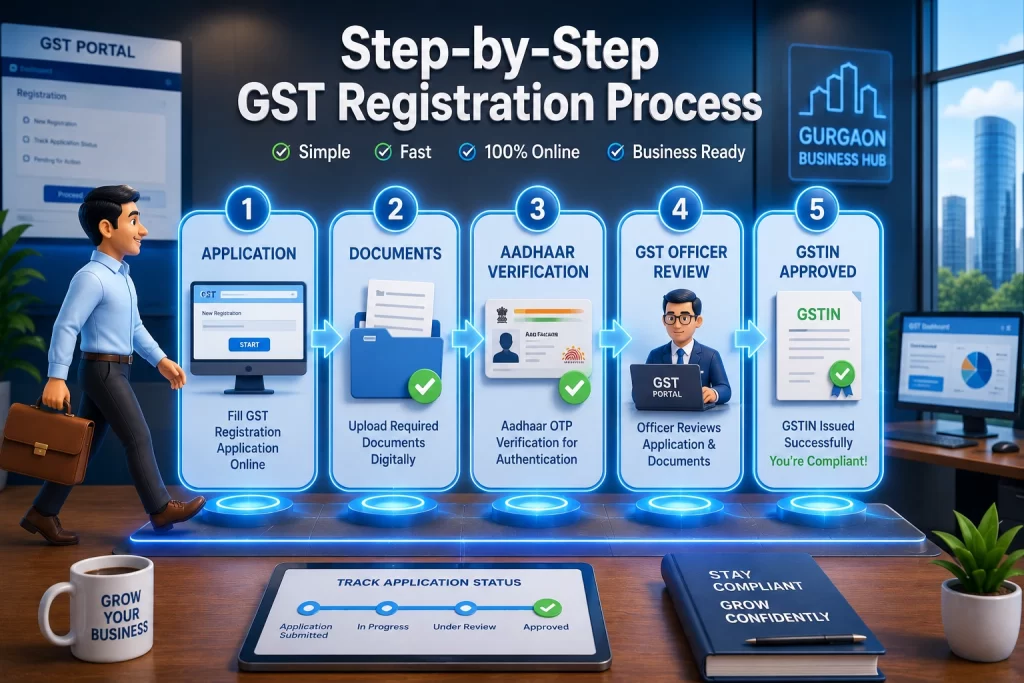
Apply at gst.gov.in. Fill Part A of Form GST REG-01 to generate a Temporary Reference Number (TRN), then complete Part B with your business, promoter, place-of-business and bank details, upload documents, and verify using Aadhaar authentication or DSC. You receive an Application Reference Number (ARN) to track the application.
The process is entirely online and, done correctly, takes one sitting. The steps are:
Part A of REG-01. On the GST portal, select “New Registration” and enter your legal name (as per PAN), PAN, mobile number, email and state (Haryana). After OTP verification you receive a Temporary Reference Number (TRN), valid for 15 days.
Part B of REG-01. Log in with the TRN and complete the full application business constitution, principal place of business, additional places, goods and services (HSN/SAC), bank details and the authorised signatory.
Upload documents. Attach clear, legible copies matching the checklist above.
Authenticate. Complete Aadhaar authentication, or verify with a Digital Signature Certificate (mandatory for companies and LLPs). If the portal flags your file for biometric verification, follow the GST Suvidha Kendra route described below.
Submit and note the ARN. On submission you receive an Application Reference Number (ARN). Use it to track status on the portal. On approval, the GSTIN and the registration certificate in Form GST REG-06 are issued and can be downloaded.
To check progress at any time, use “Track Application Status” on the portal and enter your ARN. If the ARN is not generated after submission, it usually means Aadhaar or biometric authentication has not yet been completed.
How long does GST registration take now? The 2025 fast-track
Since 1 November 2025, low-risk applicants can be granted registration electronically within three working days under Rule 9A, and small taxpayers with monthly output tax to registered persons of up to ₹2.5 lakh can opt into a simplified three-day route under Rule 14A. A standard clean application is approved within seven working days, and up to 30 days where the officer orders physical verification.
The timeline changed materially in late 2025 and most competing guides have not caught up. Following the GST Council’s recommendation at its 56th meeting on 3 September 2025, the CGST (Fourth Amendment) Rules, 2025 notified on 31 October 2025 and effective 1 November 2025 introduced two new routes:
Rule 9A allows the system to grant registration electronically within three working days for applications that the portal’s data analysis and risk parameters classify as low-risk.
Rule 14A gives an applicant whose monthly output tax on supplies to registered persons does not exceed ₹2.5 lakh the option to obtain registration within three working days, with Aadhaar authentication compulsory and a dedicated withdrawal mechanism through Form GST REG-32.
Where an application is not eligible for auto-grant, the normal position under Rule 9 applies: approval within seven working days for a clean file, or up to 30 days if the officer issues a notice or orders a physical verification of the premises. In short, a well-prepared Gurgaon application is now often approved in days, not weeks but only if it is clean enough to stay out of the risk lane.
Biometric Aadhaar authentication and the GST Suvidha Kendra in Haryana
Some Gurgaon applicants are flagged for biometric Aadhaar authentication under Rule 8(4A). If flagged, the promoter and authorised signatory must book an appointment and visit a designated GST Suvidha Kendra (GSK) in person with original documents. This rolled out in Haryana on 7 December 2024, and the ARN is not generated until this step is completed. To curb fake registrations, the portal now uses risk parameters to decide whether an applicant can authenticate by Aadhaar OTP alone or must undergo biometric verification in person. If your file is flagged, you will receive an email with the assigned GSK and the documents to carry typically the appointment confirmation, the jurisdiction details, and the original Aadhaar and PAN of the person attending. This must be completed within the period stated in the intimation (linked to the 15-day window for submitting Part B), or the ARN will not be issued and the application will stall. Ensuring your Aadhaar details (name, date of birth, gender) are accurate before you apply is the simplest way to avoid an authentication failure.
Using a virtual office or coworking address for GST in Gurgaon
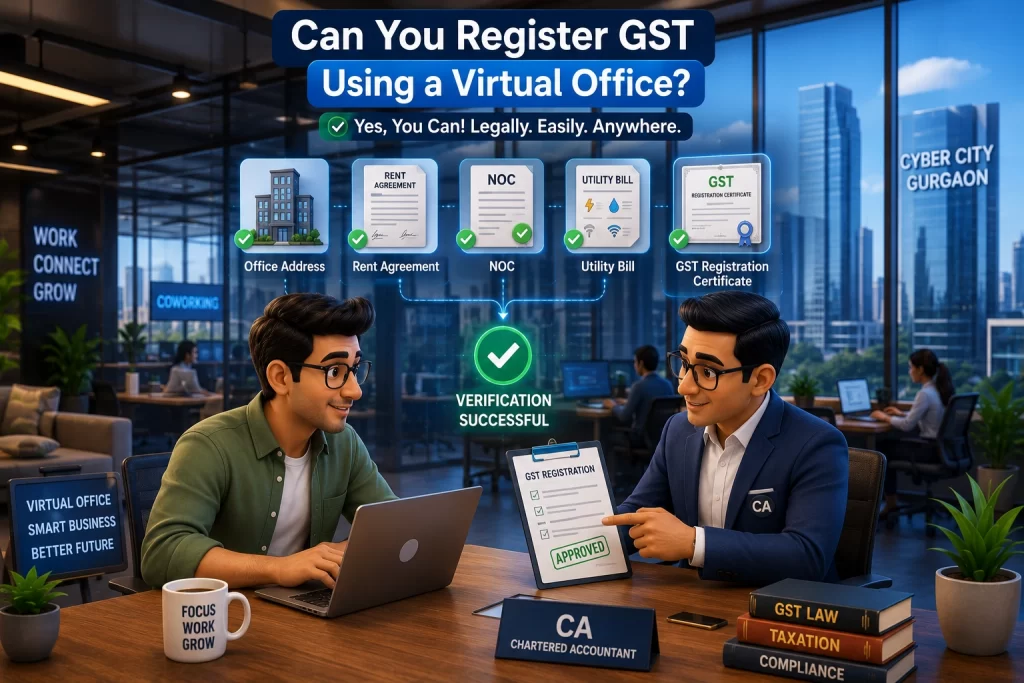
Yes, a virtual or coworking address in Gurgaon is acceptable for GST registration if it is a real, verifiable commercial premises backed by a proper (registered) rent or licence agreement, a No-Objection Certificate and a recent utility bill. The officer may still visit under Rule 25, so the address must be genuinely identifiable and, ideally, have signage. Gurugram is India’s virtual-office capital, and using a coworking address to obtain a Haryana GSTIN is entirely legitimate the law cares whether the place of business is real and documented, not whether you sit there daily. What matters is the paperwork and verifiability, grounded in the ordinary document rules of Rule 8 and the physical-verification power of Rule 25, together with the document discipline of Instruction 03/2025. (A word of caution: several provider pages cite “Circular 161/17/2021” as the authority for virtual offices that circular actually concerns the export of services and is not the correct basis. Rely on the document rules instead.) The Gurugram office scrutinises new registrations closely, and applications are most often delayed or rejected for avoidable address problems. The recurring traps are an unregistered long-term rent agreement, a utility bill more than about two months old, mismatched details across the agreement, NOC and bill, an address that does not clearly read as a commercial building, or the absence of any signage or representative when an officer visits. High-density corporate zones such as Cyber City and Udyog Vihar tend to attract stricter checks than lower-volume sectors. Choosing a provider in a genuine commercial tower with clean, consistent, recent documents is what prevents a REG-03 notice.
Received a REG-03 notice, or been rejected? Here is what to do
A REG-03 notice is a request for clarification. You must reply in Form GST REG-04 within seven working days. If the reply satisfies the officer, registration is granted; if not or if you do not reply the application is rejected in Form GST REG-05. You can then either re-apply with corrected documents or appeal the rejection under Section 107 within three months. If the officer needs more information, you will receive a notice in Form GST REG-03. This is routine and recoverable it is not a rejection. Read exactly what is being asked, address each point precisely, upload only what is required, and file your reply in Form GST REG-04 within seven working days. A common Gurugram scenario is a query about the address; the fix is usually a registered rent agreement, a fresh utility bill, or a corrected NOC so the three documents agree. If the application is rejected in Form GST REG-05, you have two routes. In most cases the fastest is to file a fresh application with the deficiency fixed. Alternatively, if you believe the rejection was wrong, you can appeal under Section 107 within three months of the order. Because a botched second attempt compounds the delay, this is the point at which many Gurgaon businesses ask a CA to take over a clarification reply that closes the file in one cycle is far cheaper than repeated rejections. If your registration is stuck at the notice or rejection stage,talk to the AVC India GST team before you re-file.
Penalty for not registering under GST
Operating without GST registration when you are required to have it attracts a penalty under Section 122 of 10% of the tax due, subject to a minimum of ₹10,000. Where the failure to register is a deliberate attempt to evade tax, the penalty rises to 100% of the tax due.Beyond the direct penalty, an unregistered business cannot collect GST from customers or claim input tax credit on its purchases, so the tax paid to suppliers becomes a sunk cost that erodes margin. For a Gurugram business supplying enterprise clients or selling on marketplaces, the practical cost of staying unregistered lost contracts and blocked credit usually dwarfs the statutory penalty. Registering on time is simply cheaper.
After you register: staying compliant in Gurugram
Once registered, you must display your GSTIN at your place of business, issue GST-compliant invoices, and file periodic returns (typically GSTR-1 and GSTR-3B, or the quarterly QRMP route for smaller taxpayers) by their due dates. Late filing attracts daily late fees and interest. Registration is the start of an ongoing obligation, not a one-time event. Display the GSTIN prominently, raise correct tax invoices, reconcile your input tax credit against supplier filings, and file every return on time even a nil return. If your circumstances change, such as closing the business or dropping below the threshold, you can surrender the registration through Form GST REG-16 rather than leaving it dormant and accruing late fees.
Is GST registration free in Gurgaon?
Yes. The government charges no fee to register on the GST portal. Any amount you pay is a professional fee for preparing and filing the application; there is no statutory registration charge.
What is the GST turnover limit in Gurgaon?
Because Haryana is a normal-category state, the limit is ₹40 lakh of aggregate turnover for a goods business and ₹20 lakh for a service business in a financial year. Certain categories under Section 24 must register regardless of turnover.
How long does GST registration take in Gurgaon now?
Low-risk applicants can be granted registration in three working days under the rules effective 1 November 2025. A standard clean application is approved within seven working days, and up to 30 days where physical verification of the premises is ordered.
Can I get GST registration with a virtual office or from home in Gurgaon?
Yes, provided the premises is real and verifiable and you supply a valid (registered, for leases over eleven months) rent or licence agreement, a No-Objection Certificate and a recent utility bill. The officer may verify the address physically under Rule 25.
What documents are required for GST registration in Gurgaon?
PAN and Aadhaar of the proprietor, partners or directors; proof of business constitution; proof of the place of business; bank details; photographs; and a Digital Signature Certificate for companies and LLPs. Under Instruction 03/2025-GST, officers cannot demand the landlord’s PAN, Aadhaar or photo if valid premises proof is provided.
I received a REG-03 notice what should I do?
Reply in Form GST REG-04 within seven working days, addressing each point precisely and uploading only the documents requested. If the reply satisfies the officer, registration is granted; if not, the application is rejected in REG-05, after which you can re-apply or appeal under Section 107 within three months.
What is the penalty for not registering under GST?
Under Section 122, the penalty is 10% of the tax due, subject to a minimum of ₹10,000, rising to 100% of the tax due where the failure to register is a deliberate attempt to evade tax.
How do I check my GST registration status?
Use “Track Application Status” on the GST portal and enter your ARN. You can see whether the application is pending, has a clarification notice, is approved, or is rejected.