
-
-
Tax Services
-
Audit & Assurance
-
Business Setup
-
Accounting & Payroll
-
Advisory
-
Gurgaon, officially known as Gurugram, is home to startups, IT companies, SaaS businesses, consulting firms, manufacturers, exporters, e-commerce sellers and large multinational companies. As these businesses expand, managing GST registration, return filing, Input Tax Credit, e-invoicing, refunds and notices can become increasingly complicated.
Professional GST services in Gurgaon help businesses manage these responsibilities accurately and on time. They can include GST registration, GSTR-1 and GSTR-3B filing, GSTR-2B reconciliation, Input Tax Credit review, e-invoicing, LUT filing, GST refunds and notice-response assistance.
Gurgaon does not have a separate GST rate. GST rates are determined under India’s national GST framework according to the nature and classification of the supply. Therefore, businesses must identify the correct service, SAC code, place of supply and applicable conditions before charging GST or claiming Input Tax Credit.
This guide explains the GST rates applicable to services in India and the professional GST support available to businesses in Gurgaon.
GST services are professional compliance and advisory services that help businesses follow the Goods and Services Tax law. They cover everything from obtaining GST registration to filing returns, reconciling Input Tax Credit and responding to departmental notices.
A reliable GST consultant in Gurgaon should do more than upload figures to the GST portal. The consultant should understand the business model, customer and vendor locations, revenue streams, registrations and movement of invoices before determining the correct GST treatment.
GST consultancy services in Gurgaon may include:
Businesses can select individual services or obtain complete GST compliance support according to their requirements.
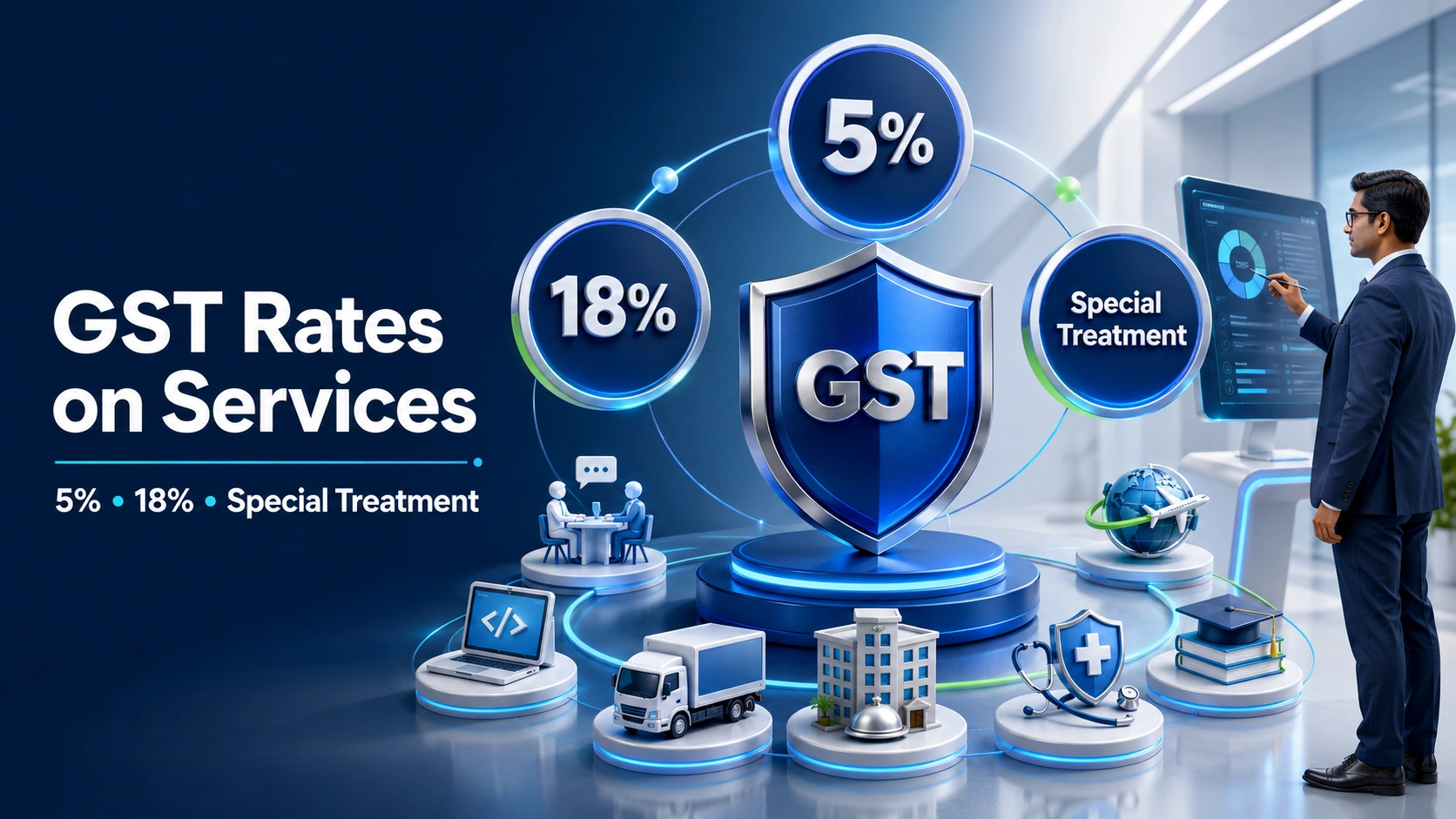
The GST rate on services is not one fixed percentage. The applicable rate depends on the nature and classification of the service.Under the GST structure announced following the 56th GST Council meeting, 5% is the merit rate, 18% is the standard rate and 40% is a special demerit rate for selected supplies. Some specified services may also be exempt from GST.Many ordinary business and professional services commonly attract 18% GST. However, businesses should not assume that every service is taxable at 18%. The applicable GST treatment may depend on several factors, including the nature of the service, its SAC code and the respective status of the service provider and recipient. The location of the supplier and customer, along with the applicable place-of-supply provisions, can determine whether CGST and SGST or IGST must be charged.Businesses must also examine the conditions attached to Input Tax Credit, the availability of any exemption and whether the transaction is covered under the Reverse Charge Mechanism. Since GST rates and conditions may be affected by new notifications, circulars and amendments, the latest official GST provisions should always be reviewed before deciding the tax treatment or issuing an invoice.
| Service Category | Common Treatment to Examine | Important Consideration |
|---|---|---|
| Consultancy and Business Support | Often 18% | The actual supply must match the relevant GST rate entry. |
| Software and IT Services | Often 18% | Export and place-of-supply rules may change the treatment. |
| Transport Services | 5%, 18% or exemption may apply | Treatment can depend on the provider, recipient and ITC conditions. |
| Hospitality and Food Services | Category-specific | Rates and ITC conditions depend on the exact service. |
| Education Services | Specified exemptions may apply | Not every education-related service is exempt. |
| Healthcare Services | Specified exemptions may apply | Non-qualifying or cosmetic services may be taxable. |
| Export of Services | Potentially zero-rated | All export conditions and documentation must be satisfied. |
| Selected Demerit Services | Special rate may apply | Only notified supplies should be included. |
This table is indicative. The current GST rate notification and applicable conditions should be checked before using a particular rate.
No, Gurgaon does not prescribe a separate city-level GST rate. Businesses in Gurgaon follow the GST rates applicable throughout India.
For an intra-state taxable supply within Haryana, the tax is generally divided between CGST and Haryana SGST. For an inter-state supply, IGST generally applies.
For example, if a service attracts 18% GST:
The correct treatment depends on the location of the supplier, location of the recipient and applicable place-of-supply rules.
Businesses can follow a structured process to determine the correct GST rate.
Understand exactly what is being supplied. Review the agreement, invoice description, deliverables and commercial arrangement.
SAC stands for Service Accounting Code. It is used to classify services under GST.
The selected SAC code should accurately represent the service. A business should not copy a SAC code merely because another company uses it.
Match the SAC code and service description with the applicable GST rate notification.
Some healthcare, education, transport and other specified services may qualify for exemptions when the prescribed conditions are satisfied.
Under the Reverse Charge Mechanism, the recipient may be responsible for paying GST on certain notified supplies.
The place of supply helps determine whether CGST and SGST or IGST should be charged.
Some concessional rates are subject to restrictions on Input Tax Credit. These conditions must be reviewed before applying the rate.
GST rates and conditions can change. Businesses should verify whether the applicable notification has been amended.
GST registration may become mandatory when aggregate turnover crosses the applicable threshold or when a business falls under a compulsory-registration category. However, registration should not be decided solely on turnover. A business must also examine the nature of its supplies, the location of its customers and whether it undertakes interstate or export transactions. E-commerce operations, casual taxable-person status, liability under the Reverse Charge Mechanism and other compulsory-registration provisions may also affect whether GST registration is required. Voluntary GST registration may be considered when commercial customers require GST-compliant tax invoices or expect to claim eligible Input Tax Credit. It can help a business work with larger corporate clients, but registration also creates continuing responsibilities. These include filing GST returns, issuing compliant invoices, maintaining proper records and paying the applicable tax within the prescribed timelines.
The documents required for GST registration in Gurgaon depend on the legal constitution of the business, the type of applicant and the arrangement of its principal place of business. The applicant generally needs to provide the PAN of the business or proprietor, Aadhaar and other identity documents, photographs of the proprietor, partners or directors, and an active email address and mobile number. A company, LLP or partnership firm may also need to submit its certificate of incorporation, partnership deed or LLP agreement, as applicable. Documents establishing the principal place of business are also required. Depending on whether the premises are owned or rented, these may include ownership documents, a rent agreement and a supporting utility document. Bank-account evidence may also be requested during or after the registration process. Where an authorised signatory submits the application, an authorisation letter or board resolution may be necessary. The application should also contain accurate information about the authorised signatory, additional places of business and the goods or services the applicant intends to supply. Aadhaar authentication and verification through the GST portal may also form part of the registration process.
A professional GST consultant can support a business through every stage of GST compliance, from registration and return filing to reconciliation, amendments, cancellation and notice management.
GST registration assistance should begin with an applicability review. Before submitting an application, the consultant should understand the nature of the business, its expected turnover, operating locations and the types of transactions it conducts. GST registration services generally include reviewing whether registration is required, preparing the application and selecting the correct business activities. The consultant may also help add the relevant goods and services, upload supporting documents, declare additional places of business and ensure that the information provided in the application is complete and consistent. If the GST department raises a query, professional assistance may include preparing the response, submitting additional documents, tracking the application and providing support after the GSTIN is approved. An existing GST registration may require an amendment when there is a change in the business address, trade name, authorised signatory or contact information. Changes involving partners or directors, additional places of business or the nature of business activities must also be reviewed to determine whether an amendment is required on the GST portal. GST cancellation and revocation require careful attention because they may involve pending returns, unpaid liabilities, stock records and final-return obligations. Before applying, businesses should review their compliance position and resolve outstanding issues to reduce the risk of rejection, additional liability or future notices.
GST return filing is one of the most important parts of GST compliance. It affects the business’s tax liability, its customers’ Input Tax Credit, its overall compliance record and its exposure to notices or penalties. Professional GST return filing services in Gurgaon should therefore include a review of invoices, accounting records, tax calculations and reconciliations instead of relying only on data entered on the GST portal.
GSTR-1 is used to report details of outward supplies made by a registered business. It generally contains information relating to B2B invoices, B2C transactions, credit notes, debit notes, export invoices and amendments made to previously reported transactions. Details of advances may also need to be reported where the applicable GST provisions require them.
Monthly GSTR-1 is ordinarily due on the 11th day of the following month, while quarterly filers must follow the applicable quarterly filing schedule. Since the government may extend a due date through a notification, businesses should confirm the current deadline before filing.
GSTR-3B is a summary return through which a registered business declares its taxable outward supplies, output tax liability and eligible Input Tax Credit. It also contains details of reverse-charge liability, exempt and non-GST supplies, and the tax amount payable for the relevant period.
Monthly GSTR-3B is ordinarily due on the 20th day of the following month. Quarterly filers must follow the applicable notified schedule based on their filing category and state. Businesses should always verify the current deadline on the GST portal because filing dates may be extended or revised through government notifications.
The figures reported in GSTR-1 and GSTR-3B should be reconciled with the business’s sales register and books of account. This review should also cover tax invoices, credit and debit notes, e-invoice records, export invoices and the electronic liability ledger.
Reconciliation helps identify missing invoices, incorrect taxable values, tax-rate differences, duplicate entries and transactions reported in the wrong period. Unresolved differences can affect a customer’s Input Tax Credit, create inconsistencies in the business’s GST records and increase the likelihood of receiving a GST notice.
GSTR-2B reconciliation involves comparing invoices reported by suppliers with the business’s purchase register, tax invoices and supporting accounting records. This process helps identify invoices that are missing, duplicated, incorrectly reported or recorded with differences in the GSTIN, invoice number, taxable value or tax amount.
However, the appearance of an invoice in GSTR-2B does not automatically establish that the related Input Tax Credit is eligible. The business must also verify that the applicable legal conditions have been satisfied, the goods or services have been received, the documents are valid and the credit is not restricted or blocked under the GST provisions.
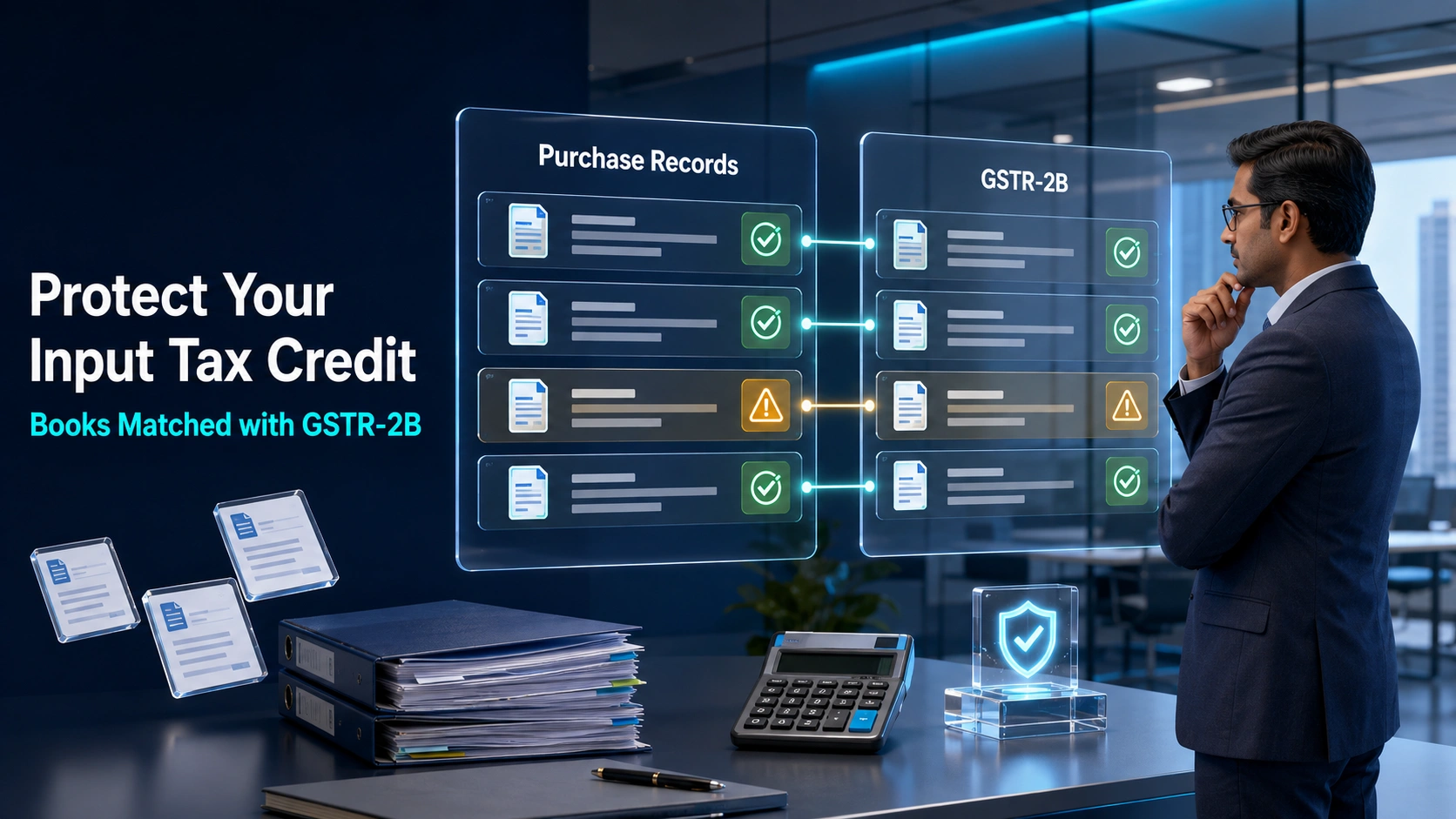
| Reconciliation Result | Recommended Review |
|---|---|
| Invoice matches the books and GSTR-2B | Confirm the invoice, receipt, business use and other ITC conditions. |
| Invoice is in the books but absent from GSTR-2B | Investigate the difference and contact the supplier. |
| Invoice appears in GSTR-2B but not in the books | Verify whether it belongs to the business. |
| GSTIN, value or invoice number differs | Arrange correction or amendment. |
| Credit may be blocked or restricted | Review the relevant ITC restriction before claiming. |
A complete ITC review involves verifying supplier GSTINs and matching invoice numbers, taxable values and tax amounts with the purchase register. It should also identify duplicate invoices, reconcile credit notes and examine whether any credit is blocked or restricted under the applicable GST provisions.
The review may further include following up with vendors about missing or incorrect invoices, monitoring ITC reversals and tracking credits that may be reclaimed after the prescribed conditions are satisfied. Regular reconciliation helps protect eligible Input Tax Credit, maintain accurate records and reduce the risk of mismatch-related notices.
E-invoicing applies to notified taxpayers that meet the prescribed aggregate-turnover threshold, subject to the exclusions provided under GST law.
The official e-invoice system records applicability for businesses with aggregate turnover of ₹5 crore and above from 1 August 2023. Businesses should nevertheless review the latest notification and any applicable exclusions before determining whether e-invoicing is mandatory for them.
From 1 April 2025, taxpayers with an annual aggregate turnover of ₹10 crore and above are required to report covered e-invoices to the Invoice Registration Portal within 30 days of the invoice date.
E-invoice implementation support may begin with an applicability review, followed by verification of customer master data and GSTINs. It can also include integrating the accounting software with the e-invoice system, generating Invoice Registration Numbers and verifying the QR codes created through the portal.
A complete implementation process should also establish controls for reporting credit notes and debit notes, cancelling e-invoices within the permitted period and reconciling e-invoice data with GSTR-1. Training accounting employees can further help the business generate accurate invoices and manage reporting errors efficiently.
E-way bill requirements must be examined separately because they relate primarily to the movement of goods. An e-way bill is not required merely because a service invoice has been issued. Its applicability depends on the nature and value of the consignment, the movement involved and the relevant GST provisions.
Gurgaon has a large number of IT, SaaS, consulting, outsourcing and professional-service businesses that provide services to customers outside India.
A supply of services to an overseas customer may qualify as a zero-rated export when all the legal conditions are satisfied. Determining this requires reviewing the location of the supplier and recipient, the applicable place of supply and the manner in which consideration is received.
The business should also examine the relationship between different establishments, the contractual arrangement with the overseas customer, export invoices, foreign-remittance evidence and compliance with the Letter of Undertaking, where applicable. Merely issuing an invoice to a foreign customer does not automatically make a transaction an export of services under GST.
An eligible exporter may submit a Letter of Undertaking to export goods or services without paying IGST, subject to the prescribed conditions.
LUT assistance generally includes checking the exporter’s eligibility, preparing and filing the application, and verifying the details of the authorised signatory. After filing, the acknowledgement should be downloaded and retained as part of the business’s GST records.
The process may also include reviewing export invoices to confirm that the required declarations and information are included. Since an LUT applies to a particular financial year, businesses should monitor its validity and complete the annual renewal before making applicable exports without payment of IGST in the new financial year.
A business may be eligible to claim a GST refund in specified circumstances. These may include exports of goods or services, accumulation of unutilised Input Tax Credit, excess funds in the electronic cash ledger or excess payment of tax. Refunds may also arise from an inverted-duty structure, where applicable, or when tax has been paid on supplies subsequently treated as zero-rated or exempt. Other notified situations may also create refund eligibility.
A refund application should begin with an eligibility analysis, followed by verification of invoices, GST returns and Input Tax Credit records. For export-related claims, the review may also cover contracts, export invoices and evidence of foreign remittances. The relevant statements must then be prepared accurately before submitting Form GST RFD-01.
Professional refund assistance may further include responding to a deficiency memo, supplying additional documents and tracking the application’s status on the GST portal. Because refund claims depend heavily on consistent returns and supporting records, an incomplete or unreconciled application may lead to queries, rejection or delays in processing.
A GST notice should not be ignored or answered without examining the underlying issue. The business should first identify the relevant tax period, the GST registration and return referred to in the notice, the alleged mismatch and the statutory provision under which the notice has been issued. It must also confirm the response deadline and collect the documents needed to support its position.
GST notices may arise from differences between GSTR-1 and GSTR-3B or between GSTR-3B and GSTR-2B. Other common reasons include excess Input Tax Credit claims, delayed return filing, short payment of tax, incorrect place-of-supply treatment, e-way bill issues and registration-related discrepancies. Unexplained differences in turnover and continued non-filing of returns may also result in departmental action.
Professional GST notice support may involve reviewing the notice and downloading the relevant data from the GST portal. The consultant can then reconcile the books with previously filed returns, identify the disputed transactions and calculate the business’s potential tax exposure.
Based on this review, a factual response should be prepared with properly organised supporting documents and submitted within the prescribed deadline. Portal updates and further departmental communication should also be monitored after submission. A generic response should be avoided because an effective reply must address each allegation directly and support the business’s position with reliable records.
| Type of Business | Priority GST Support |
|---|---|
| Startup or Small Business | Registration, invoicing, return calendar and basic compliance controls. |
| IT, SaaS or Consulting Firm | Place of supply, LUT, export documents and foreign receipts. |
| Manufacturer or Distributor | ITC, e-way bills, job work, stock movement and reconciliation. |
| E-commerce or D2C Seller | Platform data, TCS, multi-state exposure and return reconciliation. |
| Exporter | LUT, zero-rating, refunds and documentary review. |
| Multi-state Company | State registrations, ISD or cross-charge analysis and branch transactions. |
| Business Facing a Notice | Reconciliation, exposure analysis and notice-response preparation. |
Startups and small businesses often need professional assistance to establish a reliable GST compliance process from the beginning. The first step is to determine whether registration is mandatory or commercially beneficial based on the business model, expected turnover and types of transactions.
GST support for startups may include obtaining registration, reviewing SAC codes and preparing a compliant invoice format. It can also involve establishing an accounting process, creating a return-filing calendar and implementing controls for Input Tax Credit. Businesses operating internationally may require additional assistance with export conditions and LUT filing, while growing startups should regularly review whether e-invoicing has become applicable.
A preventive compliance review can identify incorrect classifications, incomplete records and reporting differences before they result in notices. Setting up the correct process at an early stage can prevent larger reconciliation problems as the business and its transaction volume grow.
IT, SaaS and consulting companies frequently provide services to customers located in different states and countries. Their GST treatment may depend on the classification of the software, subscription, implementation, support or consulting service being supplied.
Place-of-supply provisions are particularly important because they help determine whether CGST and SGST or IGST should be charged. For services provided to overseas customers, the company must verify whether all the conditions for an export of services are satisfied. This review may include LUT filing, foreign-remittance documentation and an analysis of whether the company is supplying services on its own account or acting as an intermediary.
Companies working through multiple offices or related entities may also need to examine related-party transactions, cross-charge requirements and the possible use of the Input Service Distributor mechanism. E-invoicing applicability and the reconciliation of GSTR-1 with GSTR-3B should also be monitored as the company grows.
Contracts and invoices should always be reviewed together because the actual contractual arrangement, responsibilities of the parties and flow of consideration can affect the GST position.
Manufacturers and distributors generally manage a high volume of purchases, sales, inventory and movement records. Their GST compliance may involve registration in one or more states, verification of Input Tax Credit on raw-material purchases and the correct treatment of job-work transactions.
Professional support may also cover stock transfers, inter-branch supplies, e-way bills, e-invoicing and the reporting of credit notes. Where a business operates through multiple locations, it must determine whether additional state registrations are required and how transactions between registrations should be documented and valued.
Vendor and GSTR-2B reconciliation are particularly important for identifying missing invoices, reporting differences and potentially restricted credits. Eligible manufacturers and distributors may also require assistance with GST refund claims. Regular reconciliation of purchase records, stock movements and GST returns helps protect eligible ITC and maintain a reliable audit trail.
E-commerce sellers may receive transaction and settlement reports from Amazon, Flipkart, Meesho and other online marketplaces. These reports often contain sales, product returns, platform commissions, shipping charges, taxes, TCS deductions and other adjustments, making reconciliation more complex than ordinary invoice-based accounting.
An effective GST compliance process should compare marketplace sales reports with tax invoices, credit notes, return data and payment settlements. TCS statements, shipping adjustments, state-wise sales and eligible Input Tax Credit should also be reconciled with the books of account and GST returns.
The amount deposited by a marketplace into the seller’s bank account should not be treated directly as the sales value. The settlement is usually a net amount calculated after deducting commissions, taxes, returns and other charges. Each component should be identified and accounted for separately before preparing the GST returns.
A growing Gurgaon business may operate from Cyber City, Udyog Vihar, Golf Course Road, MG Road, Sohna Road, Manesar or another part of Gurugram while supplying goods or services across India or to overseas customers.
The location of the local office alone does not determine the complete GST position of a business. The locations of customers, vendors, warehouses and branches must also be considered. Marketplace operations, interstate supplies and contractual arrangements may create additional registration, invoicing and reporting obligations.
Professional GST support becomes particularly valuable when a business handles a high volume of invoices, maintains multiple GST registrations or undertakes interstate and export transactions. It can also assist businesses dealing with e-commerce data, restricted Input Tax Credit, reverse-charge transactions, e-invoicing requirements, recurring reconciliation differences or pending GST notices.
The purpose of professional support is not limited to filing returns before the due date. A sound compliance system should also maintain a clear audit trail showing how sales, tax liabilities, Input Tax Credit and other figures reported in the returns were calculated.
One of the most common GST mistakes is automatically charging 18% without confirming the correct rate and SAC code. Businesses may also apply the wrong place of supply, use an incorrect customer GSTIN or charge CGST and SGST when IGST is applicable—or charge IGST when CGST and SGST should be levied.
Export-related transactions require particular care. An invoice raised on a foreign customer should not automatically be treated as an export of services without checking the location of the parties, place of supply, receipt of consideration and other legal conditions.
Input Tax Credit should not be claimed solely because an invoice appears in GSTR-2B. The underlying invoice, receipt of goods or services, eligibility conditions and restrictions on credit must also be examined. Businesses should reconcile GSTR-1 and GSTR-3B with their accounting records and investigate supplier non-compliance or unreconciled ITC instead of carrying differences forward indefinitely.
Other common mistakes include overlooking e-invoicing or e-way bill requirements, reporting credit notes incorrectly and responding to GST notices without adequate supporting records. Registered businesses must also remember that a nil return may still need to be filed when no transactions occurred during the tax period.
Preventive monthly reviews are generally more effective than attempting to correct several filing periods after a notice has been received.
Before appointing a GST consultant in Gurgaon, a business should understand how its records will be reviewed, who will be responsible for each compliance activity and what documents will be provided after the returns are filed.
The consultant should have relevant GST knowledge, practical filing experience and an understanding of the client’s industry and transaction types. A defined monthly compliance process should include data validation, GSTR-2B reconciliation, Input Tax Credit review and a clear procedure for identifying and resolving reporting differences.
The scope of responsibility for GST notices should be clarified in advance. Businesses should also confirm how GST portal credentials and sensitive financial data will be stored and accessed. Professional fees, the scope of services and expected turnaround times should be documented clearly to avoid future misunderstandings.
A consultant should not be selected solely on the basis of the lowest return-filing fee. Incorrect classification, unsupported Input Tax Credit and unreconciled returns can create a financial and compliance cost substantially higher than the cost of a proper review.
The process should begin with an understanding of the business model, operating locations, GST registrations, customers and vendors. The consultant should also review the current return-filing status, major transaction types and any pending compliance issues.
The business should collect all relevant sales and purchase invoices, credit notes, debit notes and e-invoice records for the applicable tax period. Relevant accounting ledgers, marketplace reports, export documents and other supporting records should also be made available where required.
The collected records should be checked for correct GSTINs, GST rates, SAC codes and place-of-supply treatment. The review should also identify transactions covered by the Reverse Charge Mechanism and confirm that the supporting documents contain the required information.
The books of account should be compared with GSTR-1, GSTR-3B, GSTR-2B and the relevant electronic ledgers. Any missing invoices, duplicate entries, tax differences or period mismatches should be investigated before the returns are finalised.
A GST computation should be prepared and shared with the authorised person. Identified exceptions, uncertain tax treatments and reconciliation differences should be discussed and resolved before filing approval is provided.
After receiving approval and completing the required tax payment, the applicable GST return should be filed within the prescribed timeline. The filed figures should match the reviewed computation and supporting working papers.
After filing, the business should retain return acknowledgements, challans, reconciliation statements and supporting working papers. An action list should also be maintained for unresolved invoices, vendor follow-ups, ITC reversals and adjustments required in a future tax period.

Many consultancy and ordinary business-support services commonly attract 18% GST. However, the exact treatment should be confirmed from the applicable SAC classification, GST rate notification, place-of-supply rules and any exemption or reverse-charge entry.
Is there a separate GST rate on services in Gurgaon?
No. Eighteen percent is a common standard rate for many taxable professional services, but specified healthcare, education and other services may be exempt or treated differently. The actual service and applicable conditions must be checked.
HSN codes primarily classify goods, while SAC codes classify services under GST. A service provider should identify the SAC code that accurately represents the contracted service.