
-
-
Tax Services
-
Audit & Assurance
-
Business Setup
-
Accounting & Payroll
-
Advisory
-
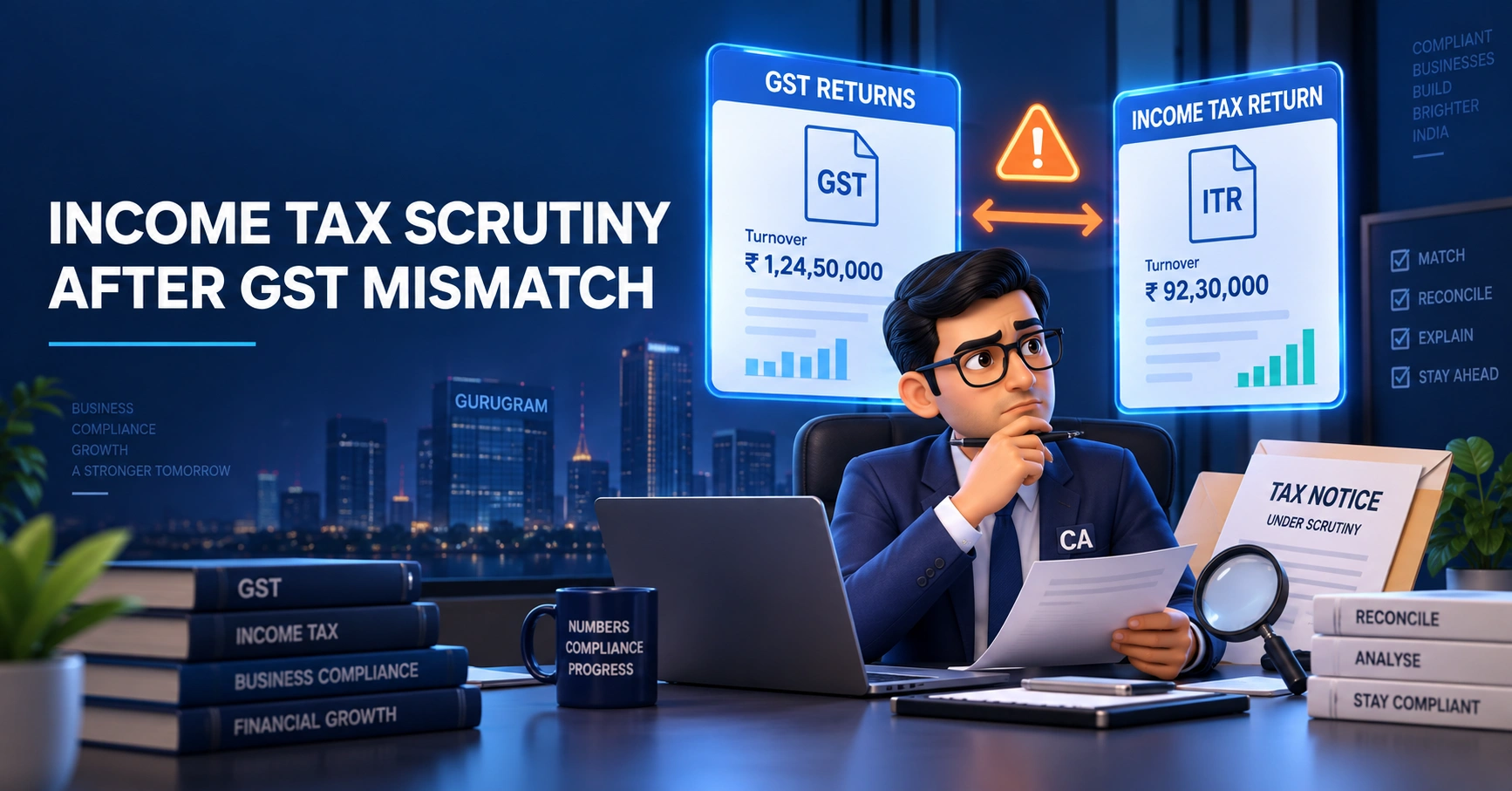
An Income Tax Scrutiny After GST Mismatch can arise when the turnover reported through GST returns does not appear consistent with the business income or sales disclosed in the Income Tax Return. Since information reported under a GSTIN can be connected with the taxpayer’s PAN, tax authorities can use available data to check whether business receipts have been properly disclosed.
A mismatch does not automatically prove tax evasion or concealment of income. GST turnover and accounting revenue may differ for several legitimate reasons, including timing differences, advances, credit notes, unbilled revenue, exempt supplies and the treatment of fixed assets. However, an unexplained difference can invite verification, a compliance communication or an income tax notice.
Businesses should therefore reconcile their GST returns, books of accounts, Annual Information Statement and Income Tax Return before filing the ITR. If a notice has already been issued, the response should explain every material difference with supporting documents.
Income tax scrutiny is a detailed examination of a taxpayer’s return and supporting records. A scrutiny proceeding commonly involves a notice asking the taxpayer to substantiate the income, deductions, expenses or transactions disclosed in the ITR.
In a GST mismatch case, the department may compare the taxpayer’s reported business income with information obtained through GST filings. The official Income Tax Department’s AIS FAQ explains that the Annual Information Statement provides a comprehensive view of information available for a taxpayer. It is intended to display information before return filing, capture taxpayer feedback, promote voluntary compliance and discourage non-compliance.
The official AIS guidance also confirms that GST turnover may appear in AIS under information code EXC-GSTR3B. Consequently, a business should review the GST-related information in AIS rather than checking only Form 26AS.
If GST turnover is substantially higher than the turnover or gross receipts disclosed in the ITR, the difference may require an explanation. The correct response depends on the kind of communication received and the actual reason for the discrepancy.
A GST turnover mismatch in ITR usually becomes visible when figures from GSTR-1, GSTR-3B, GSTR-9, AIS, financial statements and the ITR are compared.
According to the GST Portal’s official guidance, GSTR-1 is a statement of outward supplies furnished by normal and casual registered taxpayers making outward supplies of goods or services. The official GSTR-3B FAQ describes GSTR-3B as a summary return in which taxpayers declare their GST liabilities.
These forms serve GST-reporting purposes, while financial statements and income tax returns follow accounting and income-tax principles. The numbers are therefore related but are not necessarily identical.
GSTR-1 contains details of outward supplies, debit notes, credit notes and amendments. GSTR-3B contains summarized taxable supplies and tax liability. Errors, delayed amendments or an invoice reported in one form but not correctly reflected in another can produce different annual figures.
Before examining the ITR mismatch, a business should first confirm that its GSTR-1 turnover agrees with GSTR-3B after considering all amendments.
An invoice may be reported under GST during one tax period but recognized in the books during another accounting period. Advances received for services, year-end provisions, unbilled revenue and invoices raised after the close of the financial year can create timing differences.
Such differences are not necessarily incorrect. Nevertheless, the taxpayer should maintain a month-wise reconciliation showing when the transaction was recorded in the books, reported under GST and offered for income tax.
Commercial credit notes, GST credit notes, sales returns, discounts and cancelled invoices may not be reflected identically in every record. For example, a commercial credit note recorded in the books may not reduce GST turnover if the conditions for reducing the GST liability are not satisfied.
The reconciliation should separately identify GST credit notes and financial credit notes instead of reducing the total difference without an explanation.
A company or proprietor operating in different states may hold more than one GST registration under the same PAN. The Income Tax Return generally presents the combined results of the taxpayer, whereas GST data may be available GSTIN-wise.
Missing even one GSTIN during reconciliation can create an apparent GST and income tax mismatch. All active, cancelled and surrendered registrations relating to the relevant financial year should be included.
GST returns may contain taxable supplies, zero-rated exports, exempt supplies and other reported transactions. Their tax treatment does not determine whether the related receipt is taxable income under the Income-tax framework.
Businesses should prepare separate reconciliations for domestic taxable sales, exports, exempt supplies and non-GST supplies. Export invoices, shipping bills, foreign inward remittance documents and relevant agreements should be preserved wherever applicable.
The sale of machinery, vehicles or other business assets can be reported as an outward supply under GST. In financial statements, however, only the profit or loss on disposal may appear in the profit and loss account, while the sale value is adjusted against the asset.
This can make GST turnover appear higher than revenue in the financial statements. The fixed-asset register, sale invoice and computation of profit or loss should explain the difference.
No. A mismatch does not automatically result in an income tax scrutiny notice, nor does it automatically establish under-reporting. The department may process information through different compliance and assessment mechanisms depending on the facts.
A taxpayer may receive an intimation relating to return processing, a request for information, a notice for inquiry or a scrutiny notice. A notice under Section 143(2) is generally associated with scrutiny of a filed return, while a notice under Section 142(1) may require a return, accounts, statements or specific information. The eventual assessment may be completed under the applicable scrutiny-assessment provision.
The taxpayer must read the exact section, assessment year, document identification details, response deadline and questions stated in the notice. Generic explanations should not be submitted without understanding what the Assessing Officer has requested.
A successful response begins with verification rather than immediately accepting the department’s figure or denying the mismatch.
Log in directly to the Income Tax e-Filing Portal and verify the notice under the relevant pending action or e-Proceedings section. Check the taxpayer’s PAN, assessment year, issuing authority, deadline and specific information requested.
The Income Tax Department’s e-Proceedings user manual states that registered users can view and submit responses to notices, intimations and letters issued by the Assessing Officer, CPC or another Income Tax Authority.
Download AIS, TIS and Form 26AS for the relevant year. From the GST Portal, obtain filed GSTR-1, GSTR-3B and, where applicable, GSTR-9. Also collect the trial balance, sales register, audited financial statements, ITR schedules and tax-audit report.
The GST Portal’s GSTR-9 manual explains that the annual return contains information concerning purchases, sales, input tax credit, refunds and demands. It can therefore provide an important annual cross-check, where applicable.
Start with the annual turnover appearing in the relevant GST records and reconcile it with revenue in the profit and loss account and turnover disclosed in the ITR.
The reconciliation may include:
Avoid forcing the figures to match. Every adjustment should be commercially and legally explainable and supported by records.
If GST turnover in AIS is inaccurate, confirm whether it relates to the taxpayer’s own GSTIN, an old registration, a cancelled registration or possible PAN misuse. The AIS system provides a facility for taxpayers to submit feedback on displayed information.
Providing AIS feedback is helpful, but it should not be treated as a substitute for responding to a formal notice. If scrutiny proceedings are pending, submit the required explanation and evidence through e-Proceedings within the permitted time.
The response should begin with a brief factual background and then answer each query in the same order as the notice. Attach a turnover-reconciliation statement followed by supporting documents with clear file names and references.
State whether the mismatch is caused by a reporting error, accounting treatment, timing difference or incorrect third-party information. Where an actual omission is discovered, obtain professional advice about the legally available correction or tax-compliance route instead of creating a retrospective explanation unsupported by the records.
Download and preserve the acknowledgement after submission. The official e-Proceedings FAQ confirms that taxpayers can view responses submitted by them or their authorised representatives.
The exact documents depend on the notice, but a typical GST mismatch notice response may require filed ITR acknowledgements and computations, AIS and TIS, Form 26AS, GSTR-1, GSTR-3B, GSTR-9 where applicable, audited financial statements, trial balance, sales ledger and invoice register.
Businesses may also need GSTIN-wise turnover workings, e-invoice data, credit and debit notes, bank statements, export documents, fixed-asset registers, contracts and explanations for exempt or non-GST supplies. When tax audit applies, the relevant tax-audit report and reported turnover should also be checked.
Documents should be arranged year-wise and query-wise. Uploading hundreds of unexplained pages is less useful than providing a concise reconciliation supported by indexed evidence.
The best time to resolve a mismatch is before filing the Income Tax Return. Businesses should reconcile GSTR-1 with GSTR-3B every month and compare annual GST turnover with the books before finalising the financial statements.
Before ITR filing, review GST turnover shown in AIS, include all GST registrations linked with the PAN and document legitimate differences. The sales ledger, e-invoice records, credit notes and GST returns should be reviewed as a connected set of records.
A signed annual reconciliation working paper can become valuable evidence if a question is raised later. It also helps auditors and tax advisers distinguish a genuine reporting difference from unreported revenue.
It is an examination in which the Income Tax Department may seek clarification because GST-related turnover information appears inconsistent with the taxpayer’s ITR, books or financial statements. It does not by itself prove tax evasion.
Yes. The official AIS FAQ confirms that GST turnover can appear in the Annual Information Statement under code EXC-GSTR3B. Taxpayers should review this information before filing their ITR.
Possible reasons include advances, asset sales, multiple GST registrations, timing differences, commercial credit notes, exempt supplies or different accounting presentations. The exact reason must be demonstrated through a GST-to-ITR reconciliation.
Verify the notice on the e-Filing Portal, compare AIS and GST returns with the books, prepare a year-wise reconciliation, attach supporting evidence and submit a point-wise response through e-Proceedings before the stated deadline.
Not necessarily. The two figures are prepared for different reporting purposes. However, every material difference should have a valid explanation and documentary support.
A poorly prepared reconciliation can turn an explainable accounting difference into a prolonged tax proceeding. AVC India can help businesses examine GST returns, AIS information, books of accounts and ITR disclosures, prepare a defensible turnover reconciliation and organize a clear response to the tax authority.
If you have received an income tax scrutiny notice for GST turnover mismatch, do not wait until the response deadline. Visit AVC India to discuss your notice and obtain professional assistance with GST–ITR reconciliation, scrutiny-response preparation and ongoing tax compliance.