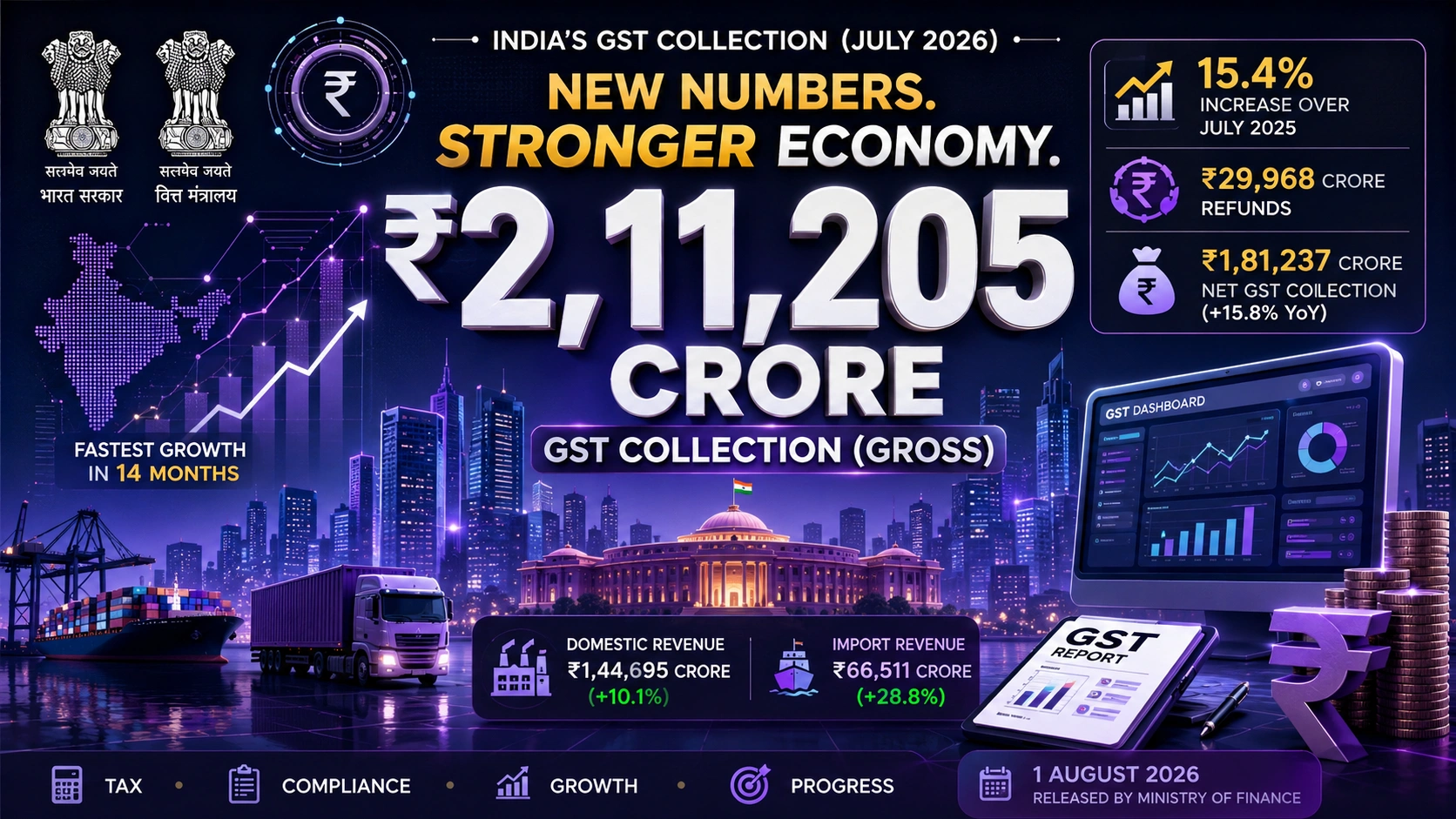
India’s GST collection released in August 2026 which covers the month of July 2026 was ₹2,11,205 crore gross, a 15.4% increase over the ₹1,83,065 crore collected in July 2025. After refunds of ₹29,968 crore, net GST revenue was ₹1,81,237 crore, up 15.8% year-on-year. The data was published on 1 August 2026 by the Ministry of Finance / GSTN. It is the fastest monthly year-on-year growth in 14 months, driven largely by a 28.8% jump in GST on imports.
"August 2026" or "July 2026"? Clearing up the confusion first
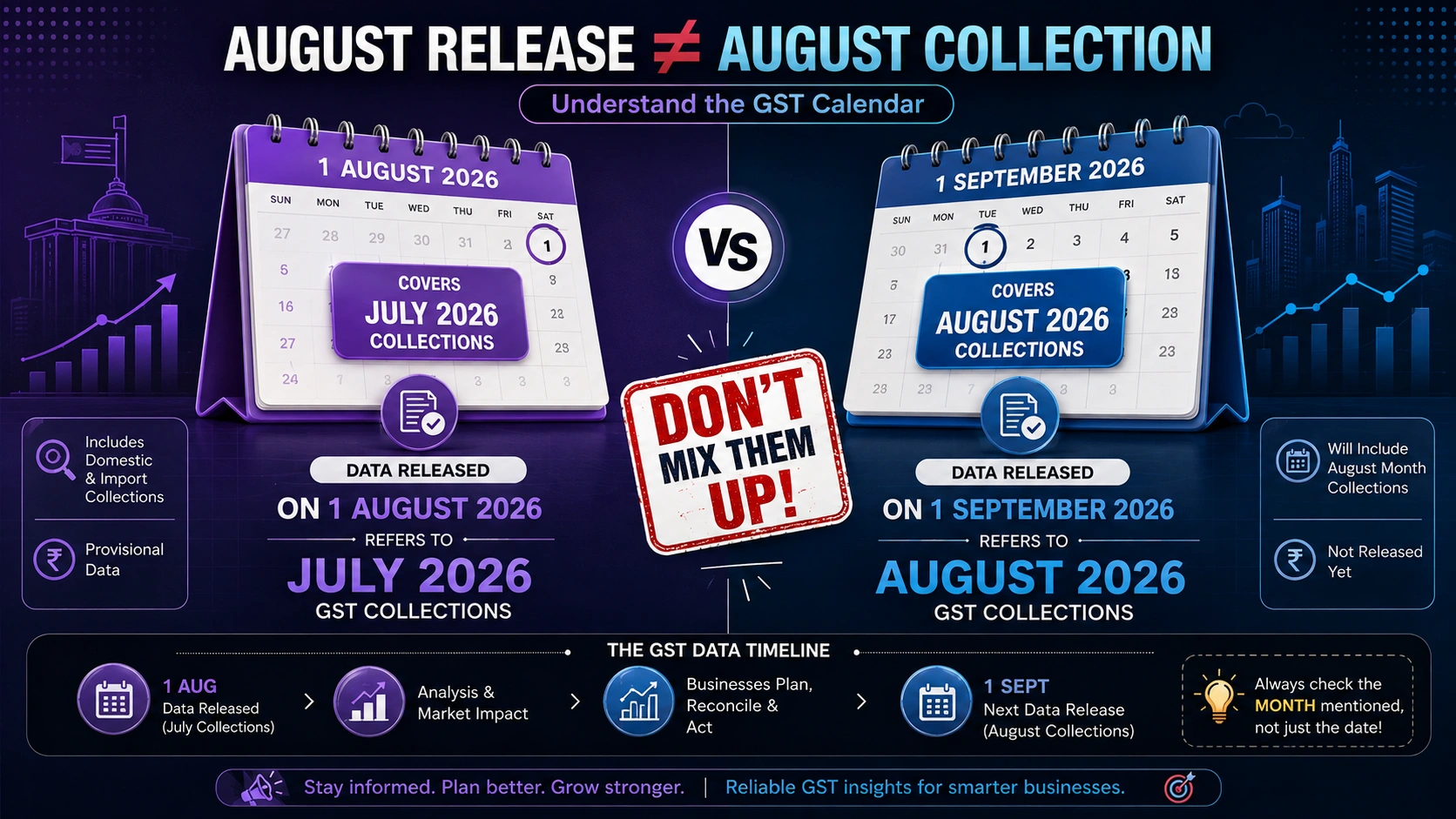
This trips up a lot of business owners, so it is worth thirty seconds. GST collection data is published on or around the 1st of every month, for the month that just ended. So the figures released on 1 August 2026 are the collections for July 2026. When you see headlines about “August GST numbers,” they almost always mean the numbers released in August, not the money collected during August. The actual August 2026 collections will be released around 1 September 2026. Nothing in this article refers to them, because that data does not exist yet. Everything below is the July 2026 collection data released on 1 August 2026. All figures are provisional and may be revised when GSTN finalises the month.
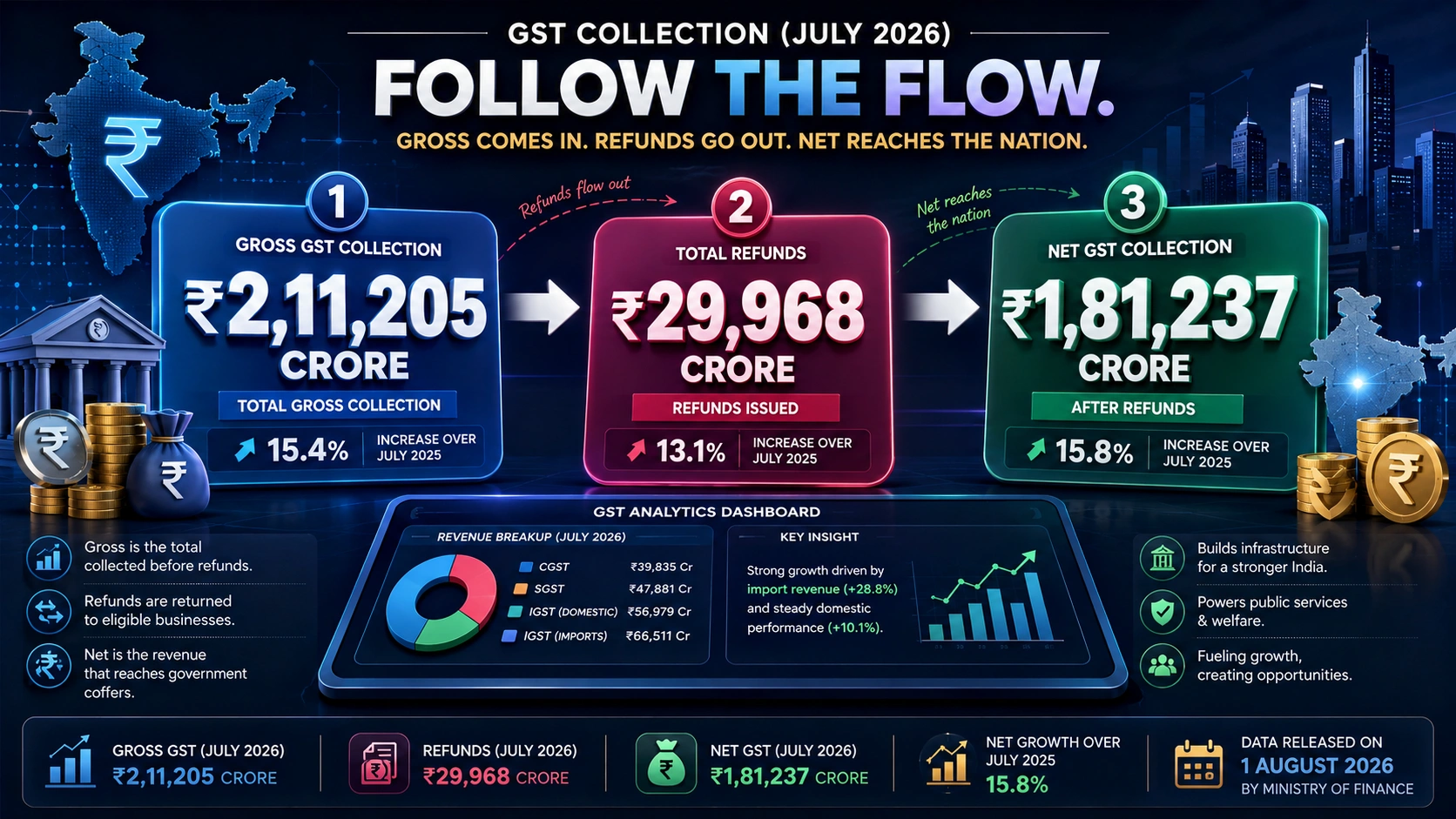
The full breakup: gross, net, and where the money came from
Particulars
July 2025 (₹ crore)
July 2026 (₹ crore)
Growth
Gross Domestic Revenue
1,31,439
1,44,695
+10.1%
Gross Import Revenue (IGST on Imports)
51,626
66,511
+28.8%
Total Gross GST
1,83,065
2,11,205
+15.4%
Total Refunds
26,495
29,968
+13.1%
Net GST (After Refunds)
1,56,570
1,81,237
+15.8%
Component-wise, July 2026 broke down as:
Component
July 2026 (₹ crore)
CGST
39,835
SGST
47,881
IGST — Domestic
56,979
IGST — Imports
66,511
IGST Total
1,23,490
Compensation Cess
Negligible
Notice the last row. Compensation cess has effectively disappeared from monthly collections. That is not an error it is the direct result of, which we cover below. Definition, because the two numbers get mixed up constantly:Gross GST collection is everything deposited before refunds are paid out. Net GST collection is gross minus refunds issued it is the figure that actually reaches government coffers, and it is the one to watch if you are reading the numbers as an economic signal.
What Drove the 15.4% Growth in GST Collection in August 2026?
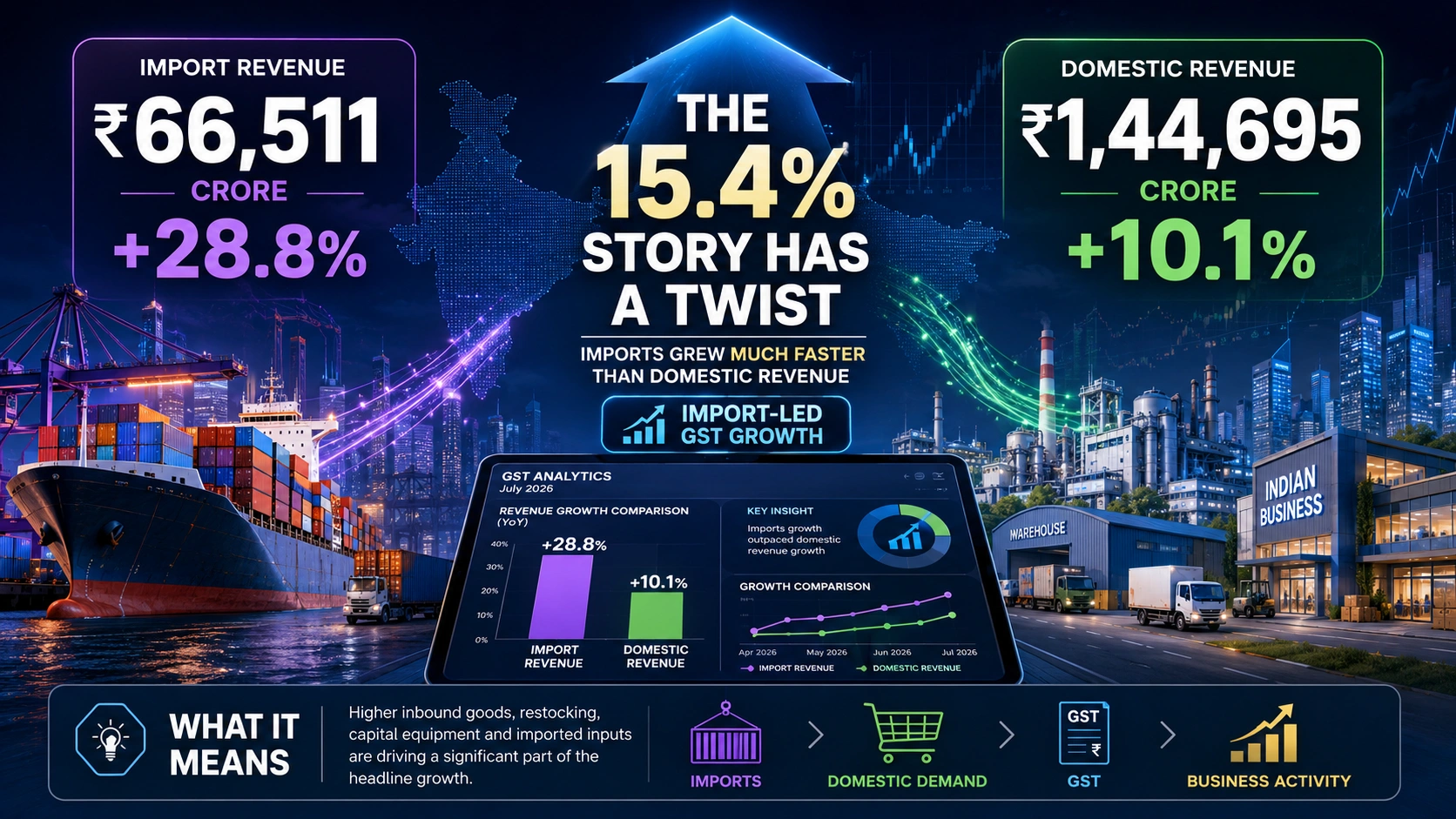
Here is the nuance almost no news report mentions. The headline growth is import-led, not domestic-led.
Gross domestic revenue grew 10.1%
Gross import revenue grew 28.8%
Both are healthy. But a 10.1% domestic number and a 28.8% import number tell two different stories. The domestic figure reflects steady, unspectacular internal consumption and B2B activity. The import figure reflects a sharp rise in inbound goods restocking, capital equipment, and input purchases by Indian manufacturers. What this means practically: if you are an importer or a manufacturer dependent on imported inputs, your IGST outflow at the customs stage is up materially year-on-year. That is cash leaving early, recovered later through input tax credit. Plan the gap. If you sell purely domestically into the Indian market, the honest read is that demand is growing at roughly 10% in nominal tax terms solid, but not the boom the 15.4% headline implies.
Refunds are up 13.1% and that matters for your working capital
Refunds issued in July 2026 totalled ₹29,968 crore, up 13.1%. Within that:
Domestic refunds: ₹17,680 crore (+7.3%)
Export / ICEGATE refunds: ₹12,288 crore (+22.7%)
Net of refunds, domestic revenue was ₹1,27,015 crore (+10.5%) and net customs GST was ₹54,223 crore (+30.3%). Export refunds growing at 22.7% three times the domestic refund growth rate indicates the export refund pipeline is moving faster than it has in a while. If your refund claims have been sitting, this is a good month to push them.
Three things that decide whether your refund moves quickly:
GSTR-1 and GSTR-3B must agree. Mismatches are the single most common reason a refund application stalls at the officer’s desk.
Shipping bill and GSTR-1 export invoice data must match on ICEGATE. Invoice number, date, value, and port code. One digit off and the transmission fails silently.
File the RFD-01 with a complete annexure set the first time. A deficiency memo resets your clock, it does not pause it.
State
July 2025 (₹ cr)
July 2026 (₹ cr)
Growth
Haryana
9,502
11,892
+25%
Gujarat
10,840
12,923
+19%
Uttar Pradesh
8,360
9,651
+15%
Maharashtra
28,551
32,210
+13%
Karnataka
12,408
13,854
+12%
Delhi
5,973
6,460
+8%
Tamil Nadu
10,536
10,414
−1%
Telangana (+19%), Kerala (+16%) and Punjab (+16%) also outperformed. On the other side, Andhra Pradesh (−5%), Madhya Pradesh (−10%), Uttarakhand (−18%), Himachal Pradesh (−22%) and Sikkim (−59%) contracted.
The Haryana number is the one worth pausing on. A 25% year-on-year rise is the highest among all major states, and it is well ahead of the 15.4% national figure. Haryana’s GST base sits heavily in the Gurgaon–Manesar–Faridabad corridor: auto and auto-component manufacturing, corporate head offices, IT and business services, logistics, and warehousing. For a Gurgaon or wider NCR business, this is a two-sided signal. Regional B2B activity is genuinely strong that is a real demand indicator you can plan procurement and hiring against. But a state whose collections are growing at 25% is also a state where the department has visible momentum, and where compliance attention tends to follow revenue.
The FY 2026-27 trend so far
Month
Gross GST (₹ crore)
YoY Growth
April 2026
2,43,286
+8.7%
May 2026
1,94,184
—
June 2026
1,94,812
+13.9%
July 2026
2,11,205
+15.4%
Cumulative April–July FY 2026-27: gross ₹8,42,905 crore (+10.1%), net ₹7,21,457 crore (+9.2%). For context, FY 2025-26 closed at ₹22,27,096 crore gross (+8.3%) and ₹19,34,766 crore net (+7.1%).
April is always the outlierit captures year-end March transactions and annual true-ups, which is why ₹2.43 lakh crore was an all-time monthly high. Stripping that out, the run rate has climbed steadily from ~₹1.94 lakh crore in May and June to ₹2.11 lakh crore in July, with the growth rate accelerating each month.
Why the numbers look like this: GST 2.0, cess, and the 1 August rule changes
Three structural factors sit behind the July data.
GST 2.0 reshaped the rate structure. The 56th GST Council meeting (3 September 2025) collapsed the four-slab system into a 5% and 18% structure, with a 40% rate on sin and luxury goods, effective 22 September 2025. July 2026 is therefore the tenth month of collections under the new rates the year-on-year comparison is now clean, with both periods no longer straddling the transition in the same way earlier months did.
Compensation cess was scrapped on all goods except tobacco. That is why the cess line has all but vanished from the monthly tables. If you are comparing today’s component breakup against pre-September-2025 data, the missing cess is a structural change, not a collections shortfall.
New e-invoice and e-Way Bill rules took effect on 1 August 2026 mandatory Ship-to GSTIN reporting, tighter field validations, and the option to voluntarily close an e-Way Bill. These do not affect the July numbers, but they affect every invoice you have raised since. More on that next.
What this means for your business
This is where a collection figure stops being a news item and becomes something you act on.
1. Scrutiny risk is rising, and it is data-driven
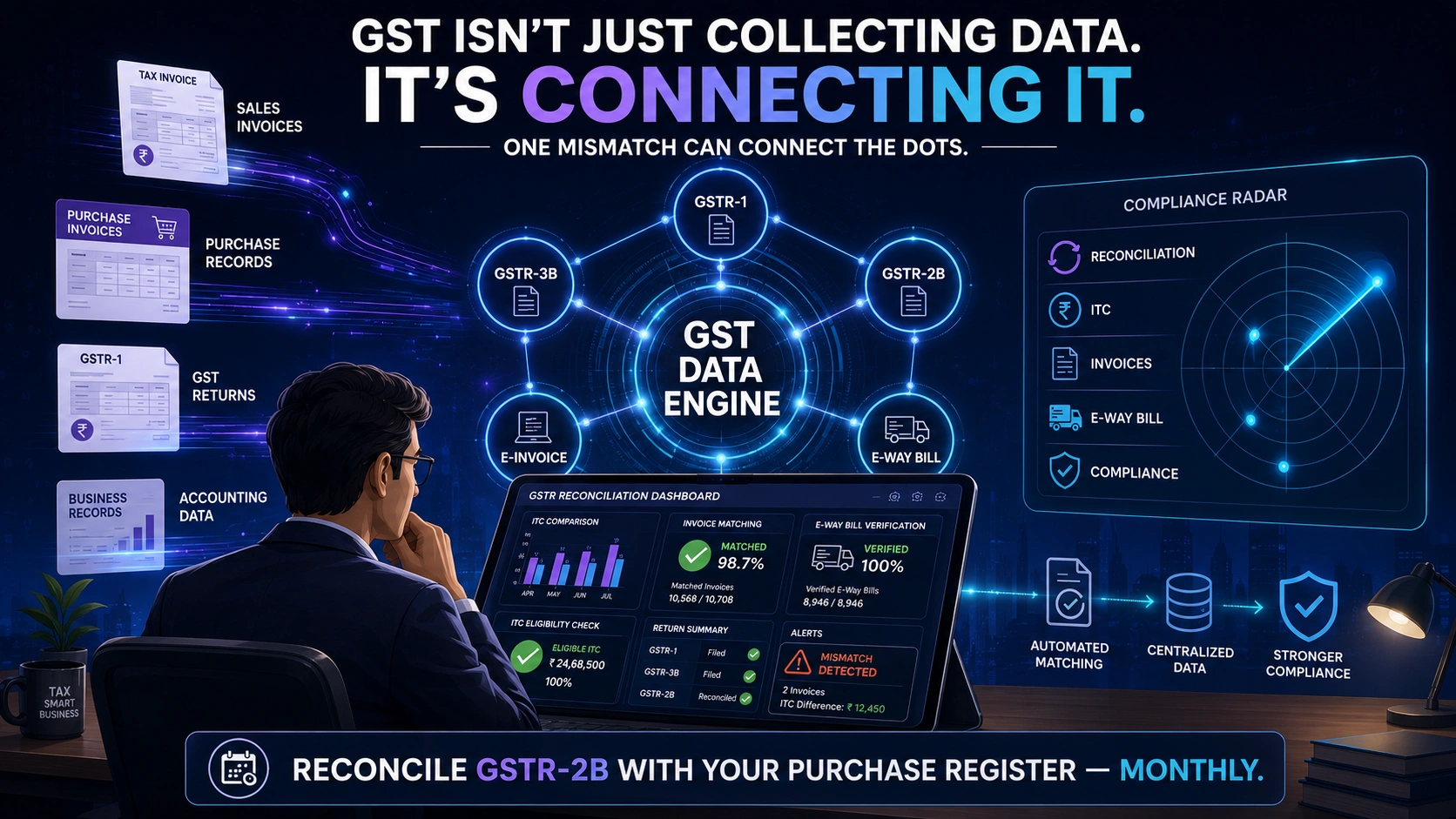
Record collections are not just a demand story. They are also a compliance-enforcement story. GSTN’s analytics now cross-match GSTR-1, GSTR-3B, GSTR-2B, e-invoice data and e-Way Bill movement automatically. The 1 August 2026 tightening Ship-to GSTIN and stricter validations adds another matched field to that engine.
Do this: reconcile GSTR-2B against your purchase register monthly, not annually. An annual reconciliation finds the same errors eleven months too late, after the ITC window has closed.
2. Watch your ITC after the rate changes
Where GST 2.0 moved a supply to a lower rate or made it exempt, the input tax credit position may have changed with it. Credit attributable to exempt supplies has to be reversed under Rules 42 and 43. Businesses with a mixed supply portfolio are the most exposed here, and reversal errors compound quietly across quarters.
Do this: run a rate-change impact review across your output supplies since 22 September 2025 and confirm your reversal working is correct.
3. Treat refunds as a working-capital lever
With export refunds moving 22.7% faster year-on-year, a clean claim now converts to cash meaningfully sooner than a messy one. For an exporter or a business in an inverted duty structure, that is a real balance-sheet difference.
4. Read the sectoral signal
Import-led growth of 28.8% points to restocking and capital investment. Haryana at +25%, Gujarat at +19% and UP at +15% suggest manufacturing and logistics belts are absorbing that inventory. Tamil Nadu’s −1% is worth watching if you sell into that market. Use these as directional demand cues for procurement and inventory planning not as a forecast.
5. If you are in Gurgaon or NCR
Haryana’s 25% growth means your competitors’ turnover is likely rising too, and that filing accuracy matters more than it did a year ago. The businesses that get into trouble are rarely the ones evading tax they are the ones with sloppy reconciliation, mismatched e-Way Bills, and ITC claimed against invoices the supplier never uploaded.
Import IGST grew 28.8% against 10.1% domestic growth, reflecting higher inbound goods volumes restocking, capital equipment and imported inputs rather than a proportionate surge in domestic consumption.
₹22,27,096 crore gross (+8.3% over FY 2024-25) and ₹19,34,766 crore net (+7.1%).
Need help acting on this?
If the reconciliation, ITC reversal, or refund points above raised a question about your own filings, that is worth a conversation rather than a guess.
AVC India (Aggarwal Varun & Co.) has been advising businesses on GST and tax compliance from Gurgaon since 2009, with a team of 20+ qualified Chartered Accountants, CPAs and finance professionals. We work with manufacturers, exporters, and service businesses across Haryana and the wider NCR.
Book a free GST health check a structured review of your GSTR-2B reconciliation, ITC position, and open refund claims.