
-
-
Tax Services
-
Audit & Assurance
-
Business Setup
-
Accounting & Payroll
-
Advisory
-
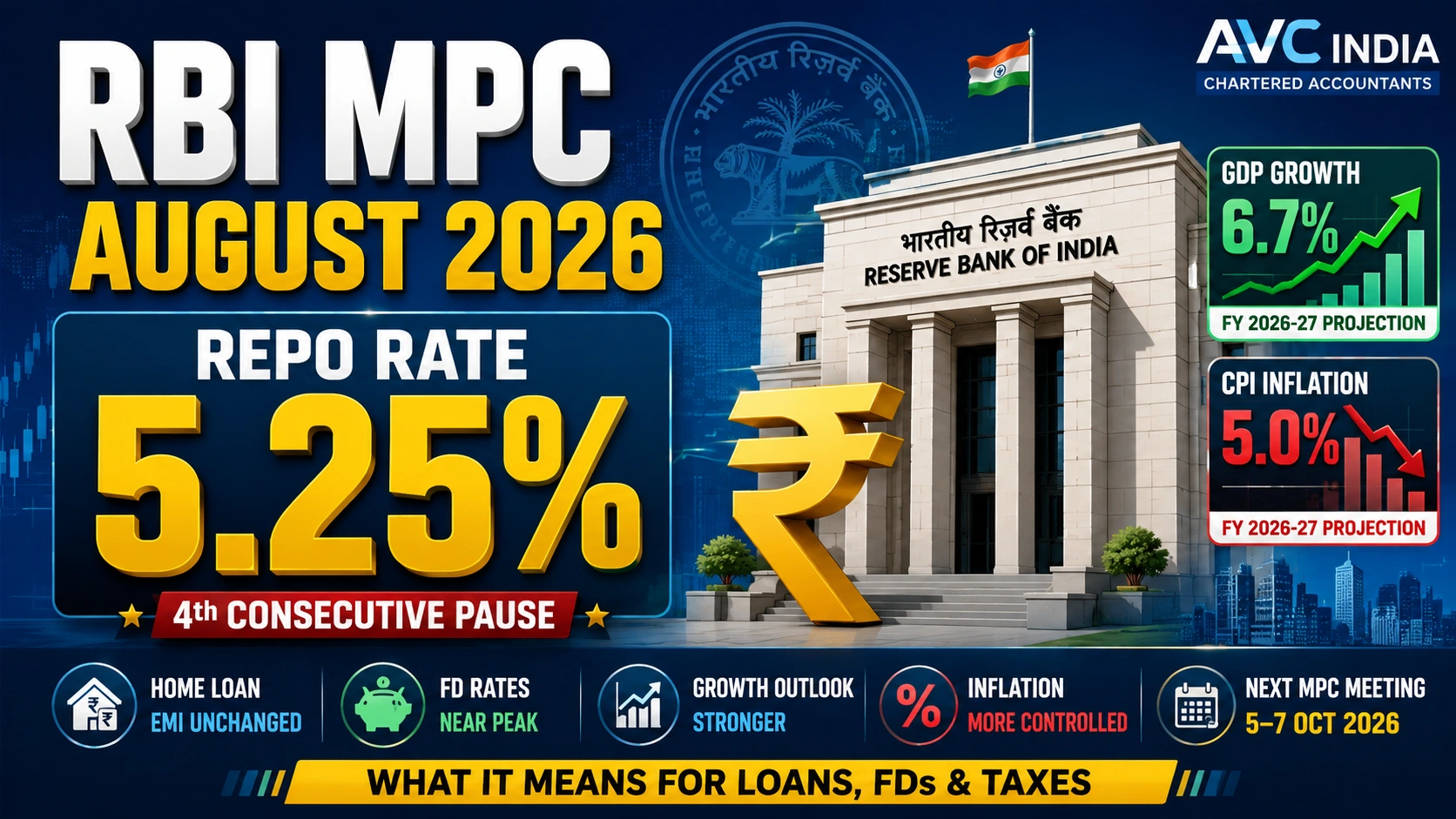
The RBI’s Monetary Policy Committee kept the repo rate unchanged at 5.25% on 5 August 2026. The decision was unanimous (6–0), the stance stayed neutral, and this was the fourth consecutive pause. The RBI raised its FY 2026-27 GDP growth forecast to 6.7% and trimmed its CPI inflation forecast to 5.0%. For borrowers, this means home loan EMIs stay where they are no cut, no increase. The next MPC meeting is 5–7 October 2026.
| Rate | Level after August 2026 Policy | Change |
|---|---|---|
| Repo Rate | 5.25% | Unchanged |
| Standing Deposit Facility (SDF) | 5.00% | Unchanged |
| Marginal Standing Facility (MSF) | 5.50% | Unchanged |
| Bank Rate | 5.50% | Unchanged |
| Cash Reserve Ratio (CRR) | 3.00% | Unchanged |
| Statutory Liquidity Ratio (SLR) | 18.00% | Unchanged |
| Policy Stance | Neutral | Unchanged |
| Vote | 6–0 (Unanimous) | — |
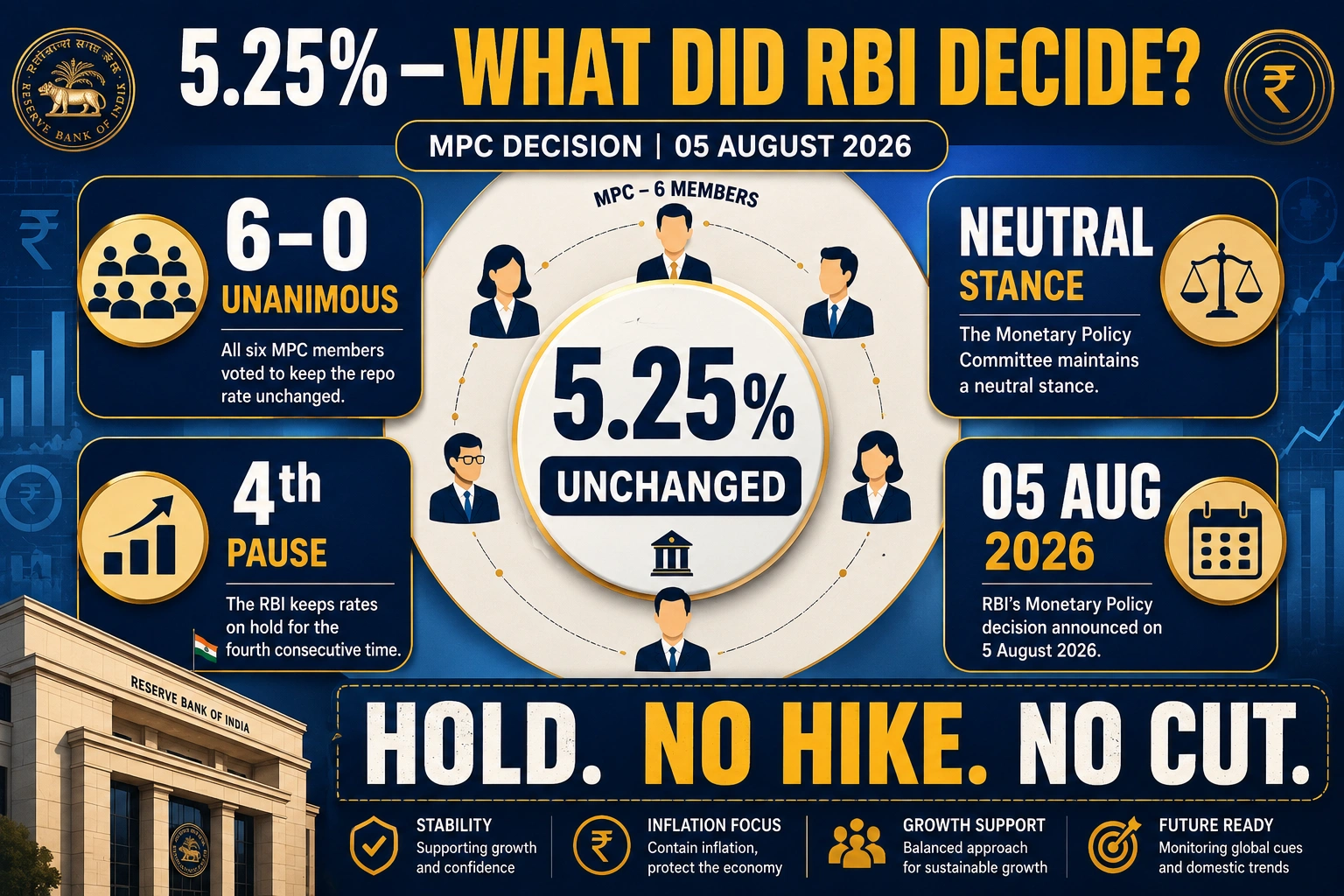
The Monetary Policy Committee (MPC) is the six-member body inside the Reserve Bank of India that sets India’s benchmark interest rate the repo rate, the rate at which the RBI lends short-term money to commercial banks. It meets six times a financial year. That single number quietly sets the price of almost everything you borrow and earn interest on. Since October 2019, most floating-rate retail loans in India home loans, car loans, many MSME loans must be linked to an external benchmark, and for most banks that benchmark is the repo rate. So when the repo moves, your EMI eventually moves. When it doesn’t move, your EMI doesn’t either. The August 2026 meeting mattered for a specific reason: retail inflation had just crossed the RBI’s 4% target for the first time in roughly 17 months, and wholesale inflation had hit a record high. Markets wanted to know whether the RBI would start tightening again. It didn’t. The 62nd MPC meeting was held on 3–5 August 2026, with Governor Sanjay Malhotra announcing the decision at 10:00 am on Wednesday, 5 August 2026, followed by a press conference at noon.
All six MPC members voted to hold. The stance remained neutral, which in RBI language means the committee has kept the door open in both directions it can cut or hike at the next meeting depending on the data. Governor Malhotra’s framing was that the MPC wanted greater clarity on the inflation outlook before acting. His argument: the rise in inflation was driven largely by food and fuel, with little sign that price pressures had spread into the wider economy. At the press conference he described the RBI as “neither dovish nor hawkish”, saying policy would continue to be guided by headline inflation.
Who is on the MPC (August 2026):
| Member | Role |
|---|---|
| Sanjay Malhotra | RBI Governor (Chairperson) |
| Poonam Gupta | Deputy Governor, in charge of monetary policy |
| Indranil Bhattacharyya | Executive Director, Monetary Policy Department (ex-officio) |
| Ram Singh | Director, Delhi School of Economics |
| Saugata Bhattacharya | Economist, former Chief Economist, Axis Bank |
| Nagesh Kumar | Director & CEO, Institute for Studies in Industrial Development |
The three external members were appointed for four years from October 2024. Indranil Bhattacharyya joined as the internal ex-officio member after Rajiv Ranjan superannuated at the end of September 2025.
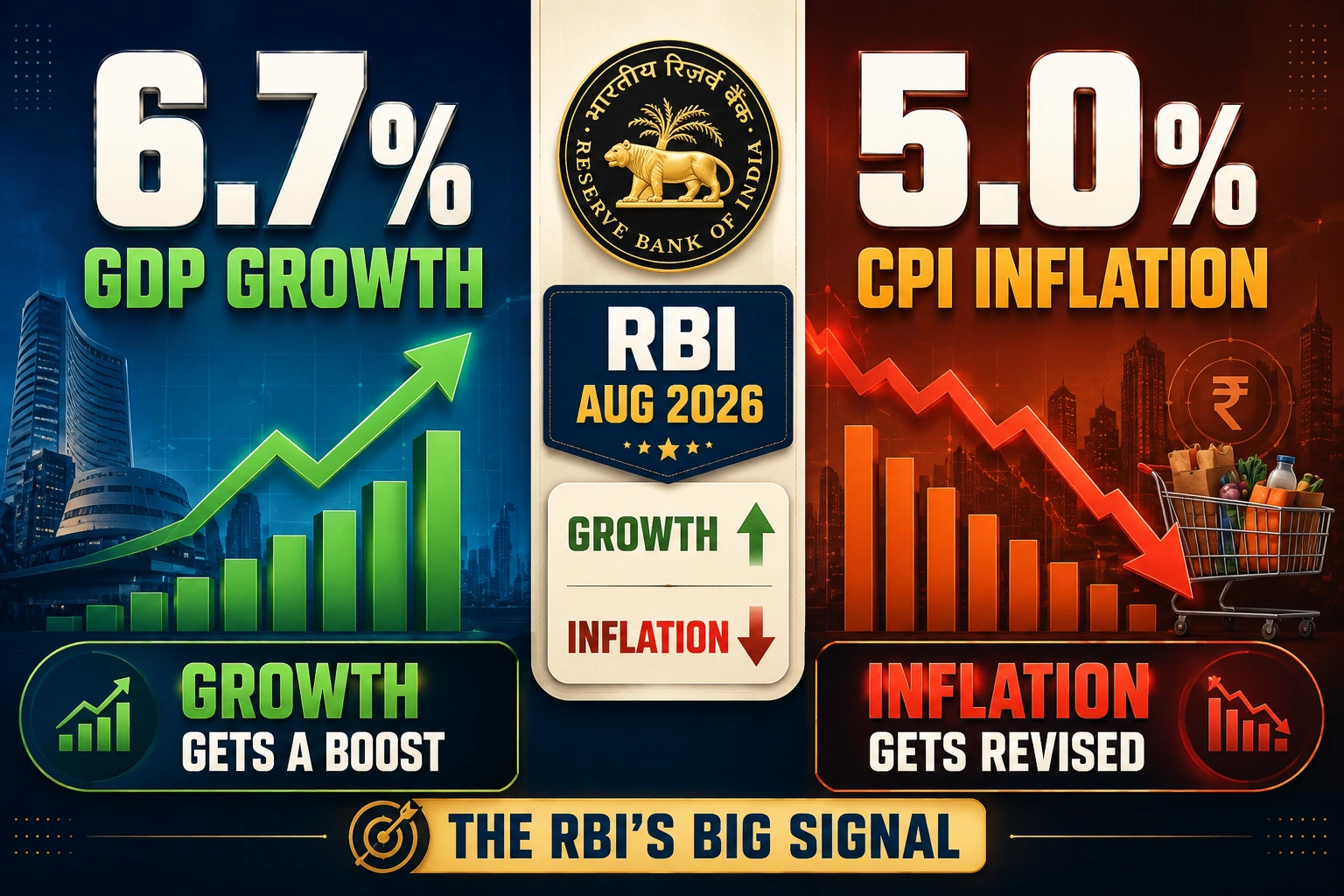
This is where the August 2026 policy was quietly positive: the RBI raised growth and lowered inflation at the same time.
Real GDP growth projection FY 2026-27: 6.7% (raised from 6.6% in the June 2026 policy)
| Quarter | Projected GDP Growth |
|---|---|
| Q1 FY27 | 7.0% |
| Q2 FY27 | 6.4% |
| Q3 FY27 | 6.5% |
| Q4 FY27 | 6.8% |
| Quarter | Projected CPI Inflation |
|---|---|
| Q2 FY27 | 4.7% |
| Q3 FY27 | 5.9% (Expected Peak) |
| Q4 FY27 | 5.5% |
| Q1 FY28 | 5.3% |
Core inflation (excluding food and fuel) is projected at around 4.3% for the year.
A fair question and the answer is in the composition of the inflation, not just its level.
That last line is the whole story. Food and fuel are supply-side shocks; core inflation is the demand signal. With core this subdued, the RBI reads current inflation as temporary and imported rather than as an overheating economy. Raising rates would not lower the price of crude oil or vegetables it would only slow growth that is otherwise doing well. The Governor also flagged the external risks the committee is watching: volatile crude oil, renewed conflict in West Asia, an uneven monsoon with El Niño risk, a hawkish US Federal Reserve and a stronger dollar. On the rupee, he noted strong FCNR(B) deposit inflows and confirmed the scheme will not be closed early.
| Effective Date | Repo Rate | Change |
|---|---|---|
| 8 Apr 2022 | 4.00% | Unchanged |
| 4 May 2022 | 4.40% | +40 bps |
| 8 Jun 2022 | 4.90% | +50 bps |
| 5 Aug 2022 | 5.40% | +50 bps |
| 30 Sep 2022 | 5.90% | +50 bps |
| 7 Dec 2022 | 6.25% | +35 bps |
| 8 Feb 2023 | 6.50% | +25 bps |
| Apr 2023 – Dec 2024 | 6.50% | Long pause |
| 7 Feb 2025 | 6.25% | −25 bps |
| Apr 2025 | 6.00% | −25 bps |
| Jun 2025 | 5.50% | −50 bps |
| Aug & Oct 2025 | 5.50% | Unchanged |
| 5 Dec 2025 | 5.25% | −25 bps |
| Feb / Apr / Jun 2026 | 5.25% | Unchanged |
| 5 Aug 2026 | 5.25% | Unchanged (4th consecutive pause) |
The takeaway for borrowers: rates have already fallen 125 basis points from the 6.50% peak. If you took a floating-rate home loan in 2023 and have never checked your current repo rate in India or your current loan rate, you may be paying more than you need to. That is a conversation with your bank, not with the RBI.
Alongside the RBI monetary policy August 2026 rate decision, the RBI announced measures in its Statement on Developmental and Regulatory Policies. These matter more to businesses and CA clients than the RBI repo rate August 2026 itself.
Also said at the press conference (not formal policy announcements):
The muted reaction is itself the signal: a hold was widely expected, and the softer inflation forecast alongside a higher growth forecast was read as mildly supportive for bonds.
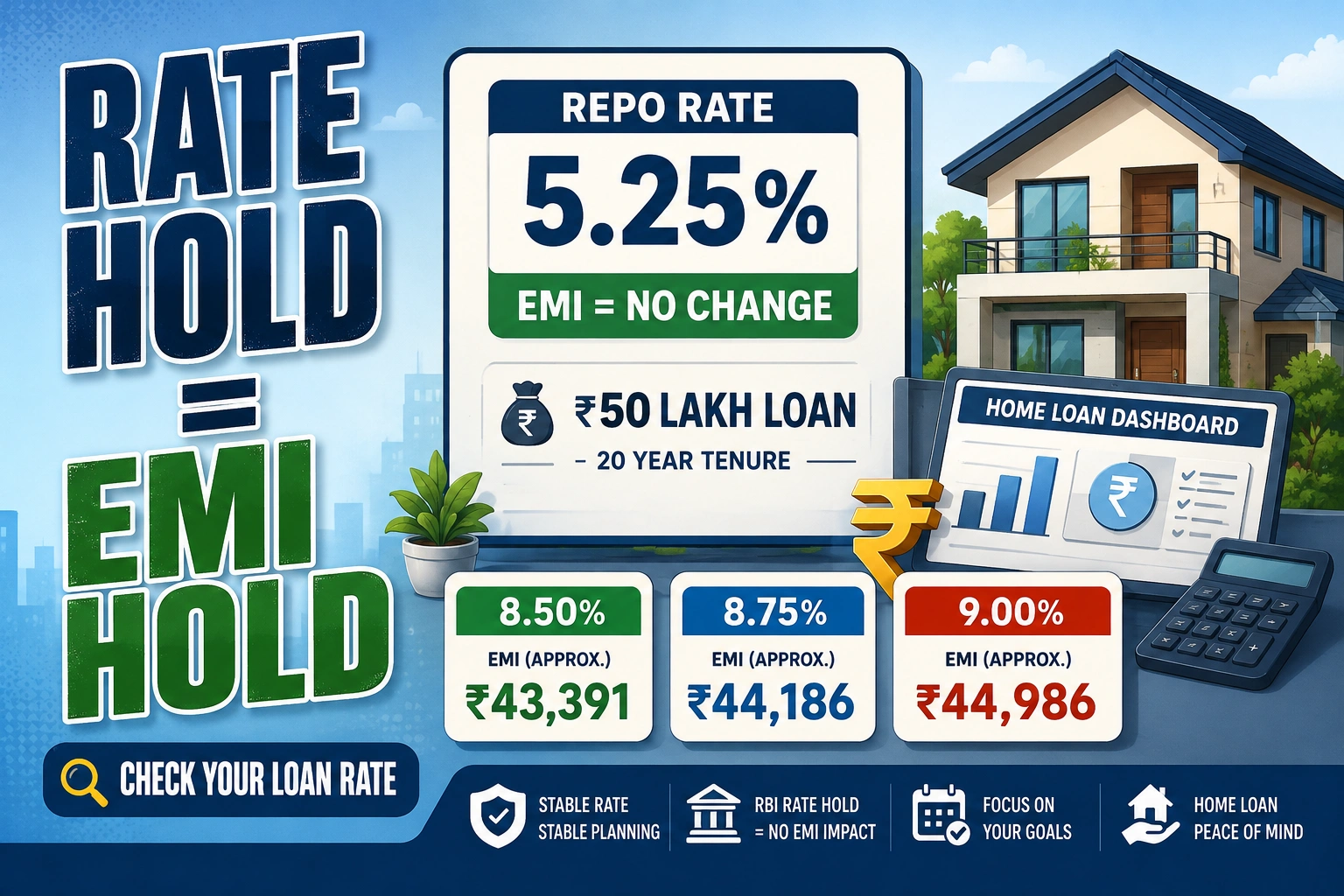
Direct answer: your EMI does not change because of this policy. With the repo held at 5.25%, repo-linked (EBLR/RLLR) home loan rates stay where they are. No relief but no increase either, and no reason to rush into a refinance. How the transmission actually works. Most floating-rate home loans sanctioned after October 2019 are linked to an External Benchmark Lending Rate (EBLR), usually the repo. Your rate = repo + the bank’s spread. Banks must reset repo-linked loans at least once every three months, so a repo cut reaches you within a quarter. MCLR-linked loans (mostly older, pre-2019) move slower reset periods are typically six months or a year, and the pass-through is partial.
What each 25 basis point move is actually worth (20-year tenure):
| Loan Amount | EMI at 8.50% | EMI at 8.75% | EMI at 9.00% | Monthly Saving per 25 bps Cut | Total Interest Saved over 20 Years |
|---|---|---|---|---|---|
| ₹30 Lakh | ₹26,035 | ₹26,511 | ₹26,992 | ~₹477 | ~₹1.14 Lakh |
| ₹50 Lakh | ₹43,391 | ₹44,186 | ₹44,986 | ~₹794 | ~₹1.91 Lakh |
| ₹75 Lakh | ₹65,087 | ₹66,278 | ₹67,479 | ~₹1,192 | ~₹2.86 Lakh |
Rule of thumb: at around 8.5% over 20 years, every ₹1 lakh of loan costs roughly ₹868 a month. At 9.0%, about ₹900.
When a rate cut does come, your bank will usually default to keeping the EMI the same and shortening the tenure, unless you ask otherwise. Most borrowers never realise they had a choice. Keep the EMI, cut the tenure you save far more total interest. On a ₹50 lakh, 20-year loan, holding your EMI steady through a single 25 bps cut (8.75% → 8.50%) closes the loan roughly 11 months early. Reduce the EMI, keep the tenure you free up monthly cash flow. This is the right call if your income is tight, if you have higher-cost debt (credit cards, personal loans) to clear first, or if you can invest the difference at a better return.
What to actually do this quarter, regardless of the RBI:
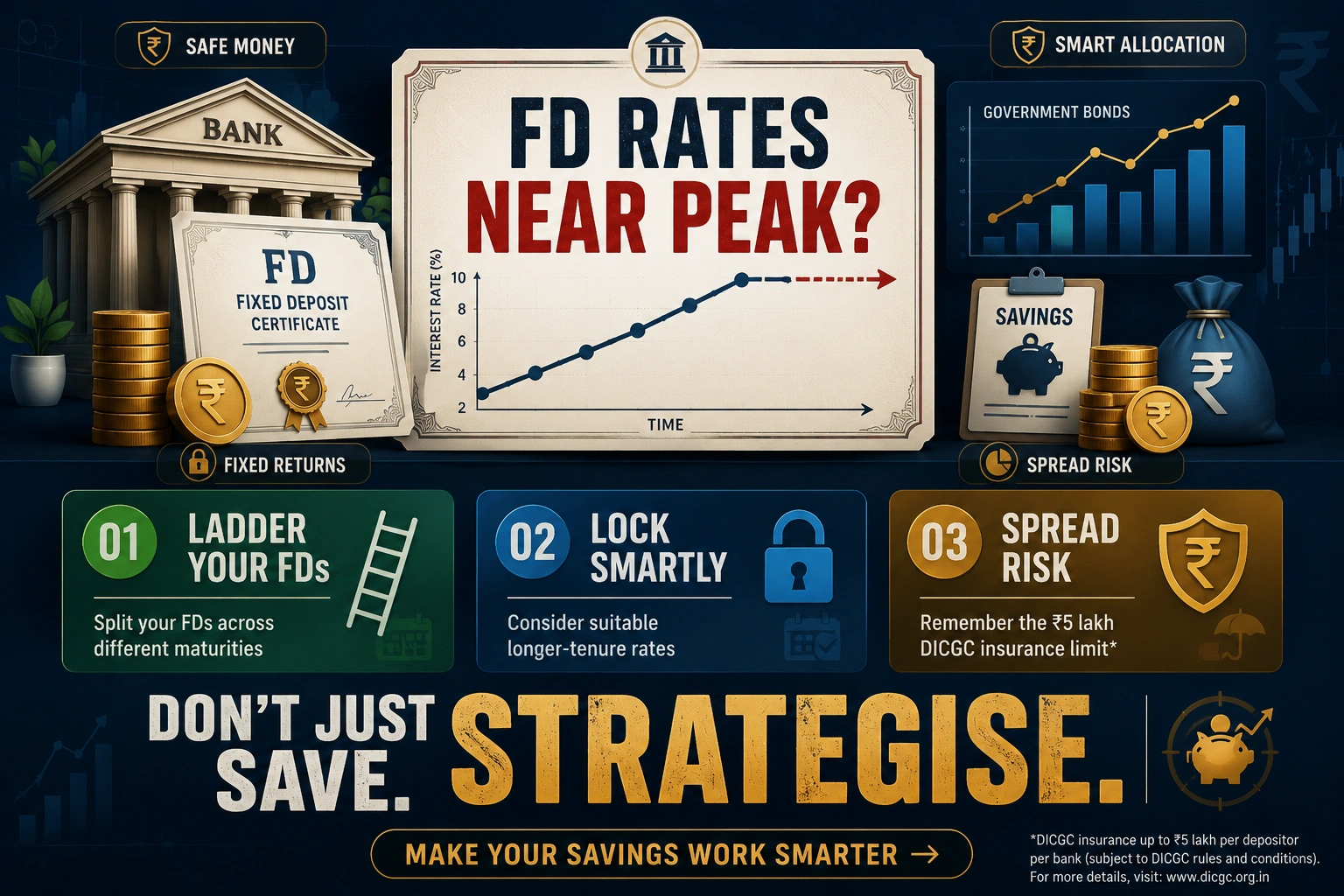
Direct answer: fixed deposit rates are at or near their peak for this cycle. If you have been waiting for a better rate, the wait is probably over. Banks cut deposit rates when the repo falls. With the repo down 125 bps from its peak and the RBI in neutral-to-easing territory, the risk for savers is asymmetric rates are far more likely to drift down than up.
Approximate senior-citizen FD rates, August 2026 (verify current rates with the bank before investing)
| Bank | Senior Citizen FD Rate (Approx.) |
|---|---|
| SBI | ~7.05% |
| HDFC Bank | ~7.00% |
| ICICI Bank | ~7.10% |
| Axis Bank | ~7.25% |
| Bank of Baroda | ~7.25% |
| Kotak Mahindra Bank | ~7.30% |
| Select Small Finance Banks | Up to ~8.50% |
Three things savers should do now:
Senior citizens should also compare the Senior Citizens’ Savings Scheme, which pays around 8.2%, against bank FDs and remember that interest income is fully taxable at your slab rate, with a deduction available on interest from deposits under Section 80TTB.
Debt mutual funds and bonds. Bond prices and yields move in opposite directions, so a peaking or falling rate cycle is generally supportive of bond prices. The 10-year G-Sec around 6.78% and the RBI’s lower inflation forecast were read as mildly positive for duration. Investors closer to retirement, or with a defined time horizon, often prefer target-maturity funds where the maturity is matched to the goal that reduces the impact of interim rate swings.
Equity markets. Rate stability is generally supportive for rate-sensitive sectors: banks and NBFCs (funding costs and credit growth), real estate and housing finance (affordability), and autos (financed purchases). Stable rates plus a raised GDP forecast is a constructive combination but a policy decision is one input among many, and no one should rebuild a portfolio around a single MPC meeting. Sovereign Gold Bonds and G-Secs. Stable yields mean stable valuations for existing holdings. A note on how to use this. The right allocation depends on your goal, horizon, tax slab and risk tolerance not on the last policy statement. If a rate view is driving a large portfolio decision, that decision deserves a conversation with a qualified adviser first.
This is where the August 2026 policy is more useful than most coverage suggests. Three practical points for businesses and individual taxpayers:
The lending-rate harmonisation the RBI proposed in this policy is also worth tracking. If reset dates and interest computation are standardised across lenders, borrowers get faster and more visible pass-through of future rate cuts which will change how businesses time their refinancing. If you would like your interest cost, loan structure and deduction position reviewed together, AVC India’s chartered accountants in Gurgaon work on exactly this see our income tax return filing services and audit services.
NRIs. The Governor confirmed the FCNR(B) deposit scheme will not be closed early, with inflows described as robust. A stable rupee and steady deposit returns make FCNR(B) and NRE deposits a reasonable place for parked funds. Note that NRE and FCNR interest is exempt from Indian income tax while you remain a non-resident; NRO interest is taxable and subject to TDS.
Homebuyers. Rate stability plus 125 bps of cuts already delivered has improved affordability compared with 2023. If you are buying, this is a reasonable window to lock in a sanction but negotiate the spread, not just the headline rate, since the spread is what stays with you for the life of the loan.
The next Monetary Policy Committee meeting is scheduled for 5–7 October 2026, with the decision announced on 7 October 2026. After that, the remaining meeting in FY 2026-27 falls in December 2026, with the final meeting of the cycle in February 2027. What to watch between now and then: the trajectory of food and fuel inflation, monsoon progress and its effect on kharif output, crude oil prices, the US Federal Reserve’s direction, and the rupee. Since inflation is projected to peak in Q3 (October–December 2026) before moderating, a near-term cut looks unlikely but the neutral stance means the RBI has deliberately kept both options open.
The repo rate is 5.25%, unchanged at the August 2026 MPC meeting held on 3–5 August 2026. It has been at this level since the December 2025 cut, making August 2026 the fourth consecutive pause.
The MPC voted unanimously (6–0) to keep the repo rate at 5.25% and retain a neutral stance. It raised the FY 2026-27 GDP growth forecast to 6.7% and lowered the CPI inflation forecast to 5.0%.
The next MPC meeting is scheduled for 5–7 October 2026, with the decision announced on 7 October 2026.
No. With the repo rate unchanged, repo-linked (EBLR) home loan rates stay the same, so your EMI does not change. It also does not increase.
On a ₹50 lakh, 20-year loan, a 25 basis point cut lowers the EMI by roughly ₹794 a month and saves about ₹1.91 lakh in total interest over the full tenure.
Reducing the tenure saves substantially more total interest. Reducing the EMI improves monthly cash flow. Choose tenure reduction if your cash flow is comfortable; choose EMI reduction if it is not.
EBLR links your loan rate directly to an external benchmark, usually the repo, and must be reset at least once a quarter. MCLR is an internal bank benchmark with a longer reset period and slower, partial transmission. EBLR generally passes rate cuts through faster.
The repo rate is what banks pay to borrow short-term funds from the RBI. The reverse repo is what banks earn on funds parked with the RBI. In the current framework, the Standing Deposit Facility (SDF), at 5.00%, is the operative floor of the corridor.
A neutral stance means the MPC has not committed to a direction. It can cut or raise rates at the next meeting depending on incoming inflation and growth data as opposed to an accommodative stance (bias to cut) or withdrawal of accommodation (bias to tighten).
With the repo down 125 basis points from its peak and rates near a cycle top, deposit rates are more likely to fall than rise. Laddering across tenures and locking longer tenures for money you do not need soon is generally the more resilient approach than one large short-tenure deposit.
The August 2026 policy is a “no news is good news” policy. Rates are stable, growth was revised up, inflation was revised down, and the RBI is watching food and fuel rather than reacting to them. That leaves the useful decisions on your side of the table, not the RBI’s: check the spread on your home loan, decide between EMI and tenure before your bank decides for you, ladder your deposits while rates are still near their peak, and make sure you are actually claiming the interest deduction you are entitled to.
AVC India (Aggarwal Varun & Co.) is a chartered accountancy firm in Gurgaon, founded in 2009 by CA Varun Aggarwal, working with individuals, startups and growing businesses across India on taxation, audit, and compliance. If you want your loan structure, interest cost and tax position reviewed together whether that is optimising a Section 24(b) claim, comparing tax regimes, or planning working-capital costs for the year talk to our team.
Sources: Reserve Bank of India Monetary Policy Statement, 5 August 2026 (rbi.org.in) · RBI Statement on Developmental and Regulatory Policies, August 2026 · Ministry of Statistics and Programme Implementation, CPI release for June 2026 · Office of the Economic Adviser, WPI release for June 2026.
This article is for general information and does not constitute investment, tax or legal advice. Interest rates, deposit rates and statutory provisions change; verify current figures with your bank and the RBI before acting. For advice specific to your situation, consult a qualified chartered accountant.