
-
-
Tax Services
-
Audit & Assurance
-
Business Setup
-
Accounting & Payroll
-
Advisory
-
The GST framework in India has introduced important changes effective from 1 November 2026, particularly concerning post-supply discounts, GST credit notes and refund claims. These amendments are relevant for manufacturers, distributors, exporters, traders, accountants and businesses registered under GST.
The Finance Act, 2026, through Notification No. 03/2026–Central Tax dated 26 October 2026, brings Sections 153, 154 and 155 into effect from 1 November 2026. These provisions amend Sections 15, 34 and 54 of the Central Goods and Services Tax (CGST) Act, 2017.
The most significant change is that businesses can now claim a reduction in taxable value for qualifying post-supply discounts without satisfying the earlier conditions of a pre-existing agreement and specific invoice linkage. However, the supplier must issue a GST credit note, and the recipient must reverse the input tax credit (ITC) attributable to the discount.
The amendments also extend the 90% provisional refund facility to eligible inverted duty structure claims and remove the minimum ₹1,000 refund restriction for tax paid on exported goods.
Let’s understand these GST amendments, their practical implications and the steps businesses should take to remain compliant.
The Finance Act, 2026 received presidential assent on 30 March 2026. However, the relevant GST provisions required a separate commencement notification to become effective.
The Central Government subsequently issued Notification No. 03/2026–Central Tax on 26 October 2026, appointing 1 November 2026 as the effective date for Sections 153 to 155 of the Finance Act, 2026.
These provisions introduce changes to three important sections of the CGST Act.
| Finance Act provision | CGST Act section | Main amendment |
|---|---|---|
| Section 153 | Section 15(3)(b) | Changes conditions for excluding post-supply discounts from taxable value. |
| Section 154 | Section 34(1) | Expressly recognises qualifying post-supply discounts as grounds for issuing credit notes. |
| Section 155(a) | Section 54(6) | Extends provisional refund provisions to eligible inverted duty structure claims. |
| Section 155(b) | Section 54(14) | Removes the ₹1,000 minimum refund restriction for tax paid on exported goods. |
These amendments are particularly relevant for businesses that regularly offer volume-based discounts, turnover incentives, promotional rebates and other commercial benefits after completing a supply.
It is important to understand that Notification No. 03/2026–Central Tax establishes the commencement date. It does not, by itself, prescribe every procedural requirement for credit-note reporting, ITC verification or refund processing.

One of the most important GST amendments effective from 1 November 2026 relates to post-supply discounts under Section 15(3)(b) of the CGST Act.
A post-supply discount is a price reduction offered by a supplier after goods or services have already been supplied. Businesses commonly provide these discounts through annual turnover incentives, quantity-based rebates, performance-linked payments and distributor schemes.
Previously, businesses faced additional conditions when seeking to exclude these discounts from the taxable value of supply.
Under the earlier provisions, a post-supply discount generally had to be established through an agreement entered into before or at the time of supply and specifically linked to relevant invoices. The recipient also had to reverse the ITC attributable to the discount.
The amended Section 15(3)(b) removes the prior-agreement and specific invoice-linkage conditions. Instead, the supplier must issue a credit note, and the recipient must reverse the attributable ITC in accordance with Section 34.
The following comparison explains the difference between the earlier provisions and the amended rules.
| Condition | Until 31 October 2026 | From 1 November 2026 |
|---|---|---|
| Agreement before or at the time of supply | Required | Not required |
| Discount linked to specific invoices | Required | Not required |
| Supplier-issued GST credit note | Required for the amended route | Required |
| Recipient reverses attributable ITC | Required | Required |
This change offers greater flexibility to businesses that calculate discounts after evaluating actual sales performance.
For example, a manufacturer may announce an annual incentive scheme for distributors. The final discount may depend on the distributor’s total purchases during the financial year. Since the actual discount becomes known only after reviewing the completed transactions, establishing the exact amount and invoice linkage beforehand can be difficult.
The amended provision makes this commercial arrangement easier to accommodate under GST, subject to the credit-note and ITC-reversal requirements.
Section 154 of the Finance Act, 2026 amends Section 34(1) of the CGST Act to expressly recognise a discount covered under Section 15(3)(b) as a reason for issuing a GST credit note.
However, businesses should not assume that every commercial discount automatically qualifies for a GST adjustment.
The following requirements should be considered:
The supplier must issue a credit note under Section 34 of the CGST Act. A purely financial or commercial credit note does not, by itself, reduce the supplier’s GST liability.
Under Section 34(2), the relevant details must be declared in the applicable GST return within the statutory deadline: 30 November following the end of the financial year in which the original supply was made, or the date of furnishing the relevant annual return, whichever is earlier.
The recipient must reverse the ITC attributable to the discount. This is an important condition for the supplier to obtain the corresponding reduction in tax liability.
Although the earlier prior-agreement condition has been removed, businesses should retain discount scheme documents, approval records, calculation sheets, credit notes and communications with customers.
These documents can help establish the commercial nature and calculation of the discount during an audit or departmental verification.
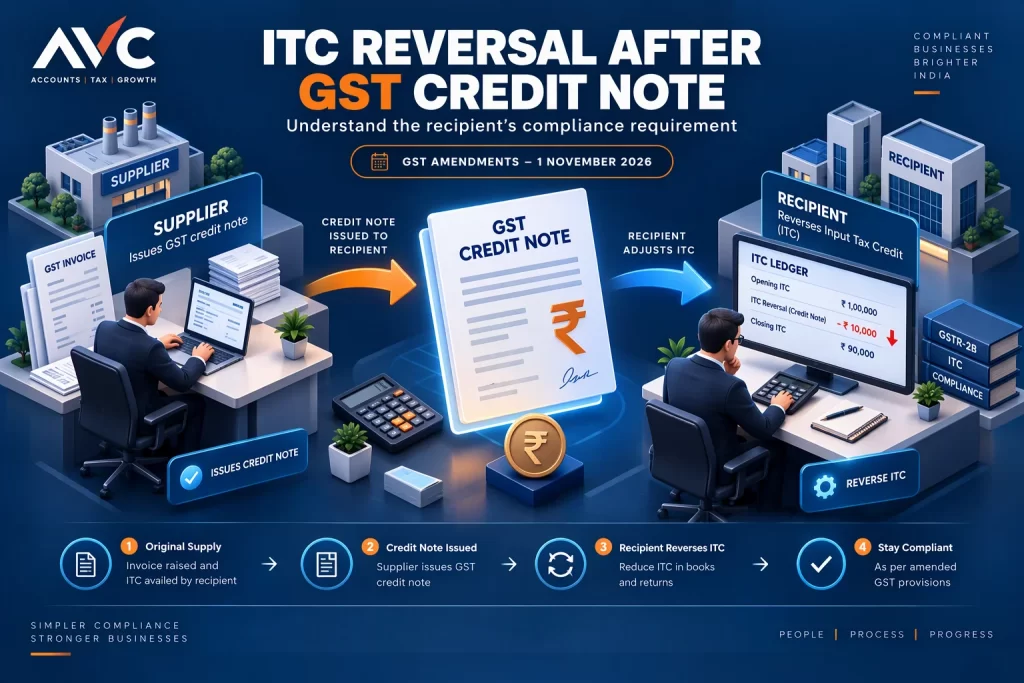
The amended provisions make the recipient’s ITC reversal an essential part of the post-supply discount mechanism.
When a registered supplier issues a qualifying GST credit note, the recipient must reverse the ITC attributable to the discount. The reversal should be reconciled with the credit note reflected in the recipient’s GST records and the applicable GSTR-3B reporting requirements.
Consider a supplier who issues a credit note containing ₹9,000 of GST on an eligible discount.
The supplier seeks to reduce output tax by ₹9,000. The recipient must correspondingly reverse ₹9,000 of the related ITC.
This creates a matching tax adjustment between the supplier and the recipient.
Businesses should therefore establish a process for communicating credit notes, checking their reflection in GSTR-2B and reconciling the corresponding ITC reversal.
Important: The treatment of discounts involving unregistered consumers, composition taxpayers or recipients with no corresponding ITC requires careful examination. The statutory conditions should not be assumed to operate identically in every such situation. Businesses should obtain professional advice where the recipient cannot make a conventional ITC reversal.
Apart from post-supply discounts and credit notes, Section 155 of the Finance Act, 2026 introduces two important changes to Section 54 of the CGST Act.
These amendments concern provisional refunds under the inverted duty structure mechanism and the minimum refund threshold for tax paid on exported goods.
An inverted duty structure arises when the GST rate on inputs is higher than the GST rate applicable to outward supplies. This can result in accumulated input tax credit that a business cannot fully utilise against its output tax liability.
For example, a manufacturer may purchase raw materials attracting GST at 18%, while its finished products are supplied at 5%. The resulting difference can create an accumulation of unutilised ITC, subject to the applicable statutory conditions.
Section 54(3) provides the framework for claiming refunds of eligible unutilised ITC arising from an inverted duty structure.
Earlier, the provisional refund facility under Section 54(6) primarily covered refunds relating to zero-rated supplies. The amendment now extends the statutory provisional refund mechanism to eligible inverted duty structure claims covered by Section 54(3).
This means that an eligible applicant may receive up to 90% of the refund claim provisionally, subject to prescribed conditions and applicable verification.
Example:
Suppose a manufacturer files an eligible inverted duty structure refund claim of ₹10,00,000.
| Particulars | Amount |
|---|---|
| Total eligible refund claim | ₹10,00,000 |
| Provisional refund at 90% | ₹9,00,000 |
| Remaining amount | ₹1,00,000 |
The eligible business may receive ₹9,00,000 provisionally, while the remaining ₹1,00,000 is subject to final verification.
However, a provisional refund should not be treated as final approval. The department may verify the claim, and any excess refund found to have been paid can be subject to recovery under the applicable provisions.
How does this benefit businesses?
The extension can improve working capital availability for manufacturers and other businesses facing continuous ITC accumulation.
Instead of waiting for the entire refund claim to complete the final verification process, eligible businesses may receive a substantial portion provisionally.
However, businesses must ensure that their refund calculations, purchase records, outward supply details and GST returns are accurate before filing.
Another important change introduced through Section 155(b) concerns the minimum refund amount under Section 54(14) of the CGST Act.
Previously, Section 54(14) restricted the payment of certain GST refunds where the amount claimed was below ₹1,000.
From 1 November 2026, this minimum amount restriction no longer applies to refund claims relating to tax paid on goods exported out of India with payment of tax.
This is particularly helpful for small exporters whose eligible IGST refund amounts may be relatively low.
Example:
Suppose an exporter ships goods outside India after paying IGST and becomes eligible for a refund of ₹700.
Under the earlier restriction, a refund below ₹1,000 would generally not be paid under the relevant provision.
Following the amendment, the ₹1,000 minimum restriction does not apply to this category of export-of-goods refund.
| Type of refund | Does the ₹1,000 restriction continue? |
|---|---|
| Tax paid on export of goods | No |
| Export of services | Yes, subject to applicable provisions |
| Inverted duty structure refund | Yes |
| Other eligible refund categories | Yes, subject to applicable provisions |
The eligibility conditions, documentation and other requirements applicable to the particular refund category must still be satisfied.
Understanding the statutory amendments is important, but businesses also need to know how these changes affect actual transactions.
The following examples illustrate some common situations.
Suppose a distributor purchases goods worth ₹10,00,000 from a manufacturer in August 2026. GST is charged at 18%, amounting to ₹1,80,000.
In December 2026, the manufacturer provides a 5% volume discount of ₹50,000. The discount was not agreed upon at the time of the original supply.
Under the amended provisions, the supplier may issue a qualifying GST credit note, provided the statutory conditions are satisfied.
| Particulars | Original transaction | After GST credit note |
|---|---|---|
| Original taxable value | ₹10,00,000 | ₹10,00,000 |
| Eligible discount | — | ₹50,000 |
| Taxable value after discount | ₹10,00,000 | ₹9,50,000 |
| GST at 18% | ₹1,80,000 | ₹1,71,000 |
| GST adjustment | — | ₹9,000 |
The supplier’s output tax reduction is ₹9,000, while the distributor must reverse the corresponding ₹9,000 of ITC.
This example demonstrates how the amended provisions can help businesses recognise qualifying post-supply discounts for GST purposes.
Suppose the supplier issues a GST credit note containing a GST adjustment of ₹9,000.
The supplier reports the credit note in its applicable GST return. However, the buyer fails to reverse the corresponding ITC and continues claiming the original credit.
This creates a compliance issue because the supplier’s reduction in tax liability depends on the recipient reversing the attributable ITC.
The buyer may face tax and interest implications in accordance with the applicable provisions. The supplier may also face difficulties substantiating the tax reduction.
To prevent such problems, both parties should maintain a documented credit-note reconciliation process.
The reporting deadline under Section 34(2) is particularly important for businesses granting annual discounts.
| Financial year of original supply | Applicable outer reporting deadline |
|---|---|
| FY 2025–26 | 30 November 2026, or annual return date if earlier |
| FY 2026–27 | 30 November 2027, or annual return date if earlier |
For example, if a supplier finalises a discount relating to FY 2025–26 supplies in December 2026, the statutory deadline may already have passed.
In that situation, a GST credit note cannot simply be used to obtain a tax reduction after the applicable deadline. A commercial adjustment may still need to be considered separately, depending on the circumstances.
Businesses should therefore review their year-end discount calculations well before the applicable reporting deadline.
A manufacturer has an eligible inverted duty structure refund claim of ₹10,00,000.
Under the amended Section 54(6), the eligible provisional refund may be ₹9,00,000, representing 90% of the claim.
The balance ₹1,00,000 remains subject to final verification.
This can help businesses manage working capital more effectively, provided their refund claim meets the applicable eligibility and procedural requirements.
The November 2026 GST amendments require coordination between finance, accounting, sales, procurement and tax compliance teams.
Businesses should review their existing processes instead of waiting until a credit-note mismatch or refund issue arises.
The following actions can help businesses prepare:
Review existing discount schemes: Manufacturers, wholesalers and distributors should review their volume rebates, annual incentives, performance-based discounts and price-protection arrangements.
Update credit-note procedures: Finance teams should ensure that GST credit notes are issued and reported correctly under Section 34. Commercial credit notes should not be confused with GST credit notes.
Coordinate with customers: Suppliers should communicate ITC reversal requirements to registered recipients and maintain evidence of the corresponding reconciliation.
Reconcile GST returns: Businesses should regularly compare their sales records, purchase records, GSTR-1, GSTR-3B and GSTR-2B to identify discrepancies.
Review refund eligibility: Manufacturers operating under an inverted duty structure should examine whether they qualify for the amended provisional refund mechanism.
Check export refund claims: Exporters should identify eligible IGST refund claims that were previously affected by the ₹1,000 minimum restriction.
Maintain supporting documents: Discount calculations, approval records, credit notes, refund workings and tax reconciliations should be preserved for future verification.
Although the GST Amendments 2026 simplify certain GST requirements, businesses may still face compliance issues if they misunderstand or incorrectly implement the revised provisions.
Some common mistakes businesses should avoid include:
Assuming that every post-supply discount automatically qualifies for a GST adjustment.
Issuing a financial credit note instead of a qualifying GST credit note.
Ignoring the recipient’s obligation to reverse attributable Input Tax Credit (ITC).
Reporting credit notes after the prescribed statutory deadline.
Treating a provisional refund as final approval.
Assuming that the ₹1,000 minimum refund restriction has been removed for all refund categories.
Calculating inverted duty structure refunds without checking the applicable refund formula and eligibility restrictions.
Failing to maintain discount approvals, supporting documents and reconciliation records.
Businesses should also review the corresponding State GST provisions and applicable notifications before implementing changes to their CGST and SGST accounting and compliance processes.
Sections 153, 154 and 155 of the Finance Act, 2026 came into force from 1 November 2026. They amend Sections 15, 34 and 54 of the CGST Act, covering post-supply discounts, GST credit notes and refund provisions.
Yes. The amended Section 15(3)(b) removes the earlier requirement for an agreement entered into before or at the time of supply. However, the supplier must issue a qualifying credit note, and the recipient must reverse the attributable ITC in accordance with Section 34.
The amended Section 15(3)(b) removes the earlier specific invoice-linkage condition. Businesses should nevertheless maintain sufficient records to establish the discount calculation and its connection with the underlying commercial supplies.
Under Section 34(2), the relevant credit note details must be declared by 30 November following the end of the financial year in which the original supply was made, or the date of furnishing the relevant annual return, whichever is earlier.
Yes. Where a credit note is issued for a qualifying post-supply discount, the recipient must reverse the ITC attributable to that discount. This is an important condition for the supplier's corresponding tax reduction.
The amended Section 54(6) extends the statutory provisional refund mechanism to eligible inverted duty structure claims. Subject to applicable conditions, up to 90% of the eligible claim may be released provisionally, with the balance subject to final verification.
The ₹1,000 restriction has been removed for refund claims relating to tax paid on goods exported out of India with payment of tax. It has not been removed for every GST refund category.
The amendments are relevant to businesses involved in qualifying post-supply discounts, eligible inverted duty structure refund claims and export-of-goods refund claims. The practical impact depends on the nature of the transactions and the applicable statutory conditions.
The GST Amendments 2026, effective from 1 November 2026, introduce important changes to post-supply discounts, GST credit notes and refund procedures. These amendments provide greater flexibility in handling post-supply discounts while maintaining the necessary requirements for issuing GST credit notes and reversing attributable Input Tax Credit (ITC). They also bring important changes to provisional refunds under the inverted duty structure and the minimum refund threshold for exported goods.
For businesses, understanding these changes is essential to maintaining accurate GST records, avoiding compliance errors and managing tax credits and refunds effectively. Reviewing existing discount agreements, updating accounting processes, coordinating with suppliers and customers, and reconciling ITC records can help businesses adapt to the revised provisions.
At AVC India, we help businesses understand GST updates and manage their tax compliance requirements with greater confidence. Staying informed about the latest GST amendments can help your business make better financial decisions and maintain smoother GST compliance.
Need professional assistance with GST compliance? Connect with AVC India for expert guidance on GST regulations, credit notes, ITC reconciliation and refund procedures.