
-
-
Tax Services
-
Audit & Assurance
-
Business Setup
-
Accounting & Payroll
-
Advisory
-
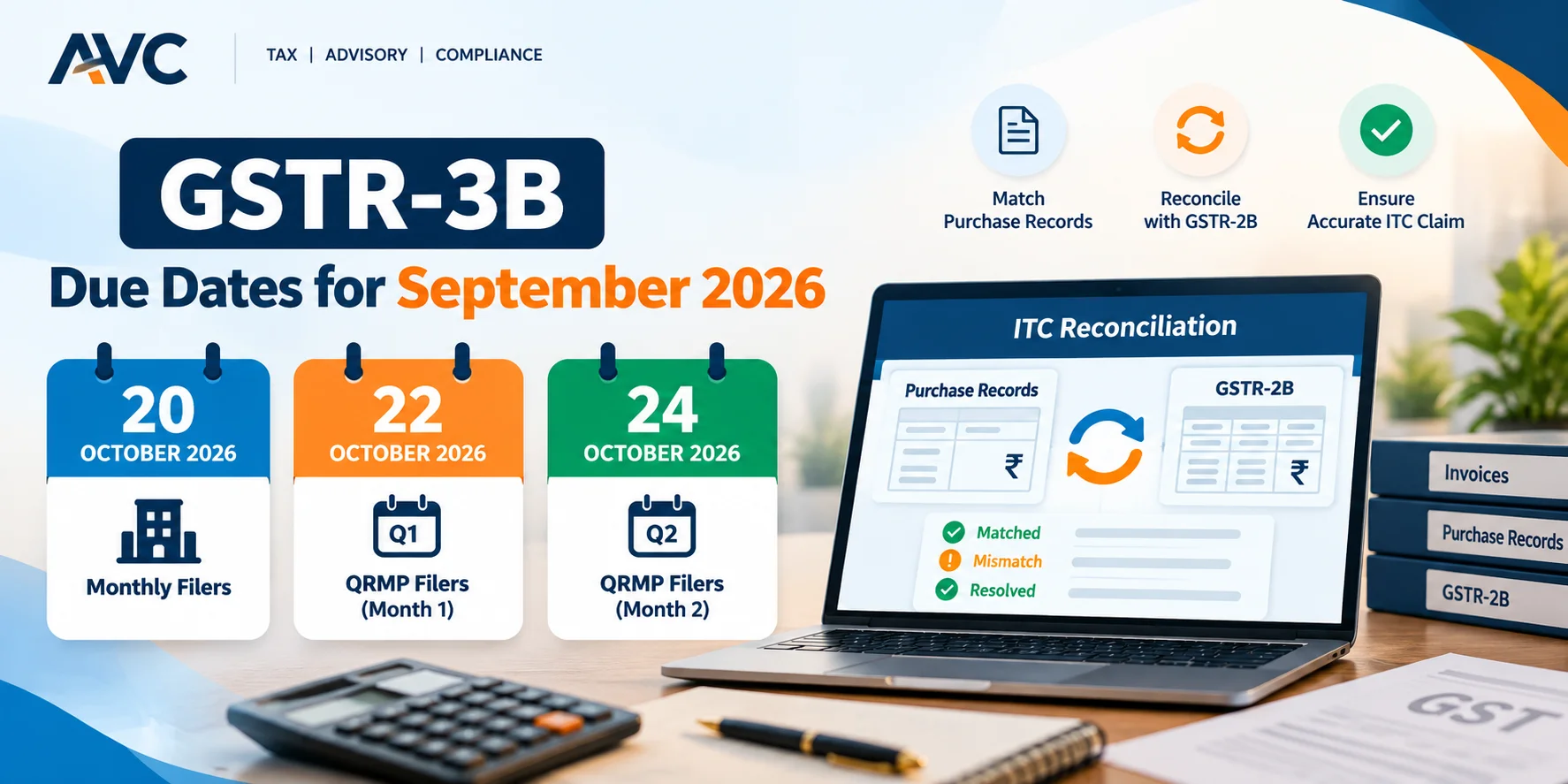
The GSTR-3B due date for September 2026 depends on whether a GST-registered taxpayer files returns monthly or has opted for the Quarterly Return Monthly Payment (QRMP) scheme. For regular monthly filers, the ordinary due date is 20 October 2026. Eligible QRMP taxpayers filing their GSTR-3B for the July–September 2026 quarter generally have a deadline of 22 October or 24 October 2026, depending on the state or Union Territory of their principal place of business. These are the ordinary statutory dates and should be checked against the latest applicable GST notifications before filing.
However, filing GSTR-3B on time is only one part of GST compliance. Businesses should also reconcile outward supplies reported in GSTR-1, review input tax credit (ITC) against GSTR-2B, account for reverse-charge liabilities and verify their electronic cash and credit ledger balances. Errors can lead to additional tax payments, interest, late fees or compliance communications.
This guide explains the September 2026 GSTR-3B due dates, QRMP filing requirements, ITC reconciliation process and the checks businesses should complete before submitting their GST returns.
The GSTR-3B filing deadline depends on the taxpayer’s filing frequency and, for QRMP taxpayers, the state or Union Territory associated with the relevant GST registration.
| Return Category | Tax Period Covered | Ordinary Due Date |
|---|---|---|
| Regular monthly GSTR-3B | September 2026 | 20 October 2026 |
| QRMP — Group A states/UTs | July–September 2026 | 22 October 2026 |
| QRMP — Group B states/UTs | July–September 2026 | 24 October 2026 |
These dates follow the ordinary filing schedule described in the source article and the GST portal’s QRMP guidance. Check the official GST portal for applicable notifications, filing instructions and any extension relevant to your GSTIN.
Regular monthly filers must ordinarily submit their September 2026 GSTR-3B by 20 October 2026. The return reports the relevant period’s taxable outward supplies, eligible input tax credit, reverse-charge liabilities and tax payable, as applicable.
Businesses should not assume that the deadline changes automatically because of a public holiday, portal slowdown or an internal accounting delay. An extension must have a valid legal basis, such as an applicable government notification. Confirm the current deadline on the GST portal before relying on any extension announcement.
Eligible taxpayers who have opted for QRMP and whose principal place of business falls within the first state group ordinarily file their quarterly GSTR-3B by the 22nd day of the month following the quarter.
The group includes Maharashtra, Gujarat, Madhya Pradesh, Chhattisgarh, Karnataka, Goa, Kerala, Tamil Nadu, Telangana and Andhra Pradesh, along with the Union Territories specified in the applicable QRMP rules.
For example, a business filing quarterly under QRMP for a GSTIN whose principal place of business is in Maharashtra would ordinarily use the 22 October 2026 deadline for the July–September quarter.
QRMP taxpayers whose principal place of business falls within the second state group ordinarily file the July–September 2026 GSTR-3B by 24 October 2026.
This group includes West Bengal, Delhi, Haryana, Punjab, Rajasthan, Uttar Pradesh, Uttarakhand, Bihar, Jharkhand, Odisha, Himachal Pradesh, Sikkim and the specified north-eastern states, along with the Union Territories covered by the applicable rules.
The classification is based on the relevant GST registration’s principal place of business. A company operating in multiple states should check the filing category and due date separately for each GSTIN. The location of its accountant, head office or customer does not by itself determine the applicable QRMP deadline.
GSTR-3B is a summary GST return used by applicable registered taxpayers to report their tax liabilities and claim eligible input tax credit for the relevant tax period. It is an important part of monthly or quarterly GST compliance.
Businesses use the return to report taxable outward supplies, eligible ITC, reverse-charge tax and other relevant liability and adjustment details. The return also determines the tax payable after eligible credits are taken into account.
GSTR-3B should not be prepared by copying figures from a single report. The figures should be checked against the accounting books, sales records, purchase register, GSTR-1, GSTR-2B and applicable tax-payment records.
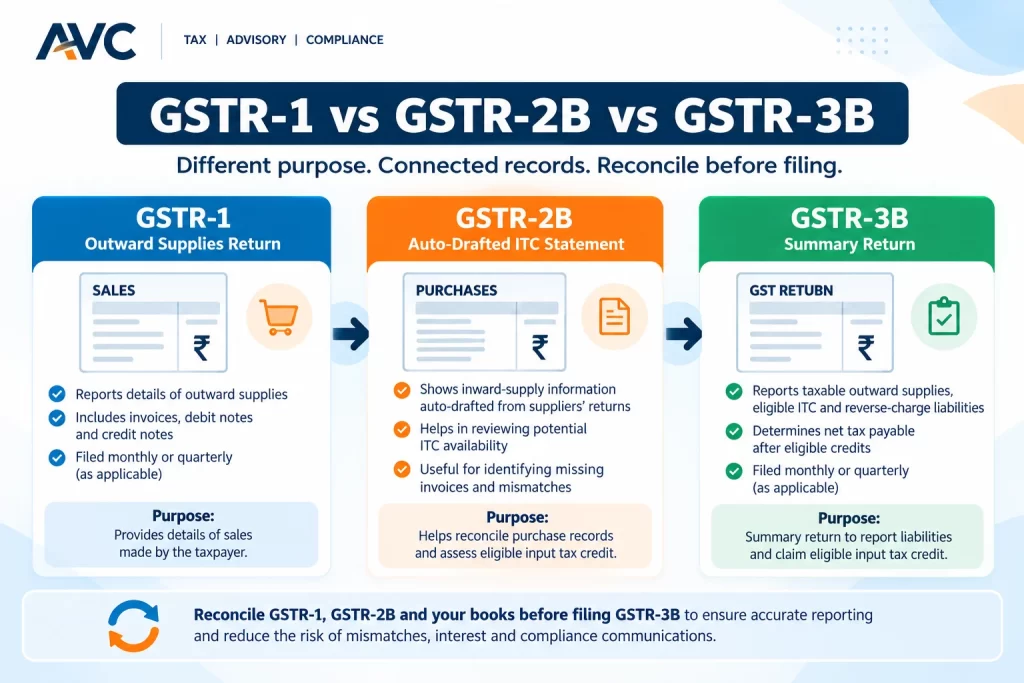
These GST forms serve different purposes and should be reconciled before filing.
GSTR-1 reports details of outward supplies, including relevant invoices, debit notes and credit notes. It provides an important basis for checking whether the sales reported in the books have been disclosed correctly.
GSTR-2B is an auto-drafted statement used to review inward-supply information and assess potential ITC availability. It helps identify supplier-reported invoices, missing documents and differences between the purchase register and the information available on the GST portal.
GSTR-3B is the summary return in which the taxpayer reports applicable liabilities and claims eligible ITC. Its figures should be supported by the underlying books, records and reconciliation workings.
A difference between these records does not always mean that tax has been underpaid or that an ITC claim is incorrect. Timing differences, amendments, credit notes, classification errors and supplier reporting issues may explain a mismatch. However, unexplained differences should be investigated before filing.
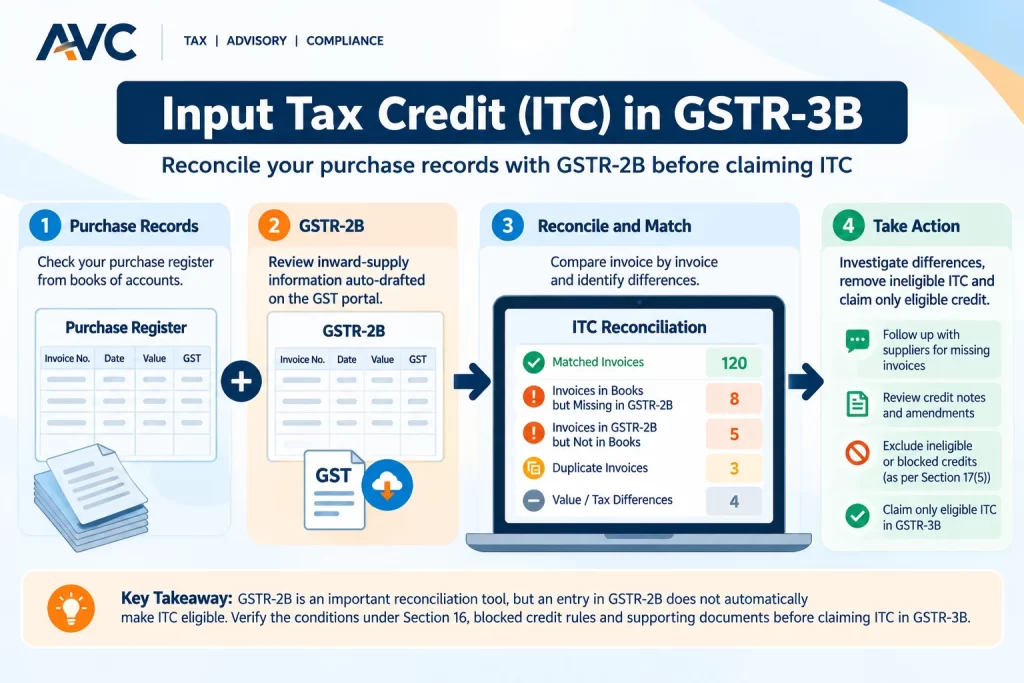
Input tax credit reduces the GST payable by a business when the credit is legally available and properly claimed. Incorrect ITC claims can result in reversals, additional tax liability and interest where applicable.
No. GSTR-2B is an important reconciliation source, but an entry appearing in the statement does not automatically establish that the recipient can claim the credit.
Businesses must assess the conditions under Section 16 of the CGST Act, restrictions under Section 17(5), possession of appropriate tax documents, receipt of goods or services, applicable supplier-reporting requirements and relevant reversal obligations. The 180-day payment condition and other statutory requirements should also be examined where applicable.
For example, credit relating to personal consumption or specified motor vehicles may be blocked, subject to the detailed statutory provisions and exceptions. A business should therefore assess the nature and purpose of each expense instead of treating every entry in GSTR-2B as claimable.
Start by comparing the purchase register with GSTR-2B invoice by invoice. Identify invoices appearing in the books but missing from the statement, entries appearing in the statement but absent from the books, duplicate records, incorrect GSTINs and differences in taxable value or tax amount.
Next, investigate missing invoices with the relevant suppliers and review whether any differences arise from reporting periods, amendments or credit notes. Separate eligible credit from ineligible or disputed amounts, and retain the reconciliation workings and supporting documents.
The objective is not merely to make the two totals match. It is to establish why each material difference exists and whether the proposed ITC claim satisfies the applicable legal conditions.
specified circumstances. Businesses should review purchase ledgers, applicable vendor categories, import-of-services records and relevant reverse-charge notifications to identify such liabilities.
Reverse-charge tax generally needs to be paid through the electronic cash ledger. Eligible ITC relating to that tax can be considered separately, subject to the applicable conditions. An available ITC balance should not be assumed to discharge the original reverse-charge payment automatically.
Before filing GSTR-3B, reconcile the reverse-charge register with the books and verify that the applicable liability has been correctly reported and paid. Retain the tax workings and payment evidence.
Missing the GSTR-3B due date can create more than one financial consequence. Late fee and interest are separate liabilities and should not be treated as interchangeable.
Section 47 of the CGST Act provides for late fees when applicable GST returns are not furnished by the prescribed deadline. The amount payable can depend on the return type, applicable statutory provisions, notified concessions and any relief available to the taxpayer.
Do not assume that every GSTIN will face an identical amount. Check the late fee calculated on the GST portal and verify whether any applicable notification or concession affects the liability.
Interest relates to delayed payment of tax and is governed by Section 50 and the applicable rules and notifications. The applicable rate and calculation depend on the nature of the liability and the relevant statutory provisions.
For delayed payment of tax reported in a return, the calculation generally requires consideration of the tax paid through the electronic cash ledger, subject to applicable statutory exceptions. Wrongly availed and utilised ITC is subject to a separate interest analysis. It is therefore not appropriate to apply one flat interest formula to every GST mismatch.
Where tax remains unpaid, calculate the applicable interest separately from the late fee. The final amount should be checked against the relevant legal provisions and the GST portal’s liability calculation.
Late filing can result in late fees and, where tax payment is delayed, interest. Outstanding returns may also affect subsequent compliance activities and can contribute to unresolved discrepancies in the taxpayer’s GST records.
A mismatch communication is not necessarily a final adjudicated demand. For example, prescribed differences between outward-supply liability and tax discharged through GSTR-3B, or between ITC claimed and credit reflected in the relevant statement, may lead to specific system-generated communications. Businesses should review the applicable notice, respond within the prescribed period and support their explanation with reconciliations and documents.
No. The QRMP scheme allows eligible taxpayers to file GSTR-3B quarterly while making tax payments for the first two months of the quarter under the prescribed monthly-payment mechanism.
Taxpayers generally need to review Form GST PMT-06 payments for the first and second months of the quarter. For July–September 2026, July and August payments should be checked separately against the applicable records.
September is the third month of the quarter. Its tax liability is considered through the quarterly return rather than by mechanically treating 25 October as an additional standalone PMT-06 deadline for September. Businesses should review the quarter’s payment trail to avoid missing a liability or paying the same amount twice.
Eligibility for QRMP generally depends on the applicable aggregate-turnover limit and other scheme conditions. Confirm that the relevant GSTIN has validly opted for the scheme before applying quarterly filing dates.
Before submitting the September monthly return or the July–September quarterly return, complete these checks:
The ordinary due date is 20 October 2026 for regular monthly filers. Eligible QRMP taxpayers file their GSTR-3B for July–September 2026 by 22 October or 24 October, depending on the applicable state group.
No. The 20 October date ordinarily applies to monthly filers for September. QRMP taxpayers filing the July–September quarter generally have a different deadline based on their state or Union Territory group.
The monthly PMT-06 payment mechanism applies to the first two months of a QRMP quarter. September is the third month of the July–September quarter, so its liability is addressed through the quarterly GSTR-3B process. Check the applicable payment instructions for the GSTIN.
No. GSTR-2B supports reconciliation, but ITC must satisfy the applicable statutory conditions and restrictions. Review invoices, receipt of goods or services, blocked-credit provisions, supplier reporting and relevant reversal requirements before claiming credit.
No. Late fees relate to delayed furnishing of the return under the applicable provisions, while interest relates to delayed tax payment or other specified circumstances. The calculation and legal basis should be assessed separately.
Investigate the difference before filing. Review sales invoices, credit notes, amendments, classification and timing differences. Maintain a reconciliation showing the reason for the difference and the corrective action taken.
Keep the filed return, ARN, payment challans, ledger records, GSTR-1 and GSTR-2B reconciliations, ITC eligibility workings and supporting documents. These records help substantiate the figures reported if questions arise later.
The GSTR-3B due date for September 2026 is not the same for every GST taxpayer. Regular monthly filers ordinarily have until 20 October 2026, while eligible QRMP taxpayers filing for July–September follow the applicable 22 October or 24 October deadline.
The more important compliance step is to prepare an accurate return. Reconcile sales with GSTR-1, assess ITC using GSTR-2B and the statutory eligibility conditions, verify reverse-charge liabilities, and check tax payments before submitting GSTR-3B. Keeping clear supporting records can reduce avoidable errors and make future GST reconciliations more efficient.